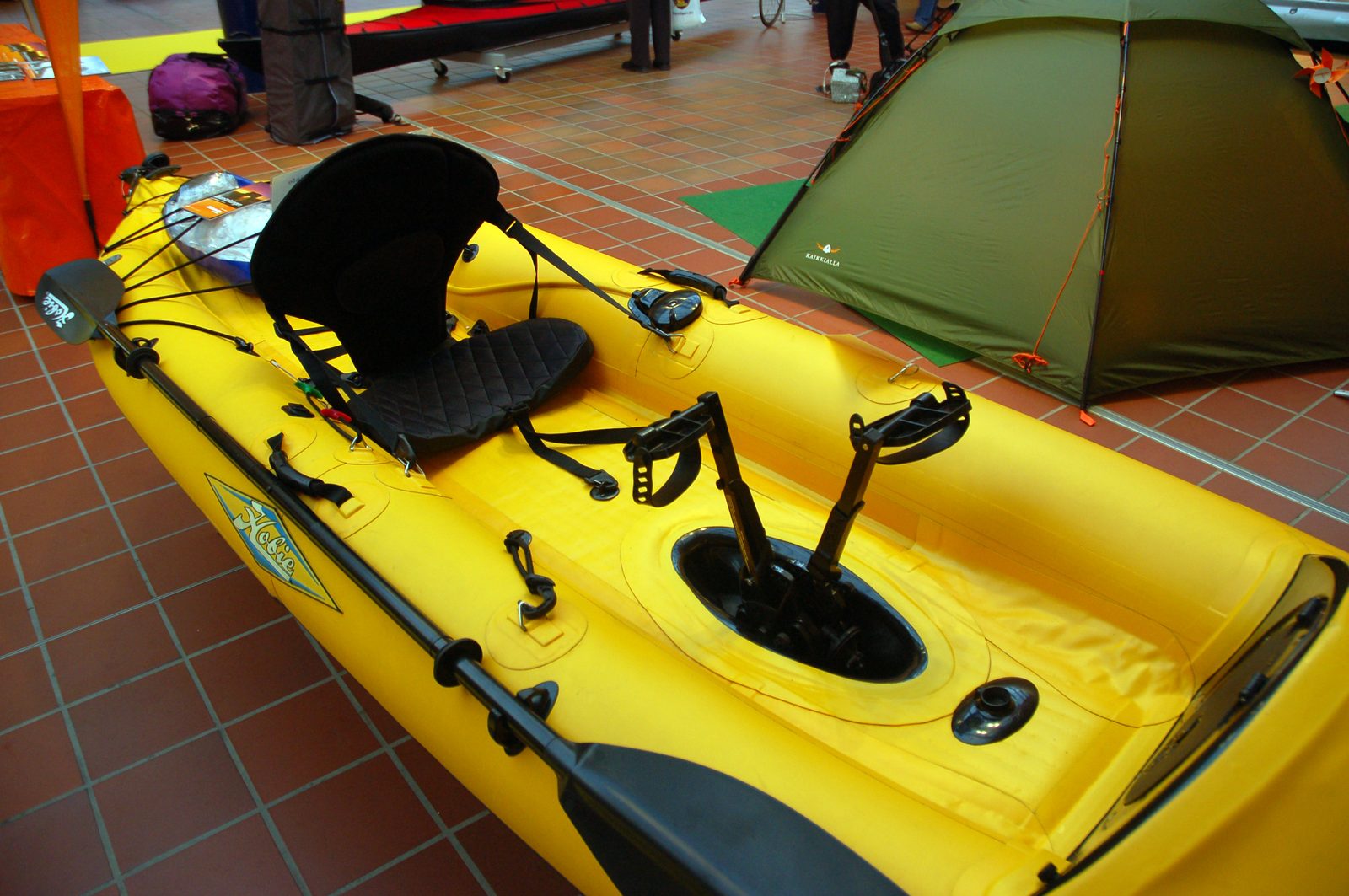
Best Inflatable SUPs and Kayaks for Cruising Sailboats
For most cruising boats the right pair is one wide all-round inflatable paddle board around 10-11 feet and an electric pump. The board costs $350-$600, stows rolled in a cockpit locker, and gets used constantly in calm anchorages. Add a tracking inflatable kayak in the $1,000 range only if your cruising grounds are windy or your anchorages are a long way from shore.
The buying decision is less about the craft than about the friction around it. A board that takes fifteen minutes of hand pumping and lives under three sail bags gets used twice a season. This guide covers the specifications that matter on a boat — packed size, pressure, capacity, tracking — and how to set the whole system up so you actually put it in the water.
Sailboat Atlas may earn a commission from qualifying purchases made through links on this page, at no extra cost to you.
Stowage is the specification that decides everything
On a boat, packed volume beats every performance figure. A rolled 10'8" board is roughly the size of a large kit bag and fits in most cockpit lockers or a lazarette. A 13 ft kayak with aluminium ribs is bulkier and heavier, closer to two duffles, and on a boat under 35 feet that may be the deciding factor on its own.
Where the board lives matters as much as whether it fits. Buried under the spare anchor rode and two sail bags, it is effectively not aboard. The cruisers who use their paddle craft most keep it in the single most accessible locker, or lashed inflated on the coachroof or foredeck when weather allows, and accept the compromise elsewhere.
Weight is the other practical limit. Hoisting 36-42 lb over a lifeline or up a stern ladder single-handed, standing in a dinghy, is harder than it sounds. If one person regularly handles the boat alone, favour the lighter option even at some cost in performance — the light board that gets launched beats the fast one that stays stowed.
Boards versus kayaks: what the wind decides
In flat water with less than about 10 knots of breeze, a paddle board is the more pleasant craft: you stand, you see into the water, and you can step off and swim. Above that, standing becomes a fight. A standing paddler is a sail, and a board that has been blown downwind of the boat has to come back upwind with the paddler's whole body acting as windage.
A kayak turns that around. The paddler sits low, presents almost no windage, and a hull with a V-bottom or a keel line tracks instead of skidding sideways. A mile back to the boat against 15 knots is a manageable if determined paddle in a kayak and close to impossible on a board. This is the single most important distinction for anyone anchoring in trade-wind conditions.
Tracking deserves its own note. A cheap flat-bottomed inflatable kayak with no keel wanders badly and needs a correcting stroke every few strokes, which is exhausting over distance. The V-bottom or rib-reinforced designs cost more precisely because they solve this, and the difference is obvious within a hundred metres of paddling.
Pressure, valves and the maintenance that keeps them alive
Modern drop-stitch boards are designed for 12-15 PSI and behave completely differently across that range. At 15 PSI a board is rigid and efficient; at 10 PSI it flexes in the middle, ploughs, and tires the paddler. Use a gauge — nearly every pump has one — and top up rather than guessing, remembering that a board inflated in cool morning air gains pressure in the midday sun and may need bleeding rather than topping.
Valves are the weak point on every inflatable in a salt environment. Rinse the valve area with fresh water after each use, keep the cap on when deflated, and check the valve core is tight with the small tool that came in the repair kit — a slow leak is almost always a loose core rather than a puncture. Keep that tool somewhere you will find it, because it is the single most useful item in the kit.
Dry before rolling. An inflatable rolled wet and left in a locker for a month grows mildew along every fold, and while that is cosmetic at first it degrades the seam tape over time. Roll from the nose towards the valve with the valve open so the last air escapes, and vary where the creases fall rather than folding at the same line every time.
Safety on a paddle craft from a cruising boat
The scenario that gets paddlers into genuine trouble is simple and repeatable: an offshore breeze, a paddler who drifts further from the boat than intended, and no way to make ground back upwind. It happens in flat water, in warm conditions, on calm-looking afternoons. Treat wind direction as the first check before launching, not the weather forecast.
Carry three things every time: a leash connecting you to the board, a whistle, and a phone in a waterproof pouch on your person rather than strapped to the board. A board that blows away with the phone on it leaves you swimming with no way to call anyone. Wear a buoyancy aid, or at minimum have an inflatable belt pack, and tell someone aboard where you are going.
Also consider what you are paddling over. In busy anchorages a low paddle craft is genuinely hard for a tender under way to see, particularly at dusk. A bright board and a bright shirt are worth more than any reflective tape, and paddling in the shallows rather than across the fairway avoids the problem altogether.
Accessories worth the locker space
An electric pump is the one accessory that changes behaviour. Everything else is optional; this is what determines whether the board gets used. Fit a 12V outlet where you can reach the foredeck if you do not have one.
A repair kit with spare valve cores, kept with the board rather than in the general tool locker. A three-piece paddle rather than a two-piece, because the extra joint halves the stowed length and those inches matter in a locker. A deflated-board bag with backpack straps, which makes the walk from a dinghy dock to a launch spot possible rather than comic.
What is not worth it on a cruising boat: fins that require tools to fit, elaborate seating systems that add bulk, and mounted coolers. Every item you add is locker volume you do not have, and the cruisers who paddle most carry the least.
Our picks
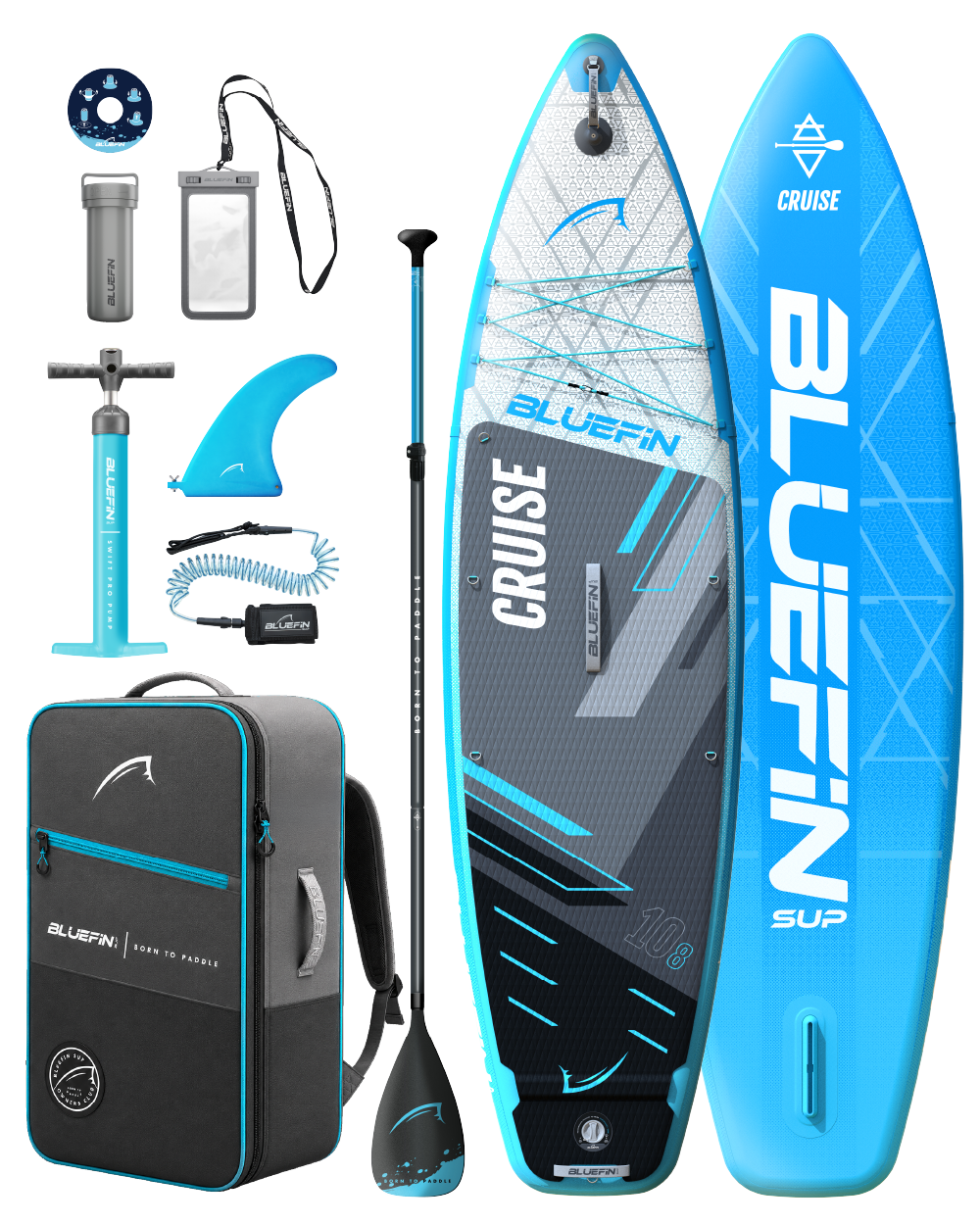
Bluefin Cruise 10'8" Inflatable SUP
Best all-round inflatable paddle board for a cruising boat
For most cruising boats this is the right first paddle board: wide enough for guests, cheap enough to stop worrying about it, and complete out of the box. Where it falls short is distance — if your anchorages are typically a mile from the beach and you want to paddle rather than take the dinghy, a longer touring board will be far less work. Store it rolled rather than folded at the same crease every time, and rinse the valve with fresh water, because a salted valve is the most common failure on any inflatable.
- Dimensions
- 10' 8" long, 32" wide, 6" thick
- Capacity
- Rated to about 330 lb of rider weight
- Package weight
- About 36 lb including pump, paddle and bag
- Typical price
- $359-$599 depending on package and season
Pros
- 32" width makes it stable enough that a nervous first-timer stays dry, which matters more than speed
- Package includes pump, paddle, leash and bag — no hunting for accessories after delivery
- Priced low enough that salt, sun and the occasional coral scrape are not heartbreaking
Cons
- 36 lb packed is heavy to hoist up a swim ladder or out of a locker single-handed
- Not a fast board — at 10'8" and 32" wide it is built for stability rather than covering distance

BOTE LowRider Aero 11'6"
Best hybrid when you want to paddle standing or sitting
The hybrid argument is strong on a cruising boat, where one inflatable that does two jobs beats two that each do one. Standing gives you the view into clear water that makes paddling worthwhile in the tropics; the seated configuration gets you back to the boat against wind and chop without a fight. The flex in the single-layer build shows up with a heavy paddler or two people aboard — if that is your usual load, look at the dual-layer boards instead and accept the extra weight.
- Dimensions
- 11' 6" long, 36" wide, 6" thick
- Capacity
- About 315 lb
- Construction
- AeroULTRA single-layer PVC
- Typical price
- $699-$1,199 depending on configuration
Pros
- 36" width and a low-rider deck make it unusually stable, including with two aboard or a dog
- Converts between standing paddle board and seated kayak-style use, covering two jobs with one item
- BOTE's accessory ecosystem — seats, coolers, rod holders — genuinely fits rather than being generic
Cons
- AeroULTRA single-layer construction is lighter but noticeably more flexible than BOTE's dual-layer boards
- Costs two to three times a basic all-round board, which is real money for a second tender
Sea Eagle 385ft FastTrack Inflatable Kayak
Best inflatable kayak for covering real distance from the anchorage
Kayaks beat paddle boards whenever there is wind, chop or distance involved, and the FastTrack is the one most cruisers end up with because it tracks like a hard boat rather than a pool toy. The V-bottom is the reason: it holds a line instead of sliding sideways in a crosswind. It is also the choice if anyone aboard is unsteady on their feet, since sitting in a kayak asks nothing of balance. Deflated it rolls into a locker-sized bundle, which is the entire reason inflatables exist on boats.
- Dimensions
- 12' 7" long, 36" wide
- Hull weight
- About 31 lb
- Rating
- Rated for up to Class II water
- Typical price
- $1,149-$1,399 as a package
Pros
- The V-bottom and external keel track properly, so you are not correcting course every third stroke
- Rated for Class II water, which means it handles a windy anchorage chop without drama
- Tandem capable, so two crew can explore together instead of taking turns
Cons
- The included carry bag has no backpack straps, which is awkward when you land at a dinghy dock and have to walk
- Over $1,100 puts it in the same conversation as a second-hand hard dinghy
Advanced Elements AdvancedFrame Expedition Elite
Best inflatable kayak for stability and load carrying
This is the load-carrier of the group. The rib-reinforced bow and stern are the meaningful feature — they let the boat cut into a chop the way a rigid kayak does, so a windward paddle back to the boat is work rather than misery. The 450 lb capacity makes it a credible provisioning runner when the dinghy is occupied, or a dive platform for a hookah rig. Accept the weight and the bulk; they are the price of the construction that makes it work.
- Dimensions
- 13' long, 32" wide
- Weight
- About 42 lb
- Capacity
- Up to about 450 lb
- Typical price
- $890-$1,050
Pros
- 450 lb capacity means a paddler plus a week's provisions or a scuba kit, not just a paddler
- Built-in aluminium ribs at bow and stern give it a hard-boat entry that cuts chop rather than slapping it
- Genuinely durable multi-layer construction that tolerates beach landings on shingle
Cons
- 42 lb is heavy to manage over a lifeline single-handed, and it is bulky even deflated
- The foot brace system is commonly criticised as fiddly to adjust and unstable for taller paddlers
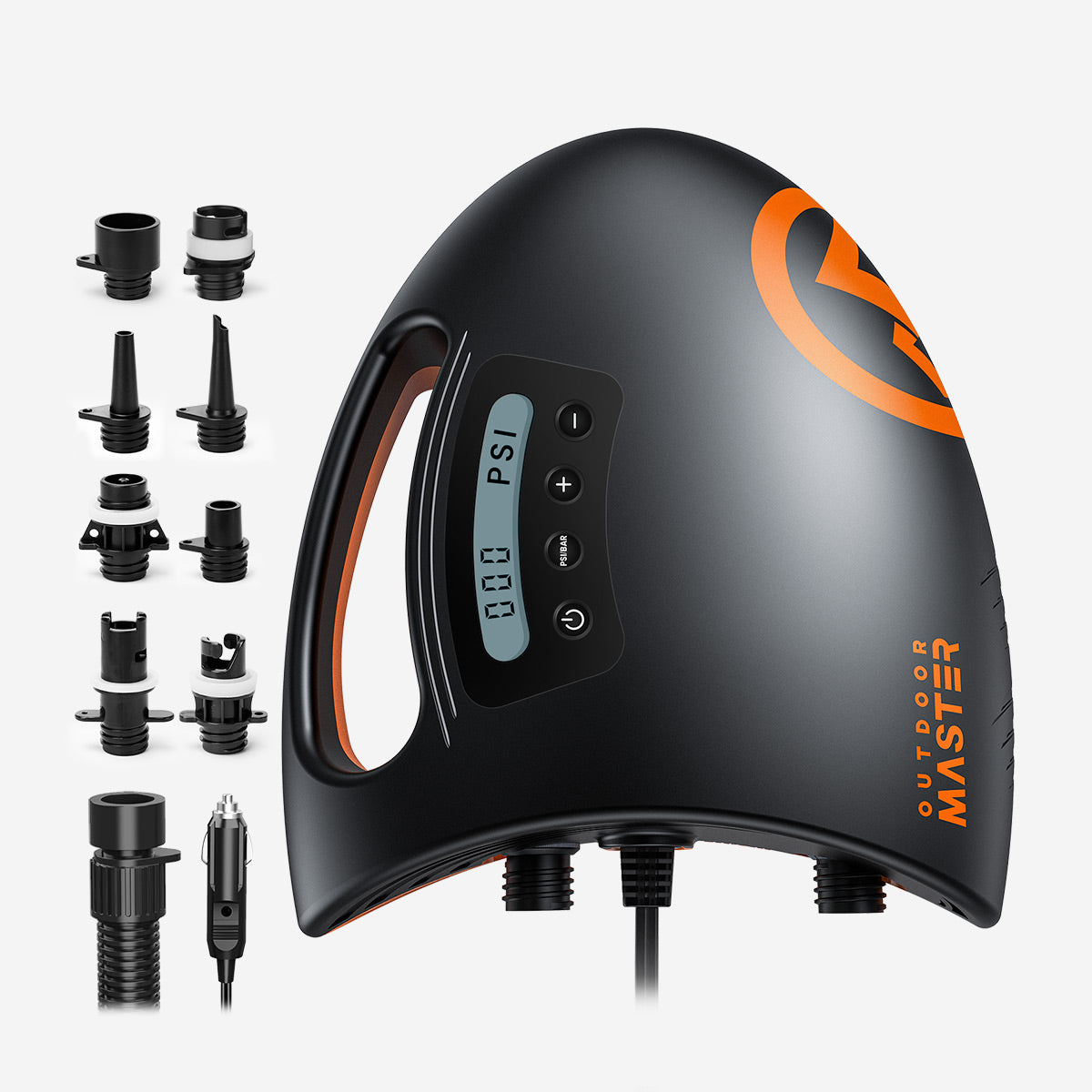
OutdoorMaster Shark II Electric SUP Pump
Best way to make an inflatable something you actually use
The honest reason inflatables sit unused in lockers is the pump. Hand-pumping a board to 15 PSI in tropical heat is genuinely unpleasant, and after the third time most people stop bothering. An electric pump changes the decision from a chore to an impulse, which is the whole point of carrying the board. Fit a 12V outlet in a cockpit locker if you do not already have one — that small wiring job is what makes the pump usable.
- Max pressure
- 20 PSI, auto shut-off at the set figure
- Power
- 12V DC via car-style connector
- Speed
- 350 L/min first stage, with active cooling for back-to-back inflations
- Typical price
- About $100
Pros
- Turns a fifteen-minute sweaty hand-pumping job into pressing a button and doing something else
- Auto shut-off at a set pressure means the board is actually at 15 PSI rather than roughly inflated
- Active cooling lets you inflate a board and a kayak back to back without a cooldown
Cons
- No internal battery — it needs a live 12V outlet, which many boats do not have anywhere near the foredeck
- It is another item to stow, and it draws enough current that you would not run it off a small battery repeatedly
How to choose
The comparison below assumes the craft will live rolled in a locker and be launched from a swim platform or foredeck.
| Craft | Price range | Best for | Key spec |
|---|---|---|---|
| Bluefin Cruise 10'8" | $359-$599 | All-round anchorage use | 32" wide, 330 lb capacity |
| BOTE LowRider Aero | $699-$1,199 | Stand or sit, two-up paddling | 36" wide, 315 lb capacity |
| Sea Eagle 385ft FastTrack | $1,149-$1,399 | Distance and chop | 12' 7", V-bottom, Class II |
| AdvancedFrame Expedition Elite | $890-$1,050 | Carrying gear and provisions | 450 lb capacity, rib-reinforced |
| Shark II electric pump | About $100 | Making any of the above get used | 20 PSI, 12V DC |
Budget tiers. Around $500 buys a capable all-round board with pump and paddle included, which is the right starting point for most boats. About $1,200 gets that board plus an electric pump and a decent dry bag setup, or a single tracking kayak if wind is your normal condition. Above $2,000 you can carry both a board for calm days and a kayak for windy ones — genuinely nice on a 45-footer with locker space, and an unrealistic use of volume on anything under 35 feet. Whatever you buy, spend the $100 on the electric pump first; it is the difference between owning a paddle craft and using one. If you are also weighing up dinghy options for the same locker space, our gear guide index collects the related comparisons.
Frequently asked questions
Where do you store an inflatable SUP on a sailboat?
Deflated and rolled in a cockpit locker or lazarette is the usual answer — a rolled board is roughly the size of a large duffle. Some cruisers keep boards inflated and lashed on deck or to the lifelines for convenience, which works in settled weather but adds windage and a UV problem, and must come below before any passage.
Inflatable SUP or inflatable kayak for a cruising boat?
A paddle board if you mostly potter around calm anchorages, want the standing view into clear water, and need something anyone can use. A kayak if you regularly face wind and chop, want to cover a mile or more, or carry gear. If you can only have one and your cruising grounds are breezy, take the kayak.
How long does an inflatable last in tropical sun?
PVC boards live three to seven years with reasonable care, and considerably less if they are left inflated on deck in unshaded equatorial sun. UV is the killer, not water. Deflate and stow after use, rinse with fresh water, and dry before rolling to prevent mildew inside the seams.
What pressure should an inflatable paddle board be at?
Most boards are designed for 12-15 PSI and feel noticeably different at the top of that range — a board at 10 PSI flexes underfoot and is slow and tiring. Check with a gauge rather than by feel; warm water raises pressure and shaded storage lowers it, so a board inflated in the morning may read differently by afternoon.
Can you use a paddle board as a dinghy?
For one person going a short distance in calm conditions, yes, and plenty of cruisers do it for a quick trip ashore. It is not a substitute for a tender — you cannot carry provisions, jerry cans, or a second person, and any wind against you turns the return trip into hard work. Treat it as recreation with occasional utility.
Are cheap supermarket inflatables worth it?
For occasional flat-water use at a lake, sometimes. On a cruising boat they fail early, because the drop-stitch quality and valve engineering are where the savings come from, and those are exactly the parts that salt water and repeated inflation cycles attack. A mid-priced board from an established brand is the sensible floor.
Looking for more gear guides? Browse all our gear recommendations or the full guides index.