
Marine Air Conditioning vs Fans and Ventilation: What Actually Works at Anchor
For almost every boat at anchor, the right answer is two good 12V cabin fans and better ventilation — not air conditioning. A pair of quality fans draws under an amp and costs about $300; a 12,000 BTU DC air conditioner draws 22-44A and needs roughly $8,000 of unit, installation and supporting battery and solar capacity behind it before it will run a single night off the dock.
Air conditioning at anchor is not impossible, it is just an electrical-system project wearing a comfort-upgrade costume. This guide works through what actually governs comfort in a sailboat cabin, the real amp-hour arithmetic for each option, and where the money is best spent at each budget.
Sailboat Atlas may earn a commission from qualifying purchases made through links on this page, at no extra cost to you.
Why humidity, not temperature, makes a cabin unbearable
The human body cools itself by evaporating sweat. That process slows dramatically as relative humidity climbs, which is why 28°C at 50% humidity is pleasant and the same 28°C at 90% is miserable. A sailboat at anchor in the tropics is effectively a small sealed box sitting on a very large evaporating surface, with several people breathing and cooking inside it. Humidity below deck routinely runs 10-20 points above the air outside.
This reframes the whole problem. Moving air over skin restores evaporative cooling directly, which is why a fan feels like air conditioning even though it adds heat to the cabin rather than removing any. Removing moisture does the same thing by a different route. Actually lowering air temperature — the expensive option — is the third way to reach the same result, and it is the only one that requires kilowatts.
The amp-hour arithmetic, done honestly
Work in amp-hours over a night, because that is the number your battery bank cares about. Two cabin fans at 0.35A each, run for ten hours: 7 Ah. A powered deck vent on a middle speed, ten hours: roughly 10-20 Ah. A dehumidifier drawing perhaps 3-5A, ten hours: 30-50 Ah. A 12,000 BTU DC air conditioner averaging 30A across a night of cycling: 250-350 Ah.
Now put those against what boats actually carry. A common cruising bank is 400 Ah of AGM, of which you can safely use about 200 Ah. Fans and a vent fit inside that with room for the fridge. Air conditioning does not — it consumes the entire usable bank and then some, on top of refrigeration, which is the other large overnight load. To run it you need lithium in the 400-600 Ah range and 800-1,200W of solar to put the charge back, a system our solar sizing guide prices out properly. That supporting system usually costs more than the air conditioner.
There is one honest exception: boats that spend most nights on shore power. If you live at a dock in Florida in August, air conditioning is transformative and the amp-hour arithmetic never happens. Buy the AC unit, and buy it in a conventional 120V version — which is cheaper — rather than paying the premium for DC you will not use.
Ventilation: the free half of the answer
A boat lying head to wind at anchor has an enormous ventilation resource available for nothing. A foredeck wind scoop over an open forward hatch can funnel a 6-knot breeze through the whole accommodation, exchanging the cabin volume many times an hour. It costs $60-$150, weighs nothing, and outperforms every fan on board when there is any breeze at all.
Dorade vents do the less glamorous job of keeping air moving when hatches must be shut — in rain, at sea, or overnight in a busy anchorage. Their baffle design separates water from air so the boat keeps breathing without taking spray below. A boat with three or four properly sized dorades feels fundamentally different from one relying on hatches alone, and the difference shows up most in how dry the lockers stay.
Then there is shade. Solar gain through deck and coachroof is the largest single heat input to a cabin at anchor. A bimini and full cockpit shade, hatch covers that block sun while letting air through, and a light-coloured deck between them can cut the heat load enough that the fans keep up. Our bimini and dodger guide covers the canvas side of that.
Insulation and the things you do once
Insulation is the upgrade nobody photographs and everybody with a hot boat wishes they had done. Closed-cell foam or foil-faced insulation behind the headliner and against the hull above the waterline attacks the heat before it enters the cabin. On an older boat being refitted it is comparatively cheap to add while the headliner is down; retrofitting it later means taking the interior apart, which is why so few boats have it.
Reflective covers over deck hatches are the small version of the same idea and cost almost nothing. So does painting a dark deck a lighter colour at the next refinish. Between them, insulation, shade and light colours can cut cabin temperature several degrees at zero running cost — the only cooling on this page with no amp-hour column.
If you are going to fit air conditioning anyway
Choose DC over AC-via-inverter if the unit will ever run off the batteries. A variable-speed DC compressor modulates its output to the load rather than cycling on and off at full draw, which typically reduces consumption meaningfully at part load, and you skip the 10-15% inverter loss. If the unit will only ever run on shore power or a generator, buy conventional 120V and save the premium.
Plan the raw-water side properly. Marine air conditioning is water-cooled: it needs a dedicated thru-hull, a seacock, a strainer you can actually reach to clean, and a circulating pump. Blocked strainers are the most common cause of an AC unit shutting down on high-pressure fault, and a strainer buried behind a bulkhead will not get cleaned. Size the ducting generously and put the return air grille where it will not be blocked by stowage.
Finally, size it to the space rather than the boat length. Roughly 5,000-6,000 BTU handles a single cabin; 12,000 BTU is a whole small cruising boat or the saloon of a bigger one. Oversizing is a real mistake: an oversized unit cools quickly, shuts down, and never runs long enough to pull humidity out of the air — which leaves you cold and still clammy.
Our picks
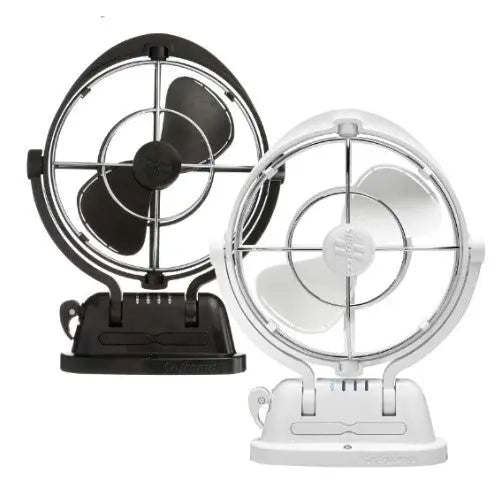
Caframo Sirocco II 12/24V Cabin Fan
Best cabin fan for a berth or saloon, and the first thing to buy
Buy this before you price air conditioning. Moving air over skin is worth several degrees of perceived temperature, and at roughly a third of an amp you can run one over each berth from dusk to dawn on about 8 Ah. Two fans in a typical aft cabin transform sleeping at anchor in the tropics. The Sirocco earns its price through the gimbal and the flat-fold mount rather than raw airflow — cheap fans move similar air and then rattle themselves apart in a season.
- Voltage
- 12/24V auto-sensing
- Airflow
- About 185 CFM on high (three speeds, 1200/1500/1800 RPM)
- Draw
- About 0.35A at 12V on high
- Mounting
- Gimballed 360° head, folds flat to about 3.8" when stowed
Pros
- 0.35A means you can run two of them all night on a few amp-hours
- The gimballed head genuinely aims air where you want it, including straight down onto a berth
- Folds flat against the bulkhead so it stops being a head-height hazard when not in use
Cons
- No protective grille — the blades are soft but it is harder to childproof than a caged fan
- Around $150-$200 is a lot for a fan, and you will want more than one

Caframo Bora 12V Cabin Fan
Best budget fan when you need several
Once you accept that fans beat air conditioning at anchor on any realistic battery bank, the question becomes how many you can justify. The Bora is the answer for the secondary spots — over the galley, at the nav station, in a pilot berth — where you want moving air but do not need to aim it precisely from a bunk. Buy Siroccos for the berths and Boras for everywhere else.
- Voltage
- 12V DC
- Style
- Fixed-base, two-speed, caged blade
- Typical price
- Around $100
- Use
- Galley, nav station, quarter berth
Pros
- Caged design is the safer choice around children and in a galley
- Costs roughly half a Sirocco, so outfitting four spaces stays affordable
- Low current draw in the same class as other quality 12V marine fans
Cons
- Fixed base means far less aiming flexibility than a gimballed head
- Does not fold flat, so it stays in the way in tight spaces
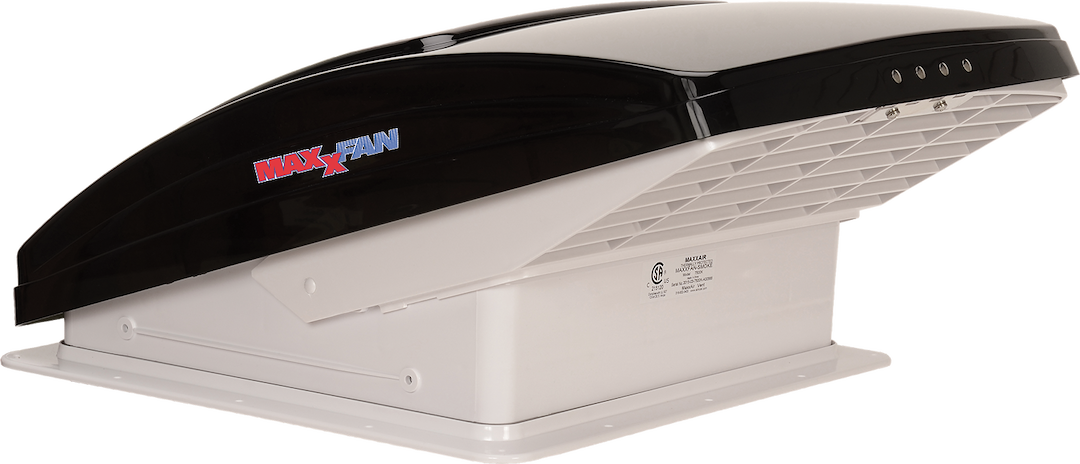
MaxxAir MaxxFan Deluxe Roof Vent Fan
Best whole-boat air exchange for a deck hatch
This is the single most effective non-refrigerated cooling upgrade on boats with a suitable flat deck area — a powered roof vent exchanging the whole cabin volume several times an hour does more than any number of cabin fans. It is also the one that demands real installation care on a sailboat: the frame is not designed for green water, the cut-out must land between deck beams, and bedding must be done properly or you will chase leaks for years. If your deck layout does not suit it, skip to more cabin fans and better dorade ventilation rather than forcing the install.
- Opening
- Fits a 14" x 14" cut-out
- Fan
- 10-speed, reversible (intake or exhaust)
- Rain
- Built-in rain shield lets it run in a downpour
- Typical price
- About $340-$400 depending on lid and control options
Pros
- Reversible airflow lets you exhaust hot air by day and draw cool air in at night
- Runs with the lid up in rain, which is when a boat gets most unpleasant below
- Thermostatic control means it manages the cabin without anyone thinking about it
Cons
- Designed for the RV market — the plastic frame needs proper marine bedding and reinforcement to survive a boarding sea
- Cutting a 14" square hole in your deck is not a reversible decision, and few sailboats have a flat area that suits it
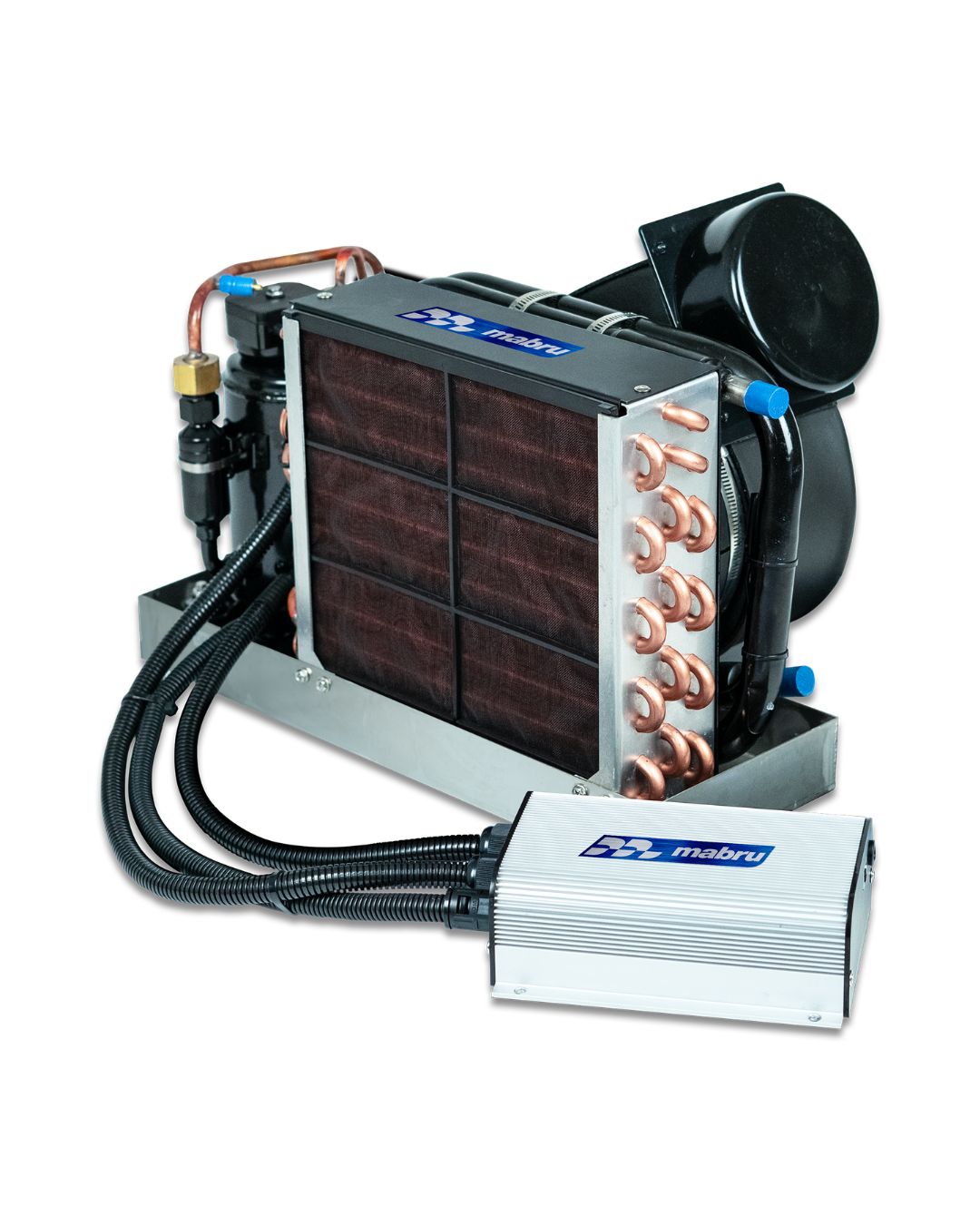
Mabru SC12DC 12V DC Marine Air Conditioner
Best air conditioning if you are genuinely committed to running it at anchor
DC air conditioning is the only version of air conditioning that makes sense at anchor, because it skips the inverter losses and modulates its compressor instead of cycling. Do the energy arithmetic before you order: eight hours at an average 30A is 240 Ah, which means at minimum a 400-600 Ah lithium bank and 800-1,200W of solar to put it back the next day. If you already built that electrical system, this is an excellent unit. If you have 200 Ah of AGM and a 100W panel, buy fans. Our solar sizing guide covers what the supporting electrical system actually costs.
- Capacity
- 12,000 BTU cooling, 12,300 BTU heating
- Power
- 12V DC, 22-44A draw while cooling
- Included
- 350 GPH raw-water pump, R-134a refrigerant, copper antimicrobial evaporator
- Typical price
- About $5,800 from the manufacturer, before installation
Pros
- Runs directly off a 12V DC bank with no inverter or generator in the chain
- Heats as well as cools, which extends the shoulder seasons meaningfully
- Variable-speed DC compressor draws far less at part load than a fixed-speed AC unit cycling on and off
Cons
- Up to 44A while cooling means roughly 250-400 Ah overnight — that is a serious lithium bank and a large solar array, not a casual add-on
- About $5,800 plus installation, thru-hull, strainer and pump plumbing puts the installed cost near $8,000
ElectroSea DryGenie Marine Dehumidifier
Best fix for a boat that feels clammy rather than hot
Most sailors describe a muggy cabin as hot when the real problem is moisture. Sweat cannot evaporate at 85% relative humidity, so 28°C feels intolerable — the same temperature at 55% is pleasant. A dehumidifier attacks the variable that actually governs comfort, at a fraction of the electrical cost of cooling the air. It is also the right tool for a boat left unattended, where the enemy is mildew rather than discomfort. Run it with hatches closed; running it with the boat open is pumping money into the sky.
- Capacity
- Up to 3 litres of moisture removed per day
- Noise
- Manufacturer rates it at 45 dB or below
- Drain
- Gravity drain via a 6" or 3 ft hose — no tank to empty
- Stability
- Suction-cup feet and a tip switch for use under way
Pros
- Dropping humidity from 85% to 60% changes perceived comfort more than dropping temperature two degrees
- Gravity drain means it runs unattended for days, including on a boat left on a mooring
- Marine-specific design details — tip shutoff, suction feet, auto-restart after a power cut — that household units lack
Cons
- 3 litres a day is modest for a large interior in a genuinely humid climate; it will run continuously
- We could not verify current pricing on a live page, so treat any figure you see as needing confirmation before you order
How to choose
The table compares what each option costs to buy and what it costs you overnight in amp-hours, which is the figure that decides whether it is usable at anchor.
| Option | Typical price | Overnight draw | Best for |
|---|---|---|---|
| Wind scoop | $60-$150 | Zero | Any breeze at all |
| Cabin fans (pair) | $200-$400 | About 7 Ah | Every boat, first purchase |
| Powered deck vent | $340-$400 | 10-20 Ah | Boats with a suitable flat deck area |
| Dehumidifier | Confirm current pricing | 30-50 Ah | Humid climates, unattended boats |
| 12V DC air conditioning | $5,800 + install | 250-350 Ah | Large lithium bank and big solar array |
Budget tiers. Under $500 buys two good fans and a wind scoop, and that combination handles the large majority of anchorages anywhere in the world. Around $1,000-$1,500 adds a powered deck vent, hatch shades and better dorade ventilation, which is where most cruising boats should stop. Above $8,000 installed, you are into DC air conditioning and the lithium bank and solar array required to feed it — worth it if you spend summers aboard in the subtropics, hard to justify if you are cruising north of Cape Hatteras or in the Mediterranean shoulder seasons.
Frequently asked questions
Can I run marine air conditioning at anchor without a generator?
Only with a substantial DC electrical system. A 12,000 BTU DC unit draws 22-44A, so an eight-hour night is roughly 250-350 Ah. That means a 400-600 Ah lithium bank and 800-1,200W of solar to replace it the next day. With a typical 200-300 Ah AGM bank you will flatten the batteries before morning.
How many amps does a marine cabin fan use?
A quality 12V cabin fan draws roughly 0.2-0.4A on high. Two fans running ten hours overnight uses about 6-8 Ah, which is within reach of almost any boat's battery bank and a single modest solar panel.
Are dorade vents and wind scoops still worth fitting?
Yes, and they are the cheapest cooling on the list. A foredeck wind scoop over the forward hatch can move more air through a cabin at anchor than any fan when there is even 5-8 knots of breeze, because it uses the whole hatch as an inlet. Dorades keep that air moving in rain and under way, when hatches must be shut.
Is a portable household air conditioner a reasonable substitute?
Rarely. Household portables are air-cooled, so they need to dump heat somewhere — usually through a hose out a hatch, which defeats the seal you are trying to maintain. They also draw 800-1,200W AC, meaning a generator or shore power. On shore power at a dock they work; at anchor they do not.
Does insulation actually help on a sailboat?
Considerably, and it is under-rated. Most cooling load on a boat at anchor is solar gain through the deck and coachroof. Closed-cell foam under the headliner, reflective covers over hatches, and a light-coloured deck all cut the heat entering the boat, which reduces the size of every cooling system you might fit afterwards.
What order should I buy cooling gear in?
Fans first, then shade and hatch covers, then a wind scoop, then a powered deck vent if your deck suits one, then a dehumidifier, and only then air conditioning. Each step up costs several times the previous one and delivers less additional comfort per dollar.
Looking for more gear guides? Browse all our gear recommendations or the full guides index.