
Upgrading Your Marine Head: Electric Toilets and Treatment Systems
For a coastal cruiser with guests aboard, a 12V macerating electric head is the right upgrade: about $600-$1,100 for the unit and a weekend of work if you reuse the existing plumbing. If you go offshore, pay the premium for a dual-mode head with a manual backup. If you anchor out for weeks at a time and dislike pumpouts, a composting head deletes the tank and its plumbing altogether for around $1,000.
What almost never fixes a head problem is replacing the toilet alone. The smell nearly always comes from permeated hose or a raw-water intake, and the blockages come from the discharge run. This guide covers the whole system — the toilet, the hose, the tank, the monitoring and the treatment — because that is what determines whether the upgrade works.
Sailboat Atlas may earn a commission from qualifying purchases made through links on this page, at no extra cost to you.
The four system types and who each suits
Manual pump heads are what most boats came with. They are cheap, repairable anywhere, and work without power. They also require technique, and every guest who over-pumps or flushes something they should not creates a job for you.
Electric macerating heads grind waste and pump it to the tank at the press of a button. They remove the user-error problem entirely, draw 20-25A for a few seconds per flush, and fail completely when the pump dies. This is the most common conversion and the right one for most coastal boats.
Vacuum systems use a separate vacuum generator to pull waste through the line, using under a tenth of a gallon of water per flush. They will lift waste upwards and over long runs that defeat other systems, and they make a holding tank last several times longer. The cost is complexity and installed space.
Composting heads separate urine from solids and eliminate the holding tank, discharge hose and thru-hull entirely. They ask for daily-life involvement — emptying a urine bottle every couple of days — in exchange for deleting the boat's worst plumbing.
Where the smell actually comes from
Sailors replace toilets to solve smells and are then baffled when the smell remains. The reason is that the toilet is rarely the source. Sanitation hose is porous at a molecular level and permeates with age; after ten to fifteen years the hose itself smells, and nothing you put in the tank changes that. The diagnostic is crude and reliable: wipe a warm damp cloth along the hose, let it cool, and smell it. If the cloth stinks, the hose is finished.
The second source is the raw-water intake line on saltwater-flush systems. Between flushes, the seawater sitting in that hose goes anaerobic, and every flush pushes that water into the bowl. It is the reason a boat left for a week smells worse than one used daily, and the reason many cruisers convert to freshwater flushing.
Third is the tank vent. A blocked or undersized vent means the tank cannot breathe, which drives the contents anaerobic and produces hydrogen sulphide — the rotten-egg smell. Check the vent is clear as a matter of routine; a wasp nest or a salt crust in a vent fitting is a genuinely common cause of a boat that smells for no apparent reason.
Only after those three are eliminated does the toilet itself deserve blame, usually via a worn joker valve letting tank contents back into the bowl.
Installation reality: what the weekend actually involves
Measure the compartment first, in three dimensions, and compare it against the actual footprint of the new unit including the pump housing. China-bowl heads are substantially deeper than the plastic units many production boats came with, and discovering that after delivery is a common and expensive mistake.
Plan the wiring properly. A 25A load needs correctly sized cable and its own fuse or breaker at the panel — not a spur off a lighting circuit. Use tinned marine cable and adhesive-lined heat-shrink terminals, mount the connections as high as possible in the compartment, and fit the switch where it will not be splashed.
Replace the hose while you are in there. This is the single piece of advice every experienced owner gives and most first-timers skip. You will never again have this access, the hose is the most likely source of future smell, and quality sanitation hose is cheap relative to doing the job twice. Use proper sanitation hose rather than generic reinforced PVC, run it with continuous fall where possible, and avoid low loops where waste will sit.
Check the discharge run for vented loops. Any part of the system below the waterline at any angle of heel needs a vented loop to prevent siphoning, and a blocked vent in that loop is another classic cause of a slowly flooding boat. Test the vent valve when you reassemble.
Tankage, monitoring and pumpout discipline
Holding tanks are sized in a rough range of 5-8 gallons per person per cruising week with a conventional head. A vacuum system using under half a litre per flush stretches the same tank enormously, which is often the real argument for fitting one. Whatever the size, the tank needs an adequate vent, an accessible pumpout fitting, and ideally a deck fitting that does not sit in a puddle.
Fit a level monitor. Guessing is how tanks get overfilled, and an overfilled tank pushes contents up the vent line and down the topsides, which is a bad afternoon by any standard. External sensors are more reliable than internal probes because they are not sitting in the fouling environment they are trying to measure. If the boat has an NMEA 2000 network, put the tank level on the existing displays — our networking guide covers how that integration works.
Treat the tank routinely rather than reactively. A tablet after each pumpout, generous water with each flush, and a freshwater rinse before the boat sits unused prevent the problems that treatment cannot fix later.
What the whole job costs
A straightforward electric head swap reusing existing plumbing is $600-$1,100 for the toilet plus perhaps $150 in wire, fuse, hose clamps and sealant — a weekend for a competent owner, or roughly four to six hours of yard labour at typical rates.
Replacing the sanitation hose at the same time adds $200-$500 depending on run length, and it is the best value line in the whole project. A tank monitor adds $560-$915. A vacuum system with generator and tank plumbing can push a full installed job past $3,000-$4,000 professionally.
A composting head is $965-$1,035 plus a vent installation, and it removes future pumpout fees — typically $20-$40 a time — along with the hose and tank maintenance entirely. Over five years of active cruising that is a genuine saving, which is why the numbers work out better than the sticker price suggests. Our ownership cost guide puts these figures alongside the other recurring bills.
Our picks
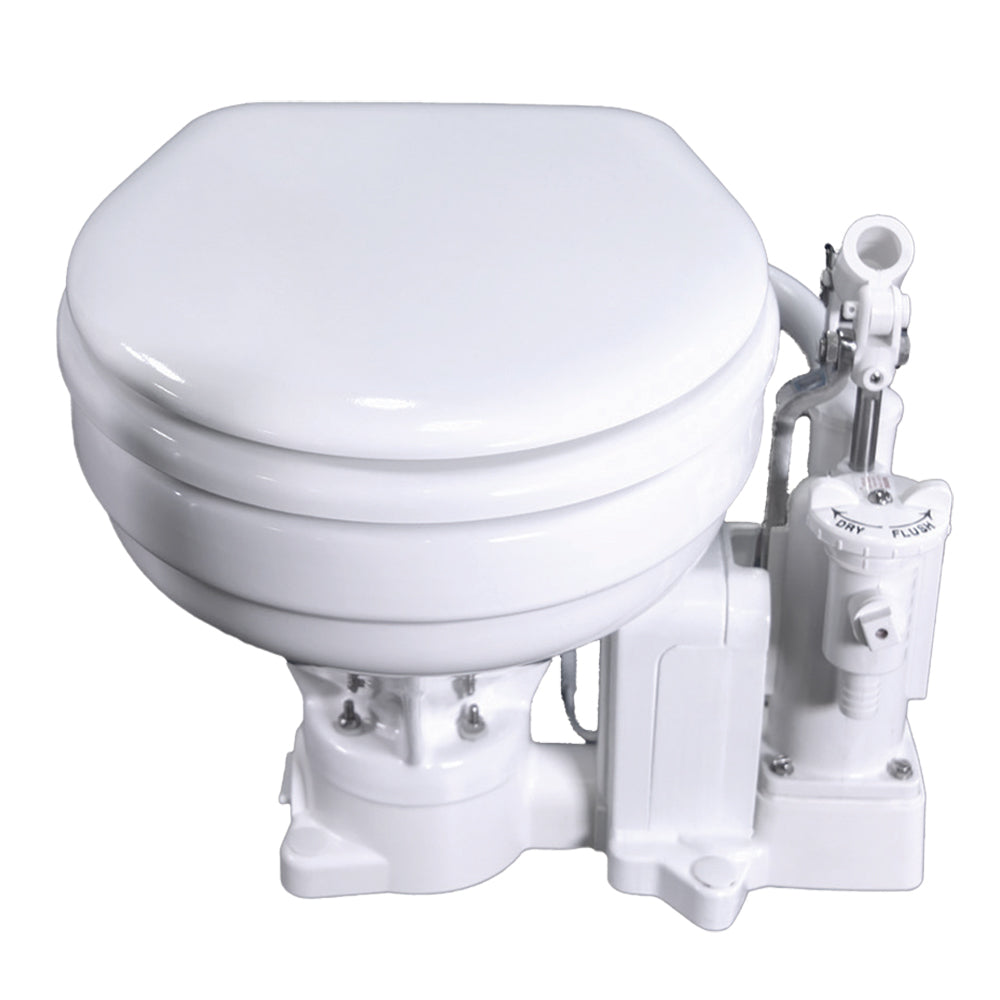
Raritan PH PowerFlush Electric/Manual Toilet (12V)
Best electric head for a cruising boat that wants a manual backup
This is the head to fit on a boat that goes offshore, because the failure mode of every other electric toilet is the one this solves. When the pump motor dies 400 miles out, you switch to manual and carry on. The price is a bigger installation footprint and a slightly more complex mechanism. Order the service kit at the same time as the toilet — joker valves are a consumable, and a spare in the locker is the difference between a ten-minute job and a very unpleasant day.
- Voltage
- 12V (a 24V version is also produced)
- Pump
- Dual-action pump, substantially larger than typical rivals
- Modes
- Converts between electric and manual operation
- Typical price
- About $850-$1,435 depending on retailer
Pros
- Manual backup means a flat battery or a failed pump motor does not put the head out of service
- The large dual-action pump moves waste through long or rising discharge runs that defeat smaller pumps
- Raritan parts and rebuild kits are widely available and the company supports old models
Cons
- Bulky vitreous china bowl needs real installation depth — measure the compartment before ordering
- Manual conversion adds linkages and seals, which is more to maintain than a simple macerator head
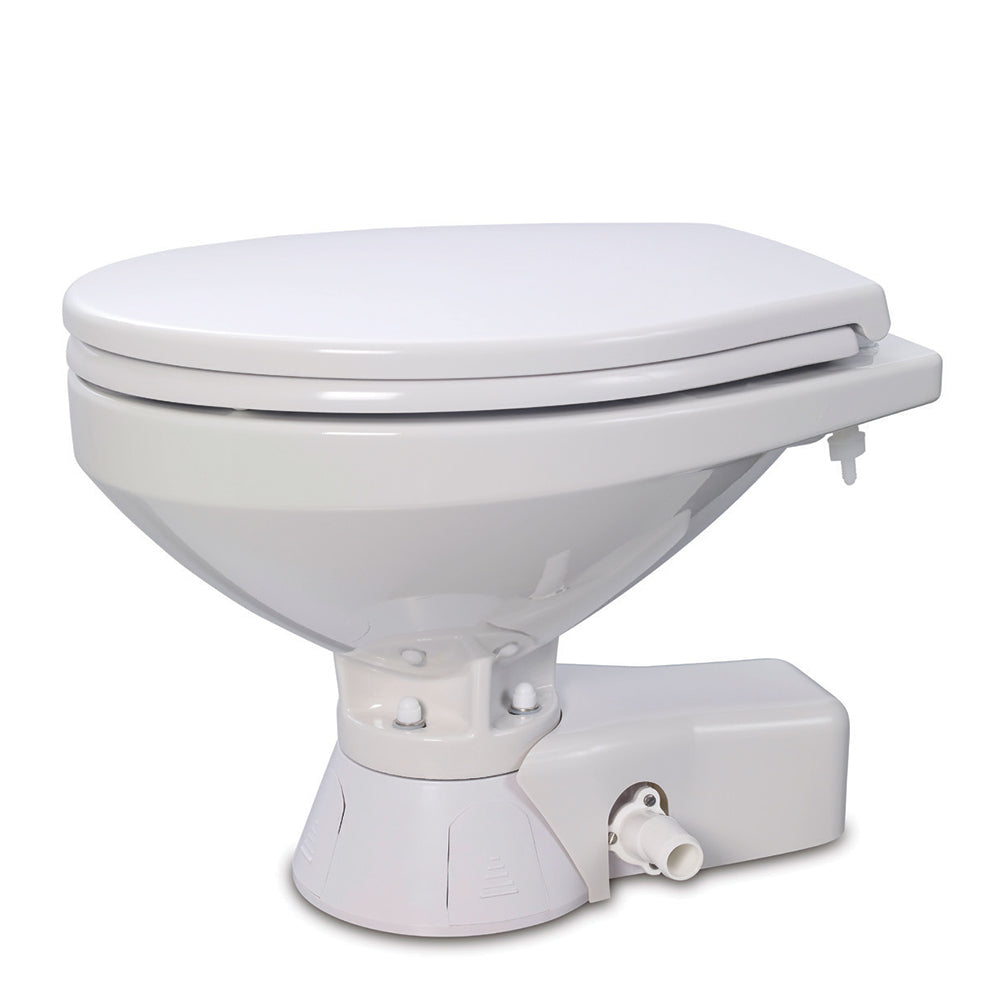
Jabsco Quiet Flush Electric Toilet (12V)
Best straightforward electric conversion for a coastal cruiser
The Quiet Flush is the default conversion for coastal boats, and it is a genuinely good one: simple, quiet, well supported and usually cheaper installed than the alternatives. Choose the freshwater version if your tankage allows, because raw-water flushing is the main source of the smell people associate with boat heads — dying organisms in the intake line, not the holding tank. Note that older part numbers circulate online; the current range uses 37045 (12V) and 37245 (24V) series numbers.
- Voltage
- 12V DC, 25A fuse (24V models in the 37245 series)
- Pump
- Macerating discharge pump
- Plumbing
- 3/4" inlet, 1" discharge
- Typical price
- $560-$1,090 depending on bowl, water type and retailer
Pros
- Noticeably quieter than older macerator heads, which matters at anchor in a quiet bay at 3 am
- Compact-bowl version fits heads compartments where a full-size china bowl will not
- Available in fresh or raw water versions, so you can choose whether to spend tank water on flushing
Cons
- No manual backup at all — a dead pump means the head is out of service until it is repaired
- 25A draw during flush is a real load on a small bank, and the macerator is intolerant of anything but waste and paper
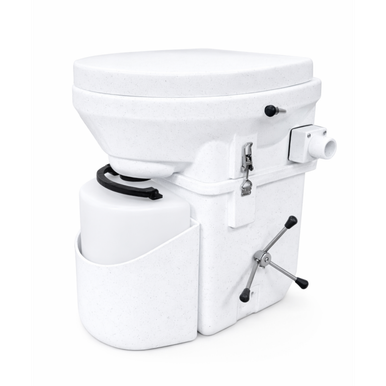
Nature's Head Composting Toilet
Best way to eliminate the holding tank and its plumbing entirely
Composting heads divide sailors sharply, and the divide is almost entirely about lifestyle rather than technology. They work, they smell better than a conventional system, and they delete an entire category of plumbing failures. In exchange, someone empties a urine bottle every couple of days, and you handle the solids bin periodically. Cruisers who spend weeks at anchor away from pumpout facilities usually love them; owners who dock at a marina with pumpout service every weekend generally find a conventional system easier. Check local regulations before fitting one, as discharge rules vary by jurisdiction.
- Size / weight
- 21"H x 20"W x 19"D, about 23 lb
- Principle
- Urine diverter with a separate solids bin and crank agitator
- Capacity
- Solids bin typically lasts about 60-80 uses
- Typical price
- $965-$1,035
Pros
- No holding tank, no macerator, no discharge thru-hull, no pumpout fees, no Y-valve to get wrong
- Very low power — only the small 12V ventilation fan, measured in milliamps rather than amps
- Removes the single worst smell source on most boats, because urine and solids never mix
Cons
- The urine bottle needs emptying every two to three days for two people, which is a daily-life reality not a footnote
- Requires a dedicated vent line to outside air, and the solids bin must be emptied and the compost managed every four to six weeks
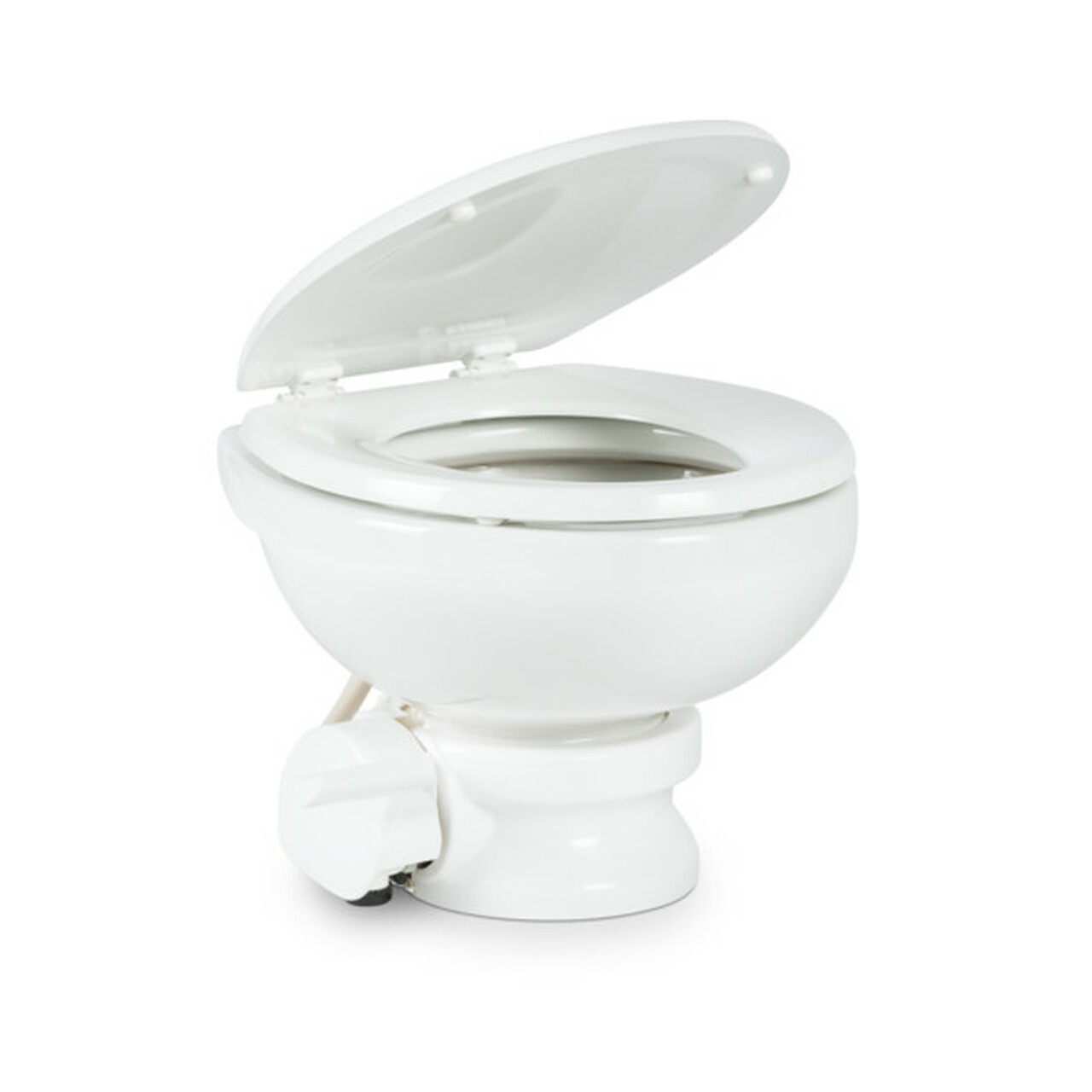
Dometic VacuFlush 5006
Best system for minimum water use and household-style flushing
VacuFlush is the system that makes sense when water is the constraint. On a boat making water with a watermaker or carrying limited tankage, going from 2-3 litres a flush to under half a litre transforms how long the tank and the tankage last. The cost is complexity: the vacuum generator lives elsewhere in the boat, the tank needs space, and diagnosing a lost-vacuum fault requires understanding the whole system. On a larger cruising boat with room for it, it is excellent. On a 32-footer it is over-engineering.
- Water use
- Under 0.10 US gallons (about 0.39 L) per flush
- Voltage
- 12V or 24V; foot-pedal and electric flush versions
- Discharge
- Through-floor, driven by a separate vacuum generator
- Typical price
- About $865 direct; comparable models $1,375-$1,700 at dealers
Pros
- Under a tenth of a gallon per flush means a holding tank that lasts several times longer between pumpouts
- Vacuum discharge will lift waste upward and over long runs that gravity and macerator systems cannot manage
- Flushes like a household toilet, which guests understand without a briefing
Cons
- Needs a separate vacuum generator and tank, so total installed cost and space requirement are the highest here
- More components in the chain — vacuum pump, vacuum tank, duckbill valves — each with its own failure mode
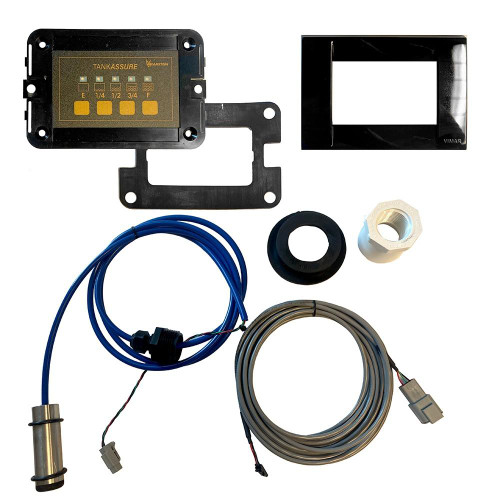
Raritan TankAssure Tank Monitoring System
Best way to stop guessing how full the holding tank is
Every boat with a holding tank has overfilled it at least once, and the experience is memorable enough that most owners then buy a monitor. The external sensor approach is the important part — internal probes sit in exactly the environment guaranteed to foul them, and a fouled probe reads full or empty regardless of reality. Add it at the same time as a head conversion while the compartment is already apart; retrofitting later means emptying and cleaning the tank first, which nobody wants to do twice.
- Sensor
- Submersible external sensor for tanks up to about 40" tall
- Capacity
- Monitors up to four tanks with additional sensors
- Readout
- Control panel plus Bluetooth app; NMEA 2000 compatible with an adapter
- Typical price
- $560-$915 depending on retailer and configuration
Pros
- External sensor avoids the classic failure of internal probes fouling and reading wrong within a season
- Bluetooth readout means anyone aboard can check the level without opening a locker
- NMEA 2000 output puts tank level on the same displays as everything else, covered in our networking guide
Cons
- Pairing and calibration can be finicky, and setup takes longer than the instructions suggest
- Monitoring all four tanks means buying extra sensor kits separately, which adds up quickly
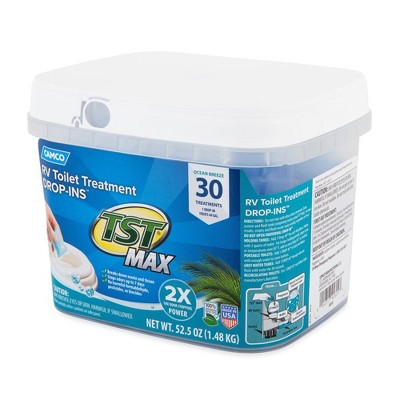
Camco TST MAX Toilet Treatment Drop-Ins
Best routine holding tank treatment
Treatment is the cheapest part of the system and the part most owners skip until there is a problem. The realistic routine is a tablet after each pumpout, plenty of water with each flush, and a tank rinse when the boat sits unused. If the boat already smells, treatment alone will not fix it — the source is usually a permeated discharge hose or a raw-water intake line full of dead organisms, and both need replacing rather than dosing.
- Format
- Drop-in tablets, 15 per pack
- Dose
- Rated at one tablet per 40-gallon tank
- Chemistry
- No formaldehyde or bronopol; RV and marine approved
- Typical price
- About $10 for 15 tablets
Pros
- Tablets are far easier to store and dose aboard than liquid treatments that leak in a locker
- Formaldehyde-free chemistry is accepted at pumpout stations that reject harsher products
- Cheap enough to dose properly rather than rationing, which is when odour problems start
Cons
- Heavier use commonly needs two tablets per tank, so a pack goes faster than the label implies
- Not as effective as a liquid enzyme treatment in genuinely hot climates or a long-neglected tank
How to choose
Choose by cruising pattern rather than by boat length. The table below summarises the four system types.
| System | Typical price | Best for | Key spec |
|---|---|---|---|
| Electric macerating | $560-$1,090 | Coastal cruisers with guests | 12V, 25A while flushing |
| Electric with manual backup | $850-$1,435 | Offshore passagemaking | Dual-action pump, convertible |
| Vacuum | $865-$1,700 plus generator | Water-limited boats, long runs | Under 0.10 gal per flush |
| Composting | $965-$1,035 | Long stays at anchor | No tank, no discharge plumbing |
Budget tiers. Around $800-$1,200 covers a quality electric head and new sanitation hose fitted by the owner, which solves the large majority of head complaints on production boats. Roughly $2,000-$2,500 adds a dual-mode offshore head and a tank level monitor. Above $4,000 you are into a professionally installed vacuum system with new tankage — worth it on a larger boat where water is the binding constraint, hard to justify on a 30-footer. Whatever tier you pick, put the hose replacement in the budget; it is the cheapest line item and the one that determines whether the boat smells afterwards.
Frequently asked questions
Is converting a manual head to electric worth it?
For most boats with guests aboard, yes. Manual heads work fine but require a briefing that visitors forget, and the resulting blockages are the most common head failure. An electric head removes the user-error problem. The counterargument is real though: a manual pump works with a flat battery, which is why dual-mode heads exist.
Why does my boat's head smell even after pumping out?
Almost always the discharge hose or the raw-water intake, not the tank. Sanitation hose permeates with age — rub a cloth on it and smell the cloth; if it stinks, the hose is the source and needs replacing. Raw-water flushing pulls in organisms that die in the intake line between uses, which is the other main culprit.
Freshwater or raw-water flush?
Freshwater flushing largely eliminates the intake-line odour problem and keeps the tank cleaner, at the cost of using tank water. Cruisers with a watermaker almost always switch. Boats with limited tankage and no watermaker usually keep raw-water flushing and manage the smell by flushing the intake line with fresh water before leaving the boat.
How much power does an electric marine toilet use?
A macerating head typically draws 20-25A while flushing, but only for a few seconds. Fifteen flushes a day at ten seconds each works out to under 1 Ah, which is negligible. The current draw matters for wiring size and fuse rating rather than for battery capacity.
Are composting toilets legal on boats?
In most US waters a composting head is treated favourably because nothing is discharged overboard, but rules vary by jurisdiction and some authorities require specific installation or documentation. Check the regulations for the waters you cruise before removing an existing certified system, especially if you cruise internationally.
What size holding tank do I need?
A common rule of thumb is about 5-8 gallons per person per week of cruising with a conventional head, and considerably less with a vacuum system using a tenth of a gallon per flush. Size to how long you actually stay away from pumpout facilities, and fit a level monitor whatever you choose.
Looking for more gear guides? Browse all our gear recommendations or the full guides index.