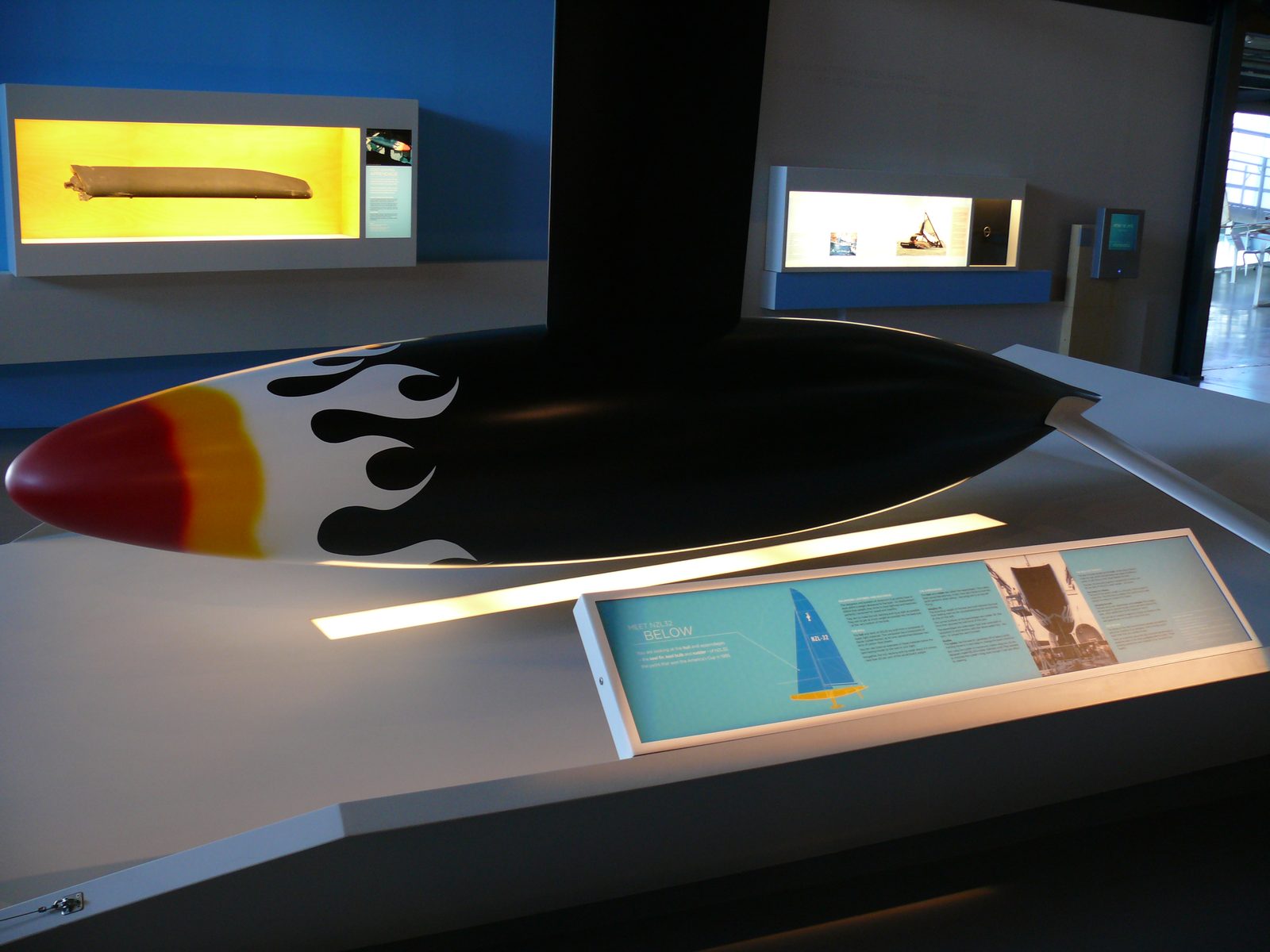
Sailboat Keel Types Explained: Fin, Full, Wing and Swing
For most cruising sailors the right keel is a shoal-draft fin with a skeg-hung rudder — it gives up only a few degrees of pointing compared with a deep fin, and it buys a foot or more of clearance for shallow anchorages, tide-driven channels and ramp launches. Choose a full or long keel when you routinely expect hard groundings and value tracking over tacking; choose a swing keel or centreboard when a trailer, a shallow mooring or a drying berth is the whole reason you own a boat.
Keel type is the single decision that quietly governs the rest of your sailing life: how deep you can go, how close you can point, what happens when you hit bottom, what your dockage costs, and how much money you spend on the survey. Yet it is usually the last thing buyers research, because keels are invisible once the boat is in the water and the sales literature treats them as a spec line.
This guide covers what a keel is actually doing, the real-world behaviour of each type, how keels are attached to the hull and what that means when something goes wrong, and how to check one before you hand over money. Every boat named below has its own specifications page on Sailboat Atlas, so you can compare the numbers directly.
Sailboat Atlas may earn a commission from qualifying purchases made through links on this page, at no extra cost to you.
What a keel is actually doing
A keel has two fundamental jobs, and people confuse them constantly. The first is righting moment: ballast placed below the waterline produces a force that counteracts the heeling force of the sails, and its size is roughly ballast weight multiplied by the vertical distance between the ballast's centre of gravity and the hull's centre of lateral resistance. That is why a bulb at the bottom of a thin fin can out-stiff a heavier keel whose lead sits only a couple of feet down. The second job is lateral resistance: a foil that stops the boat sliding sideways down the sail's drive, which is what lets you sail close to the wind instead of being pushed off.
Those two jobs do not require the same shape. Ballast wants to be as low and as compact as possible; lateral resistance wants a tall, slim, high-aspect-ratio foil with a large area. A deep fin does both at once, which is why it is the reference layout for windward performance. A full keel does the second job generously and the first job modestly. A multihull's daggerboard does only the second job and gets stability from hull buoyancy instead. Once you can keep the two jobs separate in your head, most keel arguments become obvious.
A third, less-discussed job is structure. On many older boats the keel is part of the hull's strength and the mast step sits on a keel stub that carries rigging load into the bottom of the boat. On others the keel is a bolted-on appendage with no structural role, and the rig loads go through the mast step, partners and chainplates. Which of those you have changes both the survey and the consequences of a grounding, so it is worth establishing early.
Fin keels: performance, and where the load goes
A fin keel is a high-aspect-ratio foil attached near the middle of the hull, usually bolted on, usually lead on newer boats and sometimes iron on older ones. Because it is a proper hydrofoil set well aft of the hull's forward end, it generates lift efficiently: less leeway for the same angle of heel, lighter helm, and a boat that turns in its own length and responds instantly to the tiller. Tacking is a two-second affair rather than the slow, wide arc a full keel demands, which matters every day in a tidal channel and not at all on a passage.
The costs are real. A fin presents a tall, narrow edge to the bottom, so groundings concentrate force into a small area and route it into the bolted joint. A deep fin also puts the rudder behind a gap, which is why the skeg-hung rudder — a stub of structure protecting the rudder's leading edge — became standard on serious cruising boats: it keeps most of the fin keel's handling while giving the rudder something to hit first. And a bolted joint is a maintenance item: keel bolts, nuts, bedding compound and a dry sump all need periodic attention, and a hull whose bilge is permanently wet will corrode hardware that a dry boat never thinks about.
For a fuller picture of how fin-keel boats behave offshore, our bluewater sailboats under 40 feet guide names several with skeg-hung rudders and explains why the layout keeps coming up in circumnavigation logs.
Full and long keels: the Cruising Club of America tradition
A full keel runs from near the stem to near the stern, is integral with the hull, and typically carries the rudder at its trailing edge. Its virtues are the ones that matter when things are unpleasant: enormous structural continuity, a rudder that sits behind the keel rather than exposed behind the transom, directional stability that makes a windvane self-steering rig work beautifully, and a grounding that scrapes rather than snaps. It also gives the designer a lot of lateral plane without needing a deep foil, which is how boats like the Westsail 32 and Bristol Channel Cutter manage respectable stiffness on a modest draft.
Its costs are equally concrete. Wetted surface is high, so light-air speed suffers and the boat needs more engine power than a fin-keel neighbour to make headway against a current with sails down. The deep forefoot and long lateral plane make the boat want to keep going straight, so tacks are slow, docking requires planning, and the boat will float her anchor up if you are not careful in a swell. Weather helm increases with heel because the keel's centre of lateral resistance moves as the hull heels. None of this makes a full keel a bad choice — it makes it a specific choice for a specific kind of cruising, and a frustrating one if your boating is really daysailing in a busy harbour.
Modified long keels, cutaways and skegs
Most modern cruising boats sit between the two extremes. A modified long keel keeps the structural continuity and rudder protection of a full keel but cuts away the forefoot and often the aft end, reducing wetted surface and letting the boat turn when asked. A cutaway full keel takes a bite out of the forward bottom to shorten the turning radius. A skeg-hung rudder on a fin keel delivers much of the same protection with none of the drag. These are the layouts that dominate the mid-size production cruisers you will actually be shopping, and they are a genuinely good answer for coastal and offshore work.
The practical way to evaluate a compromise layout is to ask three questions of the specific boat, not the category: How much of the rudder's leading edge is protected? Is the keel integral or bolted? And what is the ballast ratio and the vertical position of the ballast? Two boats both described as "long keel" can behave very differently depending on those answers, and the difference shows up in the helm, not the brochure.
Bulb, wing and shoal-draft fins
The bulb keel is the cleanest solution to the two-jobs problem: a slim, high-aspect fin carries a heavy torpedo of lead at the very bottom, so you get the lateral plane of a deep fin and the righting moment of ballast placed as low as the structure allows. On a given draft, a bulb is usually stiffer than a weighted-fin keel whose lead is spread along the foil, and it can be stiffer than a deeper conventional keel. Its weakness is concentrated cost and a thin section that can be damaged in a hard grounding.
The wing keel adds horizontal fins at the bottom of a shallow keel to generate lift where depth is limited. It works — a wing keel points noticeably better than a flat shoal stub of the same depth — and it is why so many trailer-sailers and shoal-draft production boats use one. It also adds a fragile, exposed structure that takes groundings on the wings, snags on mooring pennants and chain, and makes drying out awkward. Sailboat Atlas lists several designs with wing or shoal options; the Catalina 22 page shows how the same hull behaves with different keels.
Shoal-draft fins are the most underrated option and the one we recommend most often. A well-shaped shoal fin with a skeg-hung rudder, as on the Pacific Seacraft 37 or many modern Scandinavian cruisers, loses a couple of degrees of pointing to a deep keel and gains a foot or more of clearance — a trade almost every coastal sailor in tide-driven water should take seriously before assuming they want a deep fin.
Swing keels, centreboards and lifting keels
Retractable foils solve the one problem fixed keels cannot: a trailer, a ramp, a drying berth or a two-foot-deadwater mooring field. A pivoting swing keel carries ballast and swings up into a trunk, so the boat is a decent sailboat with the keel down and a shallow, trailerable hull with it up. A centreboard does the same motion unballasted, relying on hull form and crew weight. A daggerboard lifts vertically, is the most efficient foil of the three, and is the most easily broken by an object in the water.
Modern engineering has moved the needle: a proper lifting keel on a contemporary cruiser uses a substantial ram or foil with a positive mechanical lock, tight tolerances and minimal slop, so the boat sails close to a fixed-keel boat's performance with the board down and dries out to a few inches with it up. The cost is real money, a keel trunk that eats cabin volume, and a maintenance item you must not defer.
The failure mode to understand is a swing keel's suspension. On a pivoting keel, everything hangs from a pin, its bushings, and the line, cable or ram that lifts it. Corroded pins, worn bushings and chafed lifting lines are the whole story, and they are cheap to inspect and expensive to skip. If you are shopping a trailer-sailer, put the boat on the hard, drop the keel, and look for play, rust streaks and cracked trunk gelcoat before you look at anything else.
How keels are attached, and what breaks
There are three broad arrangements. Integral keels — full keels, and many older iron keels glassed into a stub — are continuous with the hull and have no bolted joint. Bolt-on keels hang from studs cast into the keel or set in the sump, with nuts and washers inside the boat, and are bedded with a compound that eventually dries out or is crushed. Keel stubs with sumps combine both: a moulded fibreglass box carries the rig and the keel bolts, and the external foil is bolted to it. Each is safe when maintained; each fails differently.
The classic bolt-on failure is not dramatic — it is section loss at the nuts, in a bilge that stays damp, discovered only when a nut shears or the keel shifts and the hull joint opens. Cast iron keels add rust-jacking: iron oxide occupies more volume than the metal it came from, so the keel's surface spalls and expands, and internal voids can hide behind a sound-looking skin. Lead keels do not rust but can creep and deform under load, and their bolts are often stainless in a lead matrix where crevice corrosion can bite.
What actually protects you is boring: a haul-out inspection with the keel cleaned and inspected for distortion, voids and weld cracks; bolts visible and inspected for thread engagement and corrosion; a keel-watertight test on a boat with a stub-and-sump arrangement; and a written history of any grounding with what was done afterwards. A few hundred dollars of survey on these questions is the highest-value money in a used-boat purchase, because a keel replacement can cost more than the boat is worth.
Choosing a keel for the water you actually sail on
Start from the bottom, not the brochure. Get a chart of your home port, your usual anchorages and the two places you most want to reach, and note the depths at low water. Then pick the shallowest keel that still sails well enough to make you want to sail — which for most people means a shoal fin with a skeg, or a centreboard you remember to lower. If you must trailer, a pivoting swing keel on a light hull is the honest answer, and you should budget for the pivot hardware before you budget for sails.
If you are planning genuine offshore passages, weight and behaviour in a seaway outweigh manoeuvring comfort: a heavier boat with a deep keel or a well-ballasted fin and skeg will be stiffer, roll more slowly and be far more predictable running downwind in big water. That is the argument that keeps full keels and heavy fin-keel boats in the fleet, and it is a fair one — provided you also accept the draft, the dock rates and the light-air performance you are trading away.
Our picks
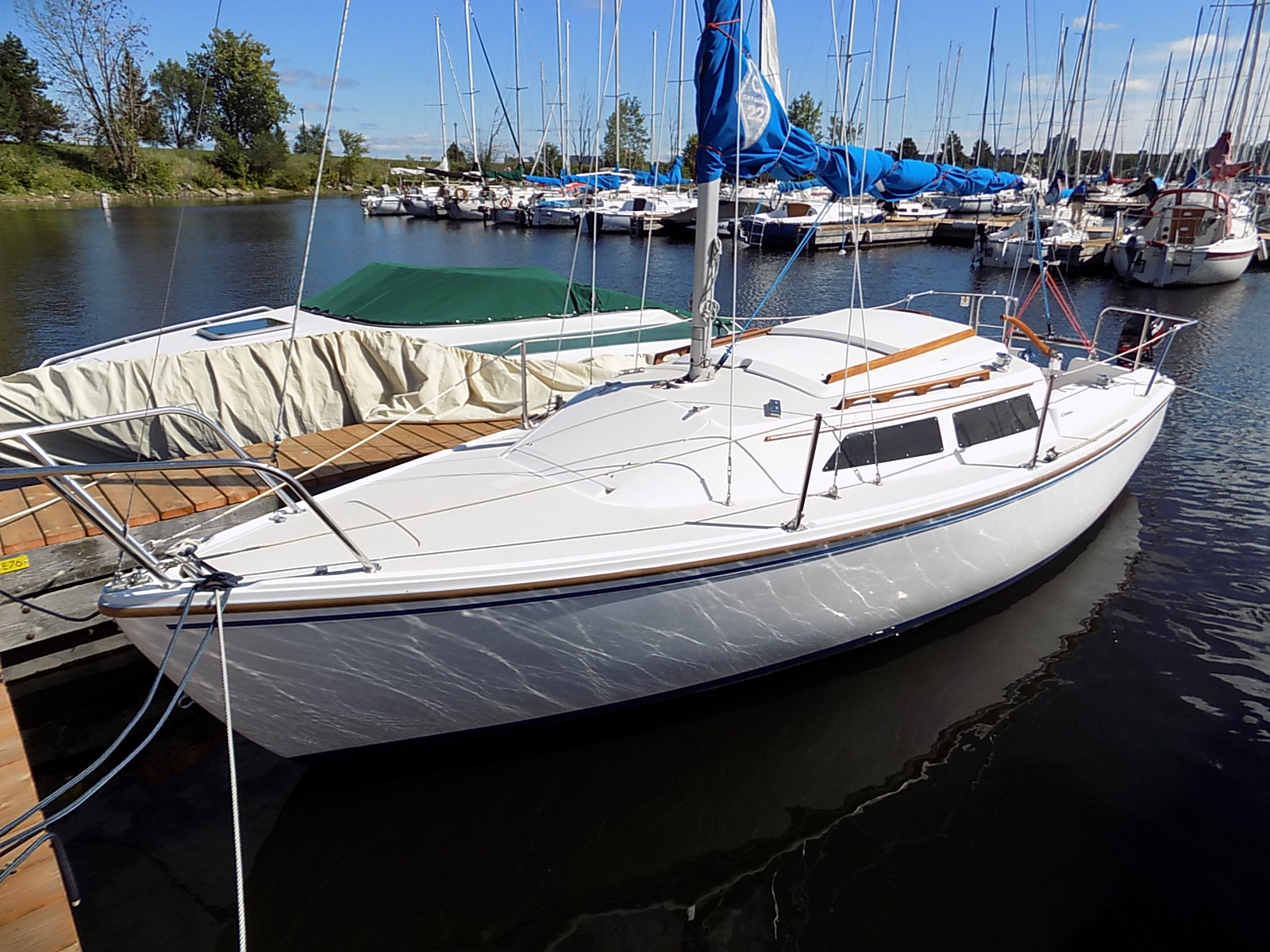
Catalina 22
Best example of a shoal-wing and centreboard layout for daysailing and light cruising
The Catalina 22 is the clearest lesson in keel tradeoffs money can buy, because you can find the same boat with a shoal wing, a deep fin, or a wing-with-centreboard. The deep fin points best and sails flatter in a breeze; the shoal wing opens up shallow creeks but leaks more leeway and needs more helm to hold a close-hauled course. If you are trying to decide how much draft you can actually live with, sailing one of these with the board up and then down will teach you more in an afternoon than any article.
- LOA
- 22' 6" (27' with boom-hangout spar version)
- Draft
- Shoal wing about 1' 6"; standard fin about 4' 6"; wing/centreboard in between
- Ballast
- About 500-800 lb depending on keel option
- Built
- 1969 onward, more than 11,000 hulls
Pros
- Several factory keel options on the same hull, so you can see how draft changes handling without changing boats
- Parts, plans and owners' knowledge are everywhere — every keel-pin bushing problem has been solved repeatedly online
- Light enough that a shoal keel still gets you into shallow coves and onto a trailer
Cons
- The centreboard pivot pin and bushings wear on a hull this popular, and a sloppy board clunks and loses efficiency
- Ultra-light construction means you must be careful not to ground hard — the keel is not the strongest part of the boat
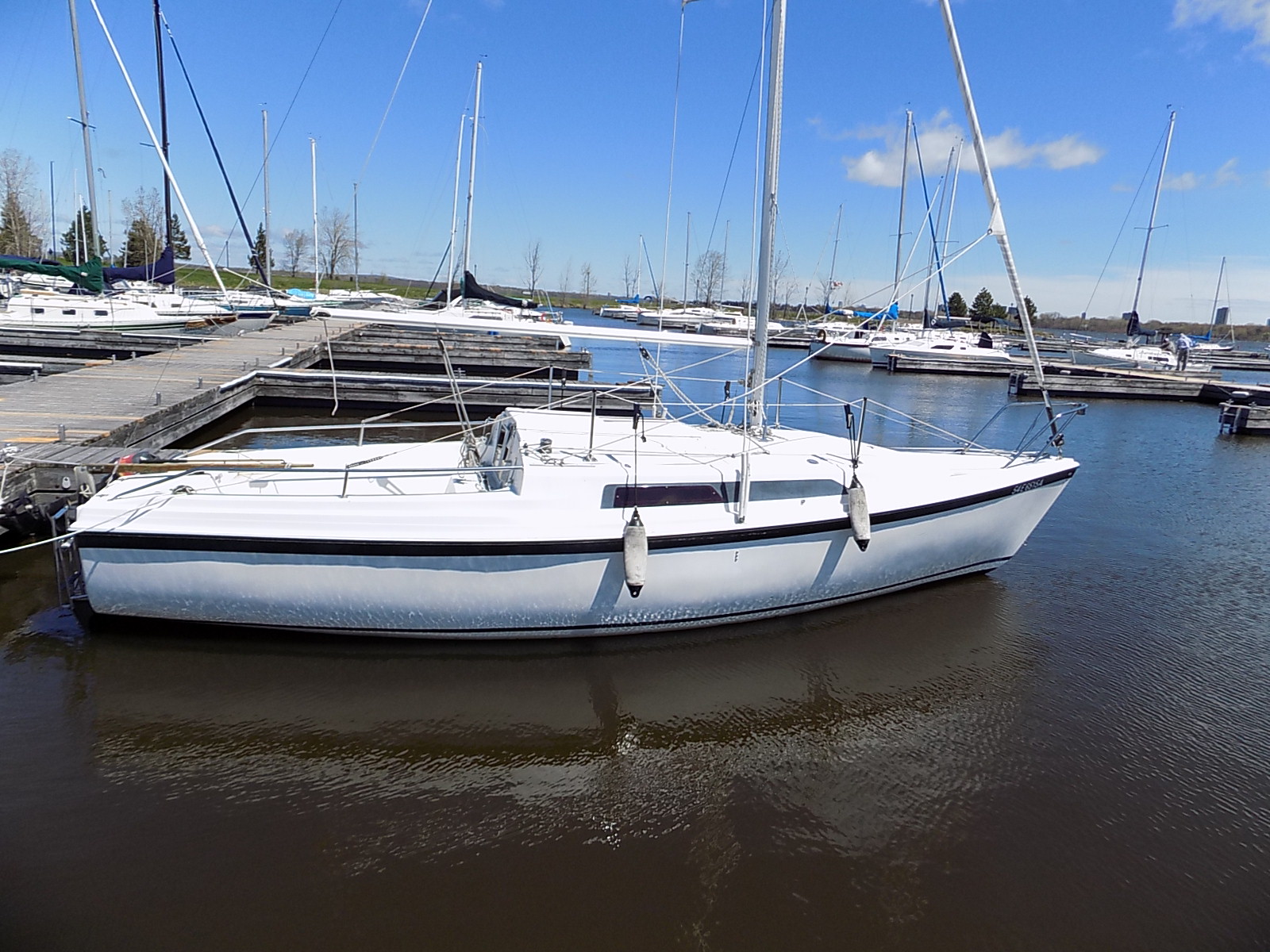
MacGregor 26
Best illustration of a pivoting swing keel for trailer sailing
Pivoting swing keels ask for one non-negotiable habit: inspect the pivot pin, its bushings and the lifting line every season, and never let a corroded or worn pin go. On a boat whose keel hangs from a single pin through a fibreglass trunk, that pin is the difference between a stiff sailboat and a keel sitting on the bottom with the boat attached. Owners who do the small yearly job — rinse the trunk, check for play in the board, replace a chafed line — sail for years without drama. Owners who do not, tell a different story.
- LOA
- 25' 6" (26' 6" with the mast in the water line)
- Draft
- About 1' 6" keel up, 5' 6" keel down
- Ballast
- Roughly 1,100 lb in a pivoting steel keel
- Weight
- About 2,600 lb dry — trailerable with a mid-size SUV
Pros
- One motion takes you from highway and shallow ramp to a boat that will point reasonably well
- Cheap to keep in the water — no dockage bill, and the boat lives out of the weather on its own trailer
- Enormous installed base, so bushings, pivot pins, lifting lines and winches are stocked items
Cons
- The keel trunk eats cabin space, and the pivot area is the single biggest maintenance item on the boat
- A light hull with a light keel is not a boat you want to hammer ashore — groundings are the owner's recurring worry
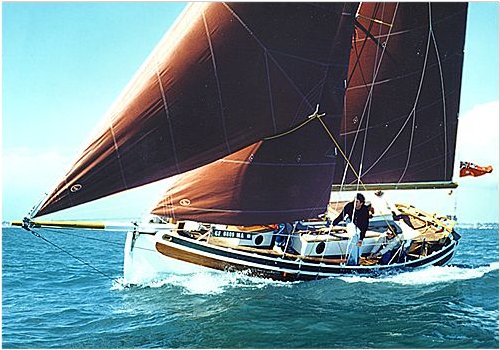
Bristol Channel Cutter 28
Best example of a classic full keel with a keel-hung rudder
This is the keel people mean when they say a boat can sit on the bottom and wait for the tide. Because the keel is structurally part of the hull rather than a fin bolted to it, there is no bolted joint to fail, and a grounding that would scare a fin-keel owner is a scraping noise to a Bristol owner. The price is paid in manoeuvring: expect to build speed before a tack, expect weather helm as heeling increases, and expect the boat to want to keep going where it is pointed.
- LOA
- 28' 3"
- Draft
- About 4' 6" full keel (a shoal version exists)
- Displacement
- About 8,500 lb
- Designer / years
- Carl Alberg, built from the mid-1970s
Pros
- The keel runs the length of the hull, so a hard grounding usually bends or scrapes rather than snapping
- The rudder sits in the keel's wash and behind the keel's leading edge — protected, and steered by clean flow
- Tracks like a train on a long passage, which makes a heavy self-steeling arrangement work well
Cons
- High wetted surface and a deep forefoot mean slow tacks and a tendency to round up in a gust
- Shallow marinas, tight mooring fields and a 4' 6" draft do not always agree with each other
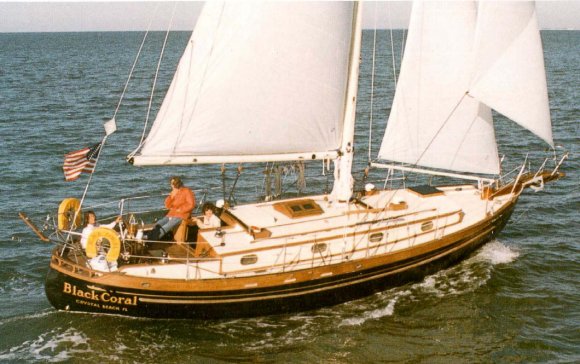
Tayana 37
Best example of a heavy full-keel cruiser built for offshore passages
Few boats make the case for displacement and ballast better. The Tayana carries so much lead that a seaway that has a light fin keel yawing and groaning simply rolls her over and brings her back. That is the honest argument for full keels offshore — not speed, but behaviour in the worst conditions. It also explains why she is a poor choice for a weekend of shallow creek hopping: draft, weight and dock rates conspire together.
- LOA
- 37' 0" (36' 0" waterline)
- Draft
- About 5' 0" full keel; a 4' 6" fin option exists on some hulls
- Displacement
- About 17,600 lb with roughly 7,000 lb of lead
- Designer / years
- Carl Alberg, still built to order in Taiwan
Pros
- High ballast ratio and a deep keel give a gentle, stiff motion that crew remember fondly after a rough passage
- The keel-to-hull connection is integral, so groundings and knocks are absorbed by structure, not a bolted joint
- A long waterline for the era means the boat keeps up with modern cruisers in a breeze
Cons
- Heavy and deep: dockage, bridge clearances and shallow anchorages all become planning problems
- Under 1,500 miles of ocean the boat wants a windvane or a good autopilot and a skipper willing to steer less
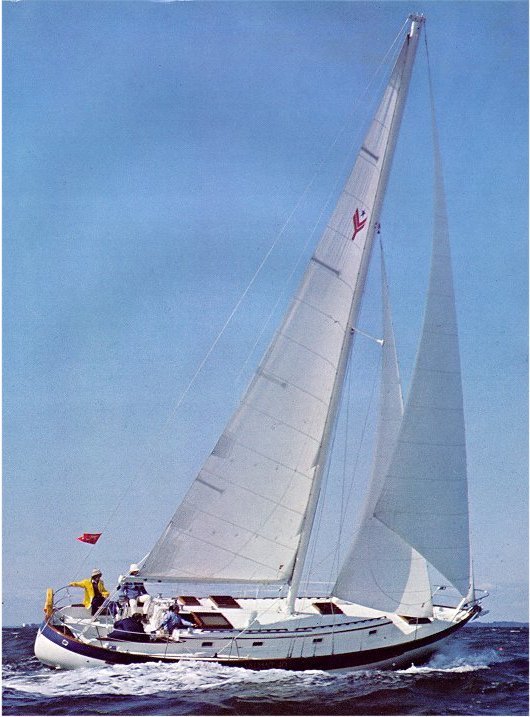
Valiant 40
Best example of a fin keel with a skeg-hung rudder for bluewater work
The Valiant is the argument that you do not have to choose between seaworthiness and sailing well. Perry's fin keel and skeg arrangement keeps the boat upwind, turns when asked and still puts the rudder behind something solid. The honest caveat is that the keel is bolted on, which makes keel-bolt condition and prior-grounding history the two most important questions at a survey — and the reason a pre-purchase haul-out on one of these is never optional.
- LOA
- 39' 11"
- Draft
- About 6' 3" fin keel
- Displacement
- About 22,000 lb
- Designer / years
- Robert Perry, 1975 onward
Pros
- A high-aspect fin gives windward performance a full keel cannot match, with a much better tack and helm
- The skeg protects the rudder head and blade from the debris and grounding damage that break exposed rudders
- Decades of circumnavigation evidence: the layout has been stress-tested by thousands of miles of real cruising
Cons
- A deep bolt-on fin transfers every grounding into the keel bolts, so the survey and the maintenance records matter
- 6' 3" is real draft — many cruising grounds require tide tables and local knowledge
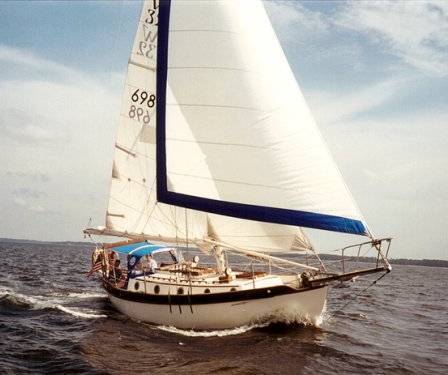
Westsail 32
Best example of a full keel taken to its logical, and expensive, conclusion
Owners buy Westsails for a feeling rather than a number, and the keel is most of that feeling. But honesty matters here: a long keel with a shallow forefoot and a lot of lateral plane will hold her course beautifully and will also refuse to turn quickly, sail best well below her theoretical hull speed in light air, and demand a prop wash over a large rudder to manoeuvre in a marina. Buy one because you have sailed one, not because a book told you it was the seaworthy option.
- LOA
- 32' 0" (27' 0" waterline)
- Draft
- About 4' 6" long keel
- Displacement
- About 15,000-16,000 lb
- Designer / years
- William Atkin concept, built from 1970
Pros
- Tremendous initial stiffness and carry-on ability — a boat that can take a hard grounding and keep floating
- Huge interior volume for the length because the hull is broad and the keel runs the whole bottom
- A devoted owners' network with decades of passage logs and repair knowledge
Cons
- Very slow through tacks and underpowered in light air — she asks for patience and a bigger engine than you expect
- The broad hull and long keel mean more wetted surface, so a windvane or generator-backed autopilot is worth the money
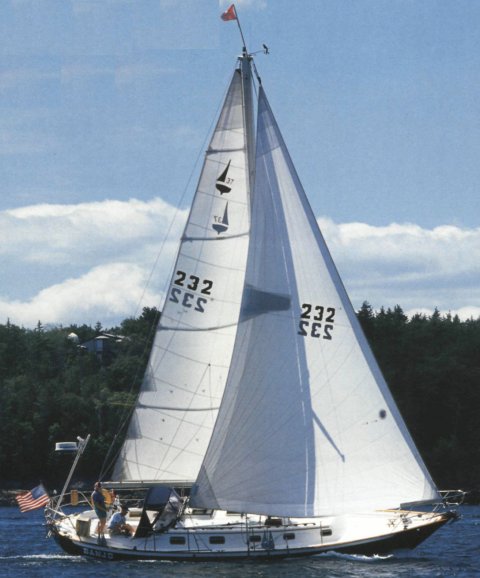
Pacific Seacraft 37
Best example of a shoal-draft fin keel that keeps its manners
This is the layout most cruising sailors in tide-dominated waters should actually be shopping for. A properly shaped shoal fin with a skeg-hung rudder gives up a little pointing and a little leeway resistance for a foot or more of clearance, and modern construction means the compromise is far smaller than the old full-keel-versus-deep-fin argument suggests. If your boating is coastal with occasional shallow anchorages, look at boats in this class before you talk yourself into a deep fin.
- LOA
- 37' 0"
- Draft
- Standard about 4' 9" (deep fin offered on some boats)
- Displacement
- About 14,700 lb
- Keel
- Bolted lead fin with a skeg-protected rudder
Pros
- Shoal draft without the usual penalty of a boardy, leeway-prone hull — the fin is still a proper hydrofoil
- Lead rather than iron keeps the weight smaller and better placed for the same stiffness
- Tide-dependent anchorages and shallow channels stop being dealbreakers
Cons
- Still a bolt-on keel on a light-ish hull: groundings need inspection, not ignoring
- Shoaler keels need more helm to hold in a blow than the deep version, and she will tell you when
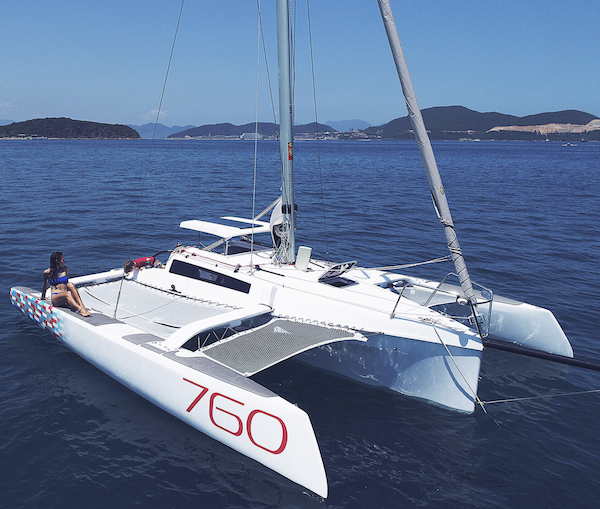
Corsair 760
Best example of daggerboards and a centreboard instead of a fixed keel
Multihulls make the point that a keel's job is lateral resistance, and lateral resistance does not require ballast. A daggerboard is the purest form: a slim hydrofoil you slide into the water when you need it and pull up when you do not. The trade is durability — boards are thin composite or aluminium foils that take groundings badly — and the fact that with no ballast, the boat's ultimate stability depends on her hulls staying dry and the crew staying mobile.
- LOA
- 25' 0"
- Draft
- About 1' 4" boards up; about 4' 6" boards down
- Displacement
- About 1,200 lb
- Rig
- Sloop on a trimaran hull with two hulls and a main
Pros
- Lateral plane on demand: boards down for windward work, boards up for a beach, a ramp or a shallow mooring
- Daggerboards are simple, light and highly efficient — no heavy ballast needed to keep the boat upright
- Dries out completely, so you can launch and retrieve anywhere the water is a couple of feet deep
Cons
- Boards are the wear items: leading edges crack, tips chip, and a broken board in the water is a swim-and-tow day
- No ballast means the boat's stability comes from buoyancy and crew weight — a very different feel from a keelboat
How to choose
Use this table as a shortlist filter, then sail the boat. Categories behave differently between designers, and a well-executed exception usually beats a mediocre example of the "right" type.
| Your situation | Best keel type | Examples to look at |
|---|---|---|
| Coastal cruising with shallow anchorages and tides | Shoal fin with skeg-hung rudder | Pacific Seacraft 37, sabre and Hallberg-Rassy shoal options |
| Bluewater passages, offshore and heavy weather | Deep fin with skeg, or integral long keel | Valiant 40, Tayana 37, Westsail 32 |
| Trailering to different lakes and ramps | Pivoting swing keel on a light hull | MacGregor 26, Catalina 22 wing/centreboard |
| Drying moorings and tidal creeks | Centreboard, or full keel that dries upright | Bristol Channel Cutter 28, O'day and Ensign centreboarders |
| Daysailing and learn-to-sail with limited draft | Shoal wing or lifting keel | Catalina 22 shoal, modern lifting-keel daysailers |
| Speed and windward work on a budget | Deep bolt-on fin, exposed or skeg-hung rudder | J/Boats, X-Yachts, C&C and Cal designs |
What to check before you buy. Have the boat hauled and the keel cleaned and inspected by the surveyor, not just waved at from the ladder. Confirm the keel's attachment method and whether the mast load goes through a keel stub. Get the bolts visible and photographed. Ask directly about groundings and get any repair invoices. On a centreboard or swing keel, check for play in the foil and inspect the lifting line, ram or winch and its lock. On a keel stub, ask for a keel-watertight test result.
Budget reality. A routine haul-out and keel inspection is a few hundred dollars and is the cheapest insurance in boating. Re-bedding a keel joint, replacing keel bolts, or fitting an inspection port runs into four figures. A dropped swing keel or a torn wing keel can cost more than a modest boat's purchase price — which is exactly why the survey question is never optional. If you are also weighing the running costs of ownership, our guide to what it costs to own a sailboat breaks down dockage, insurance and haul-outs by boat size.
Frequently asked questions
Is a full keel really safer if I run aground?
Usually yes, for the specific failure mode people worry about. A full keel is structurally continuous with the hull, so there is no bolted joint to bend or pull, and the load of a grounding spreads along a long area instead of concentrating at one stub. A bolt-on fin keel can survive a hard grounding too, but it transfers the energy into the keel bolts and the hull joint, which is exactly where damage hides. The honest tradeoff is that a full keel is more likely to hold the boat fast on a ledge, and it is a much worse boat in light air and through tacks.
How often do keel bolts need replacing?
There is no fixed interval, and any article that gives you one is guessing. Lead keel bolts in a well-drained, dry sump can go decades; iron keels in saltwater-wet bilges can show serious section loss in ten years. What matters is condition, not age: annual visual inspection of the bolts and nuts in the sump, checking for rust-jacking (a rough, expanded surface on cast iron), and a professional inspection with a hammer tap and thickness check when the boat is hauled. If you cannot see the bolts at all, that itself is a reason to open an inspection port before you buy.
What is the difference between a swing keel, a centreboard and a daggerboard?
A swing keel pivots on a transverse pin and swings up into the hull, and it usually carries ballast, so it also contributes righting moment. A centreboard does the same pivoting motion but is typically unballasted and slides or pivots into a trunk. A daggerboard is a straight foil that lifts vertically out of its own trunk, usually one per hull on a dinghy or multihull, and it is the most efficient shape but the most vulnerable to impact. In practical maintenance terms: swing keels ask about pivot pins and lifting gear, centreboards about bushings and play, daggerboards about tip and leading-edge damage.
Does a shoal keel make a boat sail badly upwind?
It makes it sail somewhat worse, and the size of the penalty depends on the design. A shoal keel has less aspect ratio and less lateral plane, so leeway increases and the boat needs more helm to hold a close-hauled angle — commonly a couple of degrees and a noticeable increase in drift in a chop. A well-designed shoal keel with a skeg-hung rudder, like the Pacific Seacraft's, loses far less than an unballasted board or a badly shaped stub. If most of your sailing is in a shallow, tide-driven system, that penalty is cheap compared to the cost of being stuck out.
Why do wing keels sometimes break off?
A wing keel concentrates a lot of side force into a relatively short, heavily loaded foil whose wings are often thin and cast with complex internal geometry. In a hard grounding the wings take the impact first, and where the casting is thin or has a casting flaw, the wing can tear. The main body of the keel usually stays attached, so the boat survives, but the loss of lateral plane makes her sail like a barge. The lesson for buyers is to check the leading edges for repair history and to ask what happened in any reported grounding — and to accept that a wing keel is a performance compromise, not a grounding-proof one.
Is a lifting keel on a modern cruiser worth the money?
If your mooring, ramp or trailer demands it, yes — a modern lifting keel with a proper hydraulic or electric ram and a positive lock gives you a deep-keel boat when you want one and a shallow boat when you need it, with far less slop than a 1970s centreboard. If you only occasionally want shallow draft, the complexity, the through-hull trunk, the maintenance on the ram and the loss of cabin space are hard to justify. Talk to owners of the exact model, because the quality of the installation varies more than the concept does.
Which keel type is best for trailering?
A pivoting swing keel or a centreboard, because you can drop draft to under two feet with the boat still on its trailer and launch from a ordinary ramp. Weight matters as much as the keel: a 2,500 lb trailer-sailer is a routine weekend, while a 6,000 lb lifting-keel boat is a special project requiring a heavy trailer, a good tow vehicle and patience. Also confirm the keel locks positively at full depth and that the lock cannot vibrate free, and inspect the pivot hardware every season.
Looking for more gear guides? Browse all our gear recommendations or the full guides index.