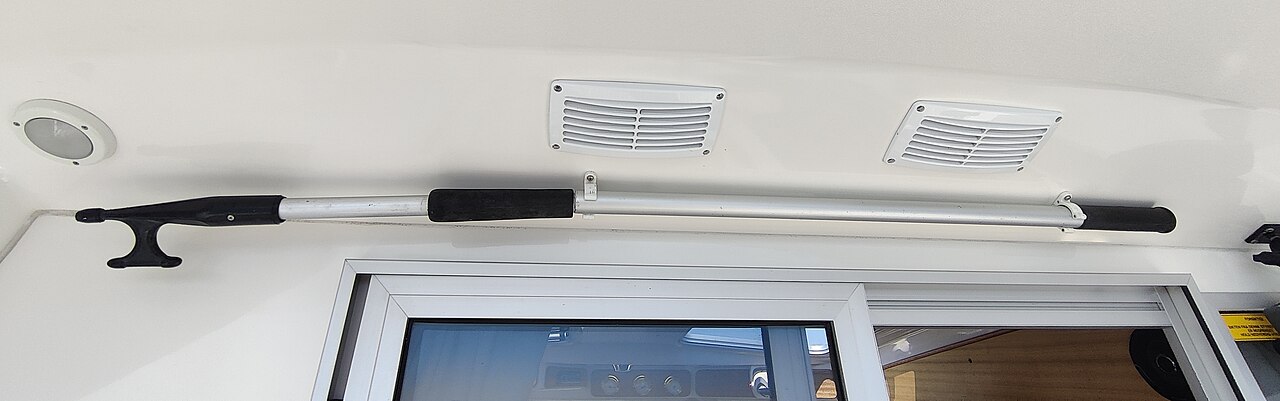
Best Boat Hooks: Telescoping Hooks for Docking
For most sailboats between 25 and 40 feet, a telescoping hook that reaches about 8 feet, such as the Garelick EEz-In 55170 (3.5 to 8 ft), is the right all-round choice. Larger boats with high bows, or anyone picking up moorings from a tall foredeck, should look at the 12-foot Garelick 55175, while a one-piece floating hook like the Beckson Hook-Mate suits small boats and dinghies where simplicity matters more than reach.
A boat hook is cheap, but the wrong one causes real problems: it collapses when you push off a piling, it sinks when dropped, or it is too short to reach the pennant (the line attached to a mooring buoy) from your bow. This guide covers length, locking mechanisms, hook shapes and how to use one without getting pulled overboard.
Sailboat Atlas may earn a commission from qualifying purchases made through links on this page, at no extra cost to you.
What length boat hook do you need?
Measure from where you will stand, usually the foredeck or side deck, down to the water and then out to where a mooring pennant or dock line will be. Most crews find that a hook extending to about 8 feet covers boats up to around 40 feet. High-bowed cruising boats and motorsailers benefit from a 10–12 foot reach, especially when picking up moorings.
Collapsed length matters too. A hook that shrinks to around 3.5–4 feet can stow in a cockpit locker or clip to the pushpit. Longer hooks may need to live on deck in clips, where they are handy but exposed to UV and snagging sheets.
Twist locks, cam locks and fixed poles
Telescoping hooks lock either by twisting sections against each other or with a cam lever. Twist locks are slim and have nothing to catch on lines, but salt and sand can make them slip or seize. Cam locks are faster to set and easier to check at a glance, but the lever can snag.
One-piece fixed hooks never collapse unexpectedly. That makes them the most reliable for pushing off, which is when telescoping hooks are most likely to slip. The trade-off is reach and stowage.
Hook shapes: single hook, double hook and push-off tips
A traditional single hook grabs lines and rings. Many modern heads add a second, opposing hook or a rounded push-off tip so you can fend off without the point scratching gelcoat. Some heads can also feed a line through a cleat or ring on the dock, which saves stepping ashore.
Interchangeable systems, such as Shurhold's SHUR-LOK handles, let one pole carry a boat hook, brushes and mops. That saves space, but the hook needs to be fitted before you need it, not hunted for in a locker while drifting onto the dock.
Does a boat hook float?
Not always. Some foam-filled or sealed designs float, such as the Beckson Hook-Mate and the Sea-Dog telescoping hook, which its listing says stays afloat for more than six minutes. Hollow aluminium poles can fill with water through the lock joints and sink. If you regularly work over deep water, buy a hook marketed as floating, or add a lanyard.
How to use a boat hook safely when docking and mooring
Never try to stop a moving boat by pulling or pushing on a boat hook. The hook is for reaching, guiding and catching a line, not for holding the weight of the boat. If the boat is still moving when you hook a pennant, let go of the hook rather than being pulled off the bow.
Keep your body inside the lifelines, kneel rather than lean over the bow, and communicate clearly with the helm. Many experienced crews use simple hand signals for distance and direction to the buoy.
Our picks
Garelick EEz-In 55170 Premium Telescoping Boat Hook (8 ft)
Most sailboats up to about 40 ft
This is a sensible default for a typical coastal cruiser. Eight feet reaches mooring pennants from most bows, and it collapses small enough to stow in a locker. The head also accepts screw-on accessories. Skip it if you have a very high bow or regularly pick up moorings single-handed from a tall foredeck, where the 12-foot version is easier. Rinse the twist locks with fresh water and check they grip before every docking; a lock that slips when you push off is the classic failure.
- Length
- 3.5 ft to 8 ft
- Sections
- 3
- Tube diameters
- 1", 1-1/8", 1-1/4"
- Lock
- Twist lock
Pros
- Good reach for most boats
- Anodized aluminium resists corrosion
- Head threads accept brushes and mops
Cons
- Twist locks can slip if salt-encrusted
- Not marketed as floating
Garelick EEz-In 55175 Premium Telescoping Boat Hook (12 ft)
High bows and larger cruisers
Choose the 12-foot model for boats over about 40 feet, high-bowed designs or anyone who picks up moorings from a tall foredeck. The extra reach also helps recover a hat or fender drifting away. Skip it on small boats: a long pole is awkward to control in a breeze and its 56-inch collapsed length may not fit your lockers. Extend it only as far as needed; the further out you hold it, the more leverage the wind and the boat have on your arms.
- Length
- 56 in to 12 ft
- Sections
- 3
- Head
- Marine composite
- Lock
- Twist lock
Pros
- Longest reach in this shortlist
- Same proven construction as the 8 ft model
- Helpful for recovering items in the water
Cons
- Harder to control at full extension in wind
- Long collapsed length is awkward to stow
Sea-Dog Telescoping Boat Hook (48 to 96 in)
Crews who want a hook that floats
Pick this if your main worry is dropping the hook overboard. The listing says it stays afloat for more than six minutes, which is usually long enough to circle back. The soft rubber hook is kind to topsides and dock fittings. Skip it if you push hard against pilings; a nylon head flexes more than heavier metal-reinforced designs. Its buoyancy is time-limited, so a lanyard is still sensible when working over deep water.
- Length
- 48 in to 96 in
- Hook
- Over-molded soft rubber
- Tip
- Removable orange cover
- Buoyancy
- Floats more than six minutes (listing)
Pros
- Rubber-coated hook protects gelcoat
- Bright tip is easy to see
- Floats long enough to recover
Cons
- Nylon head is less rigid than metal-reinforced designs
- Only floats for a limited time, not indefinitely
Beckson Hook-Mate HM-6BL (6 ft)
Dinghies, small boats and reliable push-offs
A one-piece hook is the most reliable choice for pushing off, because there is no lock to slip. The Hook-Mate floats, and the PVC sheathing is gentle on gelcoat. It suits dinghies, small keelboats and as a second hook on larger boats. Skip it if you need to reach mooring pennants from a high bow; six feet will not be enough. Plan where it stows before buying, since it cannot shrink to fit a locker.
- Length
- 6 ft fixed
- Construction
- One-piece aluminium, PVC sheathed
- Hook
- Double-ball end
- Guarantee
- Hook end, 5 years (listing)
Pros
- Cannot collapse when pushing off
- Floats
- PVC sheath protects hull and hands
Cons
- Fixed 6 ft length limits reach
- Awkward to stow on small boats without deck clips
How to choose
| Product | Price check | Best for | Key detail |
|---|---|---|---|
| Garelick EEz-In 55170 Premium Telescoping Boat Hook (8 ft) | Often around $50; check seller | Most sailboats up to about 40 ft | 3.5 to 8 ft; 3 sections |
| Garelick EEz-In 55175 Premium Telescoping Boat Hook (12 ft) | Often around $70; check seller | High bows and larger cruisers | 56 in to 12 ft; 3 sections |
| Sea-Dog Telescoping Boat Hook (48 to 96 in) | Usually budget-priced; check seller | Crews who want a hook that floats | Floats over six minutes (listing) |
| Beckson Hook-Mate HM-6BL (6 ft) | Check seller | Dinghies, small boats and reliable push-offs | One-piece; floats; double-ball hook |
Amazon links open model searches, not verified individual listings. Availability and seller identity have not been independently confirmed; compare the exact model with its maker's documentation before buying. No unverified live price is quoted.
Budget tiers and the decision that matters
Budget tier: a basic telescoping hook in the 8-foot range is enough for most boats. Spend a little more for a head with a push-off tip and a rubber cover.
If you anchor or moor often, consider two hooks: a long telescoping one for pennants and a short fixed or floating one for push-offs and dinghy work.
Store the hook where the crew can reach it without going below, and practise picking up a mooring in light conditions so the helm and bow crew agree on signals before it gets windy.
Related planning decisions
Sources and photograph credits
- Garelick EEz-In 55170 Premium Telescoping Boat Hook (8 ft): manufacturer documentation
- Garelick EEz-In 55175 Premium Telescoping Boat Hook (12 ft): manufacturer documentation
- Sea-Dog Telescoping Boat Hook (48 to 96 in): manufacturer documentation
- Beckson Hook-Mate HM-6BL (6 ft): manufacturer documentation
- Telescoping boat hook stowed under a cabin overhang (Båtshake1) by JOestby, CC BY-SA 4.0. Display crops and JPEG recompression may apply; image adaptations retain the indicated license. Photo licensing does not imply endorsement.
Reviewed 20 October 2026. Specification-led editorial guidance, not a claim of hands-on testing. Recheck models, manuals, availability and prices before purchase.
Frequently asked questions
What size boat hook do I need for a 30-foot sailboat?
An 8-foot telescoping hook is usually enough. Measure your bow height to the water first; high-bowed boats may need 10–12 feet.
Do aluminium boat hooks float?
Not necessarily. Hollow poles can flood through the joints. Choose a hook marketed as floating, or use a lanyard over deep water.
Can I use a boat hook to stop the boat?
No. A hook is for reaching and guiding lines. Trying to hold the boat's momentum with one risks injury or being pulled overboard.
Why does my telescoping boat hook keep slipping?
Salt and grit in twist locks reduce friction. Rinse with fresh water, keep the sections clean and check the lock grips before each use.
Is a boat hook required safety equipment?
US federal rules do not list a boat hook as required equipment for recreational boats, but most sailors treat it as essential for docking, mooring and recovery.
Related guides
 Anchoring
Best Boat Fenders for Sailboats
Fender sizing by boat length, cylindrical vs ball vs flat fenders, hanging height, lines and top picks.
 Anchoring
Best Anchors and Windlasses for Sailboats
Modern anchor and windlass picks that hold hard and lift reliably — Rocna, Mantus, Spade, Lewmar, Maxwell.
 Anchoring
Anchor Chain and Rode
How to size, grade, and rig anchor chain and rode — G4, G7, calibrated European chain, snubbers, and chain hooks.
 Anchoring
Storm Anchors: A Second Anchor Setup That Holds
How to size, rig and deploy a second (storm/kedge) anchor: holding power, seabeds, scope in 40+ knots, snubbers and dinghy deployment.
Looking for more gear guides? Browse all our gear recommendations or the full guides index.