Galley Stoves Compared: Propane, Alcohol, Diesel, Electric
Choose your fuel before you choose a stove: for most cruising boats with room for a proper locker, propane remains the best all-round choice for heat output and cooking speed, with the Force 10 three-burner gimballed range as the benchmark full-size unit. If you sail a smaller boat and want to avoid a pressurised fuel system entirely, a non-pressurised alcohol stove like the Dometic Origo 4100 is the lowest-risk retrofit. Cold-climate cruisers already running diesel heat should look at a Wallas diesel cooktop, and boats with a serious lithium bank can consider induction.
The fuel decision drives everything else — locker space, plumbing, ventilation, refill logistics on your actual cruising route, and total conversion cost. This guide walks through how each fuel behaves at sea, what a proper propane installation actually requires, and which stove and control hardware to buy once you have picked a fuel.
Sailboat Atlas may earn a commission from qualifying purchases made through links on this page, at no extra cost to you.
How each fuel actually behaves at sea
The spec sheet BTU number matters less than how a fuel behaves once you are heeled over, rolling in a seaway, and trying to get dinner on the table before dark. Propane burns hottest and most controllably of the common marine fuels — it lights instantly, responds instantly to the knob, and boils a pot of pasta water in a time that feels like a home stove. It is also, refill for refill, usually the cheapest fuel per meal, and tanks are exchangeable or refillable in almost every cruising ground in the world, from a hardware store in rural Mexico to a chandlery in the Mediterranean.
Alcohol (denatured alcohol, sold as marine stove fuel or methylated spirits in some countries) burns noticeably cooler. Boiling the same pot of water takes meaningfully longer, and simmering is easier than a hard boil. It produces more moisture in the cabin per unit of heat than propane, which matters on a boat already fighting condensation. Its major weakness is availability — it is common in North America, Scandinavia and parts of Europe, but genuinely hard to find in many parts of the tropics and the Pacific, so long-range cruisers relying on it need to stock up opportunistically.
Diesel cookers are slow to light and slow to respond — expect a minute or two of warm-up before the burner is at temperature, and a cooking style built around longer, gentler heat rather than a flash sear. What they buy you is fuel commonality with the engine and, often, a diesel cabin heater, plus genuine ambient warmth thrown into the cabin, which is a real asset rather than a side effect in cold climates. See our guide to marine diesel heaters for how the two systems typically pair.
Electric and induction cooking is fast and clean with zero cabin moisture or combustion smell, but it converts the fuel question into a battery and inverter question. An induction burner at full power draws a genuinely large current, and whether that is trivial or impossible depends entirely on your house bank chemistry and inverter sizing — see the sections below on what it actually demands.
Propane plumbing done properly
A propane installation is only as safe as its worst-plumbed joint, because leaked LPG is heavier than air and will pool in the bilge rather than dissipate — the exact opposite of a safe failure mode. A correct installation starts with a dedicated, sealed locker that is vapor-tight to the rest of the boat and drains overboard through its own thru-hull, above the waterline, so any leak vents outside the hull rather than into the bilge.
From the tank, gas passes through a regulator that drops tank pressure to the low pressure the stove burners are designed for — running a burner on unregulated tank pressure is both dangerous and destructive to the burner. A solenoid valve, wired to a switch at the galley, lets the crew remotely shut gas off at the tank end of the line rather than relying on someone walking to the locker and opening a manual valve every time — which in practice means the gas stays on far more often than it should. A propane sniffer mounted low in the bilge or near the stove completes the system, sounding an alarm — and ideally cutting the solenoid automatically — if gas is detected.
None of this is optional extras stacked onto a "real" installation; it is the installation. Inspect the hose itself regularly — propane hose has a service life, typically measured in years rather than decades, and it hardens and cracks with UV and heat exposure long before it visibly fails. Replace hose on a schedule, not when it looks bad.
Non-pressurised alcohol: the low-risk retrofit
For an owner uncomfortable with a pressurised flammable gas aboard, or a boat too small to sacrifice locker space to a compliant propane installation, non-pressurised alcohol stoves like the Origo remove the entire risk category. Fuel is poured directly into a canister inside the burner and lit — there is no line to fail, no regulator to fault, no solenoid to wire. An alcohol fire, unlike a propane fire fed by an ongoing gas leak, can be smothered with water or a wet towel, which is a meaningfully different risk profile for a boat with limited firefighting capability. The honest cost is cooking performance: slower boils, gentler heat, and a fuel that is not sold everywhere. For a coastal cruiser or a boat that does mostly simple one-pot cooking, that trade is often the right one.
Diesel stoves: cooking and cabin heat in one system
Diesel cooktops make the most sense as part of a cold-climate heating strategy rather than as a standalone stove choice. Drawing fuel from the same tank that runs the engine and a diesel cabin heater eliminates an entire fuel category from the boat — no propane tanks to source and swap, no alcohol to stock up on. The trade-off is response time: diesel combustion needs real warm-up, so meal planning shifts toward starting dinner earlier rather than a quick flash-fry. Installation is also a genuine project, needing a dedicated fuel line, a properly routed sealed exhaust to the outside, and a mounting location that tolerates the sealed combustion housing — treat it as a comparable job to installing a diesel heater, not a stove swap.
Induction and electric on lithium: what it actually demands
Induction cooking is genuinely excellent once the electrical system can support it — fast, precise, and free of flame, moisture and combustion smell in the cabin. The problem is almost never the cooktop; it is the battery bank and inverter behind it. A typical portable induction burner draws up to roughly 1500-1800W at full power, which through a 12V inverter is well over 100A of instantaneous DC draw from the house bank. Lead-acid banks sag badly under that kind of sustained pull and rarely sustain it for a full cooking session.
A realistic induction-capable boat has a substantial lithium battery bank — commonly 400Ah or more at 12V, or the 24V/48V equivalent — sized to deliver that current without voltage collapse, plus a pure sine inverter rated well above the cooktop's peak draw with margin for other loads running simultaneously. If you are also running refrigeration off the same bank, size the whole system with induction as one demand among several, not the only one. Attempting induction as a primary cooking method on a modest lead-acid bank is the single most common way these installations disappoint their owners.
Gimballing, pot fiddles, and cooking on a heel
A stove that is dead level at the dock is only useful underway if it can also be level heeled at 20 degrees. A gimballed mount pivots the stove around a fore-and-aft axis so the cooking surface stays roughly horizontal regardless of heel, with a lock-out bar to hold it steady in port. Pot fiddles — the folding wire frames around each burner — are what actually keep pots and pans in place through a sudden roll; the gimbal handles the average angle, the fiddles handle the sudden deviation from it. Buy the gimballed version of a stove model designed for it from the start rather than retrofitting a bracket to a fixed stove, since burner fuel connections and ignition components on a purpose-built gimballed stove are engineered to tolerate the motion.
Oven versus two-burner, and ventilation
An oven is a genuine quality-of-life feature for longer passages and liveaboard cruising — bread, roasts, and casseroles are simply not possible on a bare cooktop — but it adds weight, LPG or fuel consumption, and locker space demands. A boat that does mostly quick one-pot meals underway may be better served by a compact two-burner cooktop and a separate way to bake occasionally, such as a stovetop oven insert, rather than carrying a full range it rarely uses.
Whatever fuel and configuration you choose, ventilation is not optional. Every combustion appliance consumes cabin oxygen and produces carbon monoxide as a byproduct, and a closed-up boat in cold or wet weather is exactly the environment where CO accumulates. Fit a CO detector in the saloon, keep a fresh air source open near the galley when cooking, and keep a fire blanket and a suitable extinguisher within reach of the stove — not stowed in a locker across the cabin.
Our picks
Force 10 3-Burner Gimballed Propane Range
Best full-size propane range for a proper offshore galley
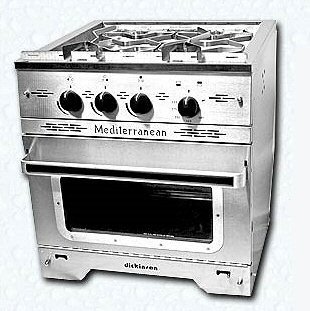
This is the benchmark three-burner gimballed propane range for boats over about 35 feet, and the honest reason to choose it is the oven. A crew that bakes bread, roasts, or wants a proper Sunday dinner offshore needs an oven, and Force 10's is sized and insulated for that job. The gimbal swings freely enough to stay level through real heel, and the pot fiddles hold cookware without babysitting. The catch is that the stove is the easy half of the project — the propane locker, regulator, solenoid and sniffer around it are the expensive half, covered below.
- Burners
- 3 sealed burners plus oven and broiler
- Mounting
- Gimballed with lock bar and pot fiddles
- Safety
- Thermocouple flame-out shutoff on burners and oven
- Construction
- 304 stainless steel body and trim
Pros
- Genuine oven and broiler in addition to the cooktop, so it replaces a full household range rather than just a burner
- Gimbal and pot fiddles are properly engineered for sustained heel, not an afterthought bracket
- Widely fitted on cruising boats for decades, so parts and service knowledge are easy to find
Cons
- Requires the full propane installation — dedicated vented locker, solenoid, sniffer — not just a stove swap
- Large footprint and weight, and the gimbal needs real clearance to swing on both tacks
Dickinson Caribbean Propane Cooktop
Best compact propane cooktop for smaller cruisers
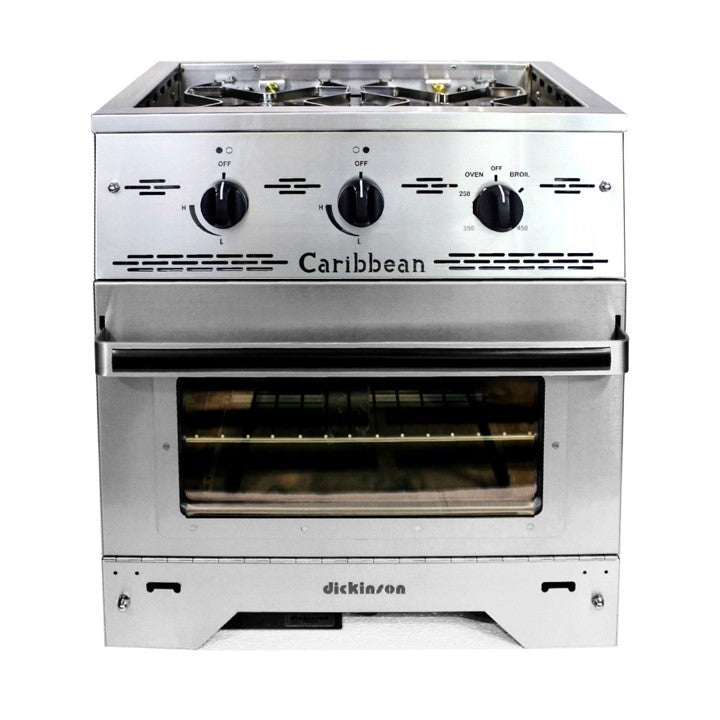
For a boat where a three-burner range simply will not fit the galley footprint, the Caribbean is the compact alternative that keeps the oven. Two burners cover a coffee pot and a single saucepan comfortably, and the oven turns out real baking rather than a warming function. It runs on the same low-pressure regulated propane as any marine stove, so it demands the same dedicated vented locker and shutoff — buying the smaller stove does not buy you a smaller safety installation.
- Burners
- 2 burners, roughly 11,000 and 7,000 BTU
- Oven
- Compact oven included on the full Caribbean range version
- Safety
- Flame-out protection on each burner
- Construction
- 304 stainless steel, drop-in or gimballed mounting options
Pros
- Smaller footprint than a full three-burner range, a realistic fit for boats in the 28-38 foot range
- Dickinson's build quality and finish hold up well to years of salt air
- Available as a drop-in cooktop or with a gimbal kit, so it fits both fixed and swinging installations
Cons
- Two burners only, which is tight if the crew cooks multi-pot meals underway
- Still needs the same full propane safety installation as a larger range — no shortcuts on the locker or solenoid
Dometic Origo 4100 Non-Pressurised Alcohol Stove
Best low-risk retrofit for small boats without a propane system
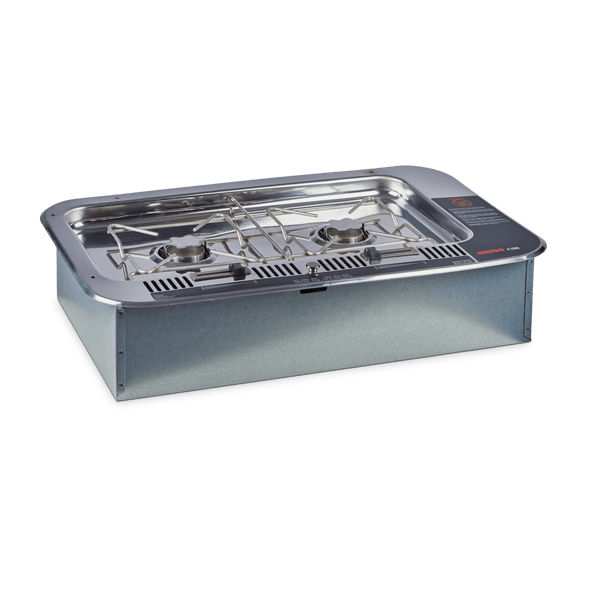
For a small boat, a weekend cruiser, or an owner who simply does not want propane aboard, the Origo is the honest low-risk answer. There is no tank pressure, no solenoid, no sniffer to install or fail — you pour fuel into a canister and light it. The trade-off is real: alcohol burns cooler than propane, so simmering is fine but boiling a big pot of pasta water takes patience. Before committing, check fuel availability on your actual cruising route, because denatured alcohol is not a universal marina staple the way propane and diesel are.
- Burners
- 2 burners, non-pressurised wick/canister design
- Fuel
- Denatured alcohol, poured directly into burner canisters
- Pressure
- None — no pump, no regulator, no line to fail
- Mounting
- Drop-in or gimballed mounting kit available
Pros
- No pressurised fuel system at all, which removes the entire propane leak and explosion risk chain
- Simple enough to install and maintain without a marine gas fitter
- An alcohol fire can be smothered with water, unlike a propane fire fed by an ongoing gas leak
Cons
- Meaningfully slower to boil and lower peak heat output than propane or diesel — plan on longer cooking times
- Denatured alcohol is not sold everywhere outside North America and Northern Europe, and running out mid-passage is a real planning problem
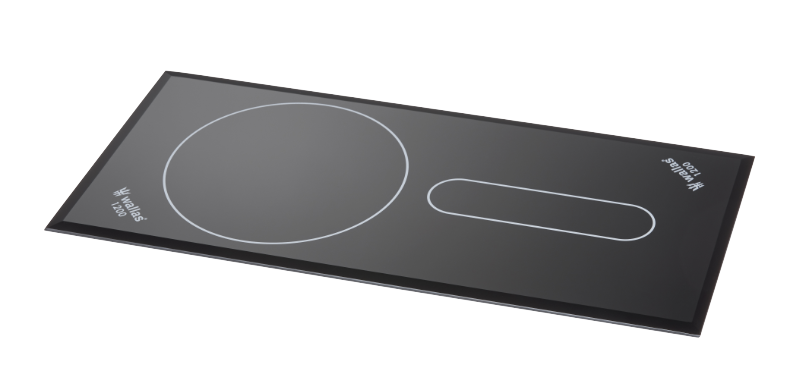
Wallas 1200D Diesel Cooktop
Best diesel stove for cold-climate cruisers who already carry diesel
Wallas diesel cooktops make the most sense on boats already committed to diesel for heating, most often higher-latitude cruisers who also run a diesel cabin heater — see our guide to <Link to="/guides/marine-diesel-heaters">marine diesel heaters</Link> for the parallel system. Pulling fuel from the same tank that runs the engine and heater removes an entire fuel category from the boat. The honest limitation is speed: diesel combustion is not as quick to respond as a propane flame, so meal planning shifts toward longer, gentler cooking rather than a fast boil.
- Output
- 1000-2200W, roughly 3,400-7,500 BTU
- Fuel
- Diesel, drawn from a small day tank or the main tank
- Power draw
- 12V DC for the fuel pump and ignition, low amperage
- Combustion
- Sealed combustion chamber, exhausted outside the cabin
Pros
- One fuel for engine, heater and stove eliminates carrying propane or alcohol at all
- Sealed combustion keeps combustion byproducts out of the cabin air, unlike an open flame
- Genuine heat contribution to the cabin in cold-climate cruising, useful beyond just cooking
Cons
- Noticeably slower to respond and to boil than propane — this is a simmer-and-plan cooktop, not a flash-boil one
- Installation is a real job: fuel line, dedicated exhaust routing, and a mounting location that tolerates the sealed housing
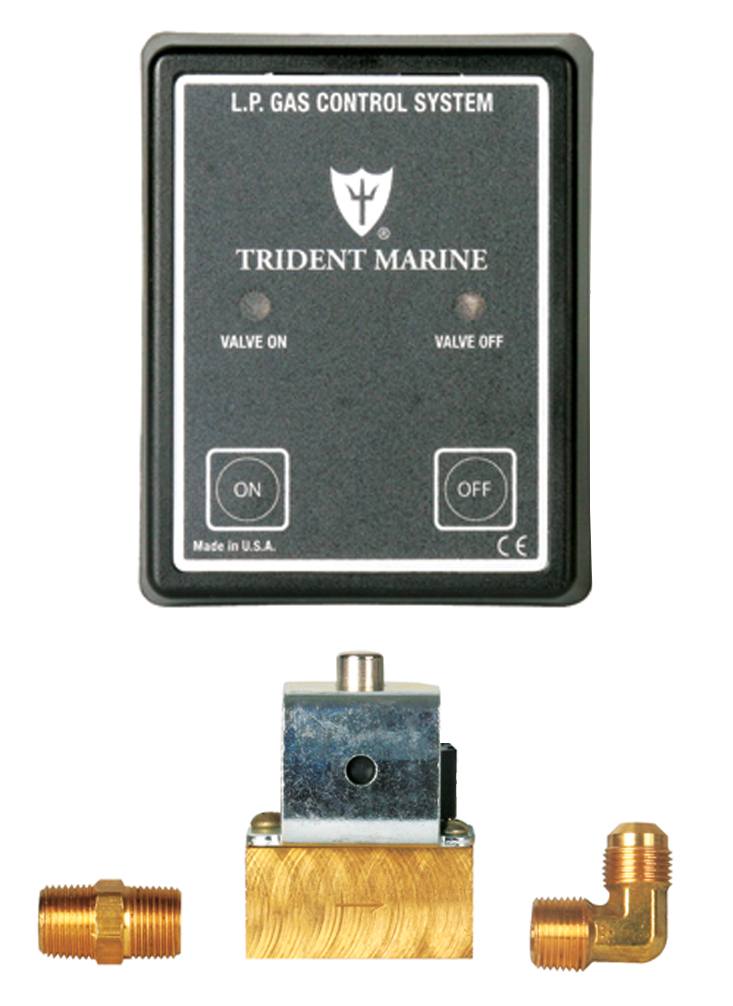
Trident Marine LPG Control & Solenoid Kit
Best way to bring an existing propane installation up to proper safety practice
If your boat has a bare propane installation with just a tank valve at the locker, this is the single highest-value safety upgrade available. The solenoid sits at the tank, the switch sits at the galley, and gas only flows when someone has deliberately turned it on — which is the behaviour that actually gets followed underway, unlike a valve buried in a cockpit locker. Buy the port size that matches your existing hose fittings, and wire it as part of a complete system alongside a sniffer, not as a standalone fix.
- Includes
- Galley control panel switch and 12V DC solenoid valve
- Function
- Remotely opens/closes gas flow at the tank end of the line
- Ports
- Available in 1/4" and 3/8" FPT versions — match your existing fittings
- Indicator
- Panel shows gas-on status so it is never left open unattended
Pros
- Turns a manual tank valve you have to walk to the locker for into a galley-side switch, so the gas is realistically shut off between uses
- Pairs with a sniffer/detector system for automatic shutoff on a gas alarm
- Inexpensive relative to the rest of a propane installation and the risk it manages
Cons
- The panel and solenoid alone are not a complete safety system — a proper installation still needs a vented overboard-draining locker and a sniffer
- Wiring the solenoid and running the control cable correctly requires care; a badly wired failure mode can leave gas on rather than off
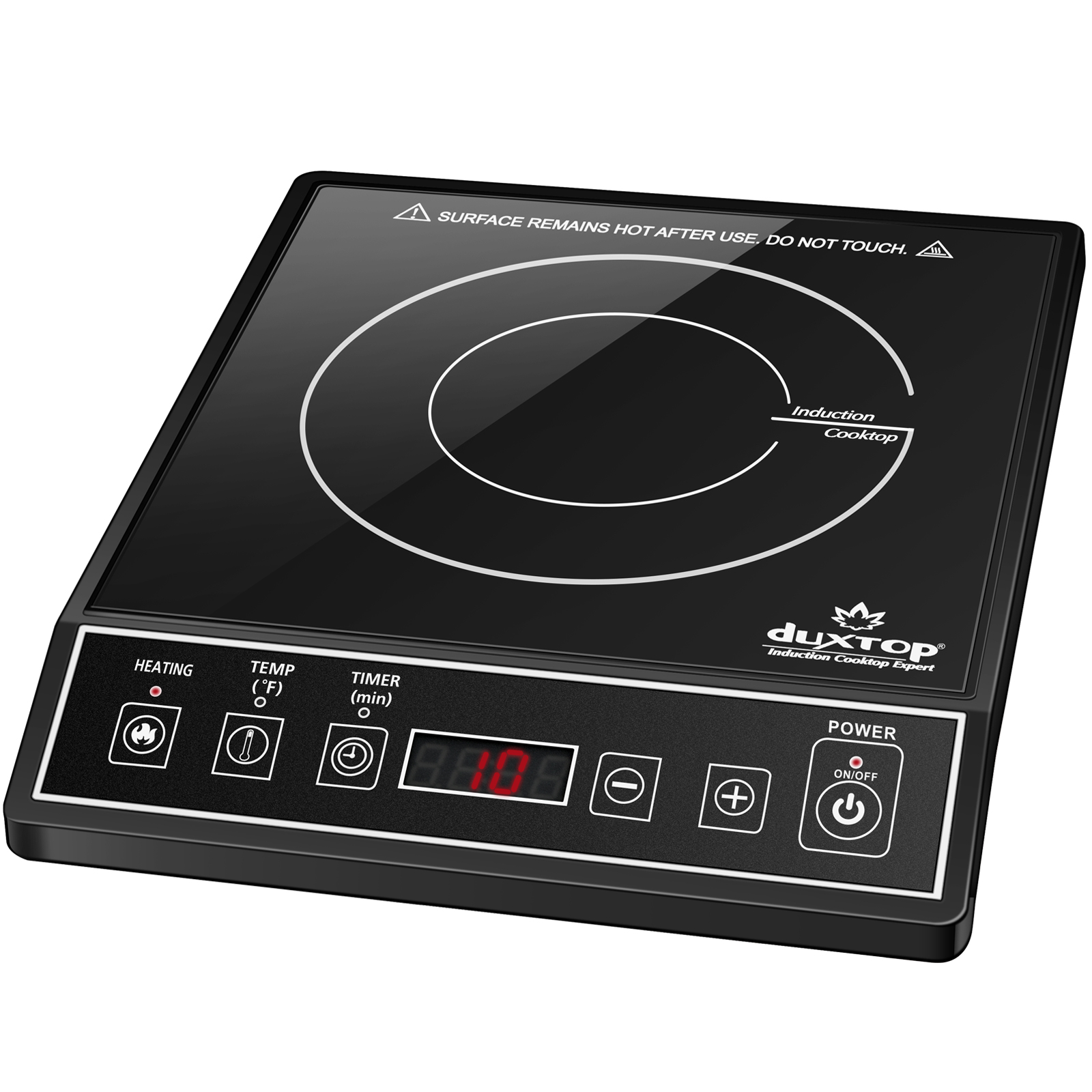
Duxtop Portable Induction Cooktop
Best no-flame cooking option for boats already running lithium and a capable inverter
Induction cooking on a boat is entirely a battery bank and inverter question, not a stove question. This unit is genuinely excellent at boiling water fast and holding a precise simmer, and it eliminates fuel storage entirely. But 1800W is a serious continuous draw, and most boats trying this on a modest lead-acid bank find it collapses voltage or trips the inverter within minutes. On a boat with 400Ah-plus of lithium and a 2000W-plus pure sine inverter, it is a legitimate primary or backup cooking method; on anything less, treat it as an occasional dockside convenience.
- Power
- 1800W, runs on a standard 120V/15A circuit through an inverter
- Controls
- 20 preset power levels and temperature settings
- Cookware
- Requires induction-compatible (magnetic) cookware
- Footprint
- Portable single-burner unit, stows in a locker when not in use
Pros
- No open flame, no combustion byproducts, no fuel to carry or refill at all
- Fast, efficient heat transfer directly into the pan rather than into the surrounding air
- Cheap enough to try as a supplement before committing to a full stove conversion
Cons
- A genuinely heavy load — 1800W briefly draws well over 100A from a 12V bank through the inverter, which most lead-acid systems cannot sustain
- Only practical on a boat with a substantial lithium bank and an inverter sized for the surge — see our guides to <Link to="/guides/best-lithium-batteries">lithium batteries</Link> and <Link to="/guides/marine-inverter-chargers">inverter chargers</Link> before buying one expecting it to be a primary stove
How to choose
Match the fuel to your cruising pattern first, then pick hardware within that fuel. The table below is a rough guide, not a substitute for checking availability on your actual route.
| Fuel | Heat output | Refill availability | Best for |
|---|---|---|---|
| Propane | Highest, fast response | Excellent worldwide | Most cruising boats with locker space |
| Alcohol | Moderate, slow response | Good in N. America/Europe, patchy elsewhere | Small boats avoiding pressurised gas |
| Diesel | Moderate, slow warm-up | Excellent — same as engine fuel | Cold-climate boats already running diesel heat |
| Induction/Electric | High, instant response | N/A — needs charged battery bank | Boats with a large lithium bank and inverter |
Budget tiers: a straightforward stove swap onto an existing compliant propane system typically runs $1,500-$3,000 installed. Adding or upgrading the full propane safety system — locker, regulator, solenoid, switch and sniffer — on a boat that lacks one commonly adds $2,000-$4,000 before labor. An alcohol stove retrofit is usually the cheapest option, often $500-$1,500 installed since it avoids the locker and plumbing work entirely. A diesel cooktop installation is comparable in complexity and cost to adding a diesel heater, often $2,500-$5,000 depending on fuel line and exhaust routing. Induction is the cheapest appliance by far but only economical if the battery and inverter capacity already exists — otherwise the electrical upgrade dwarfs the cost of the cooktop itself.
Frequently asked questions
Which galley fuel is safest for a sailboat?
Non-pressurised alcohol carries the lowest inherent risk because there is no pressurised fuel line to leak, and any spilled fuel can be extinguished with water. Diesel and induction are also low-risk once installed, since neither involves a pressurised flammable gas in the bilge. Propane can be made very safe with a correctly installed dedicated locker, solenoid and sniffer, but it is the fuel that punishes a shortcut installation most severely, because leaked propane is heavier than air and collects in the bilge where it can ignite.
Do I need a propane locker even for a small two-burner stove?
Yes. The stove size does not change the safety requirement — any pressurised LPG tank aboard needs to live in a dedicated, sealed locker that drains overboard rather than into the bilge, so that any leaking gas vents outside the hull instead of pooling below the cabin sole. This applies equally to a single-burner cooktop and a full three-burner range.
How much does a full propane system conversion cost versus just swapping the stove?
Swapping one propane stove for another of a similar size, using an existing compliant locker and plumbing, typically runs $1,500-$3,000 including the appliance and installation labor. Building or upgrading the full system — a proper vented locker, regulator, solenoid, galley switch, sniffer and new hose — on a boat that lacks one is a materially bigger job, commonly $2,000-$4,000 in parts and fittings before labor, and can exceed the cost of the stove itself. Budget for the system, not just the appliance, when a survey flags an existing installation as non-compliant.
Is diesel or induction better for a cold-climate cruiser?
Diesel wins if you already run a diesel cabin heater and want to consolidate onto one fuel with genuine ambient heat output as a side benefit of cooking — useful in high latitudes. Induction wins if you have a large lithium bank and inverter already installed for other loads and want to avoid diesel smell and exhaust routing in the galley. Neither is a fast-boil substitute for propane, so factor slower cooking times into passage planning either way.
What ventilation does a galley stove need regardless of fuel?
Any combustion appliance consumes cabin oxygen and produces carbon monoxide as a byproduct of incomplete combustion, so the galley needs a fresh air supply and, ideally, a dedicated exhaust path — a cowl vent, opening port, or powered extractor near the stove. A carbon monoxide detector in the saloon is inexpensive insurance regardless of fuel choice, and is essential if you run a diesel or propane stove with the boat closed up in cold or wet weather.
Can I gimbal any stove, or does it need to be designed for it?
Only stoves designed and rated for gimballing should be mounted on a swinging bracket — the burner, fuel connections and any pilot or ignition components need to tolerate continuous motion and a lock-out bar for use at the dock. Retrofitting a gimbal kit to a stove not designed for one risks fuel line fatigue and burner misalignment. Buy the gimballed version of the model from the outset if you intend to cook underway on a heel.
Do I need pot fiddles if my stove already gimbals?
Yes. The gimbal keeps the stove roughly level through heel, but pot fiddles are what stop a pot sliding off the burner during a sudden roll or tack. The two work together — a gimballed stove without fiddles will still spill boiling water in a beam sea.
Looking for more gear guides? Browse all our gear recommendations or the full guides index.