Sailboat Water Pumps: Fresh, Bilge and Washdown
For most cruising boats, the right setup is a Shurflo 4008 Revolution or Jabsco Par-Max 3 on fresh water, a Whale Gulper 220 on the shower sump, a Rule 1100 GPH submersible as the primary electric bilge pump, and a Whale Gusher 10 manual pump plumbed in as an independent backup before heading offshore. A boat has four or five different pumping jobs and no single pump type does them all well — the mistake most owners make is buying on GPM or GPH alone without matching the pump technology to the job.
This guide walks through the whole pump ecosystem: how diaphragm, impeller, centrifugal and manual pumps differ, why the numbers on the box overstate real performance once hose and head are accounted for, how to wire and protect each circuit properly, and the failure modes that take pumps out in the field. It pairs well with our guides to marine toilets, watermakers and marine refrigeration, since all three systems depend on some of the same pumping principles covered here.
Sailboat Atlas may earn a commission from qualifying purchases made through links on this page, at no extra cost to you.
Diaphragm vs impeller vs centrifugal vs manual diaphragm
A sailboat carries several genuinely different pump technologies, and confusing them is the root of most bad purchases. Diaphragm pumps use a flexing rubber or synthetic membrane to push water through one-way valves. They self-prime, tolerate running dry for short periods, and handle some debris — which is why they dominate fresh water pressure systems and washdown duty. Freshwater pumps like the Shurflo 4008 and Jabsco Par-Max are diaphragm pumps.
Impeller pumps use a flexible rubber vane impeller spinning inside an eccentric housing, and they are the standard for raw-water engine cooling and some washdown applications. They move a lot of water efficiently but the impeller vanes will overheat and shred within seconds if the pump runs dry — there is no tolerance for a clogged strainer here the way there is with a diaphragm pump.
Centrifugal pumps spin an impeller-like rotor to fling water outward by centrifugal force rather than positive displacement. They are simple, cheap, and tolerate a fair amount of debris passing through, which is exactly why submersible bilge pumps like the Rule 1100 use this design — bilge water is dirty and a centrifugal pump shrugs off grit that would jam a diaphragm.
Manual diaphragm pumps like the Whale Gusher 10 use the same membrane-and-valve principle as an electric diaphragm pump but are driven by a hand lever, so they need zero electrical power — the entire reason they exist as an offshore safety requirement.
GPM and GPH ratings vs what actually comes out the hose
Every pump is sold with a headline flow number — gallons per minute for pressure pumps, gallons per hour for bilge pumps — and that number is measured under close to ideal bench conditions: minimal lift, no hose, no fittings, often with the discharge wide open into free air. Installed on a real boat, flow drops for three reasons: static head (the vertical distance water has to be lifted), friction loss through corrugated bilge hose or long fresh-water runs, and restriction at fittings, thru-hulls and check valves.
The effect compounds. A 1100 GPH bilge pump lifting water three feet through ten feet of corrugated hose with a mitre-elbow fitting and a thru-hull check valve can easily deliver 500-650 GPH in practice — not far off half its rated figure. This is a widely observed rule of thumb across submersible centrifugal bilge pumps, not a defect in any particular brand. When you are sizing a pump to handle a plausible leak rate, size to the derated, installed number, and if in doubt, go up a size class rather than trusting the number on the box.
The same logic applies to freshwater pumps, though the practical effect is different: a 3 GPM pump feeding a long run to a stern shower with several fittings and a significant rise will deliver a noticeably weaker stream than the same pump on a short, straight run to a nearby galley tap. If a shower feels underpowered, check the hose run length and fitting count before assuming the pump has failed.
Accumulator tanks, pressure switches and pump cycling
A demand-type freshwater pump switches on when a pressure switch senses pressure drop (someone opens a tap) and off again when pressure is restored. Without any buffer, a partly open tap — the way most people actually run a faucet — causes the pump to cycle on and off rapidly, which is noisy, causes voltage spikes on the wiring, and wears the diaphragm and switch contacts faster than steady running would.
An accumulator tank solves this by storing a small volume of pressurised water (often behind an internal air bladder) that absorbs small flow changes without triggering the pump. With one fitted, the pump runs in longer, less frequent bursts and the system feels smoother at the tap. Many modern pumps, including the Shurflo Revolution series, include a basic internal bypass that achieves a similar smoothing effect without a separate tank, but a dedicated accumulator still noticeably improves multi-tap systems and is worth adding on any boat with more than one head or a transom shower.
Strainers, self-priming and why dry-running kills pumps
Every raw-water intake — for a washdown pump, a watermaker feed, engine cooling or a head — needs a strainer ahead of the pump, sized to catch debris without restricting flow so much that the pump starves. A clogged strainer is one of the most common on-the-water pump failures, and it is entirely preventable with a quick visual check before a passage and a proper clean at haul-out.
Self-priming matters because most pumps on a boat are mounted above the water they are lifting, at least briefly, and need to pull air out of the line before water arrives. Diaphragm pumps handle this well and most can run dry for short periods without damage. Impeller pumps cannot: an impeller spinning without water to lubricate and cool the rubber vanes will overheat and disintegrate within seconds, which is why an engine raw-water strainer getting sucked dry — by a clogged strainer, a closed seacock, or a fouled intake — is a genuine emergency, not a minor nuisance.
Float switches vs solid-state sensors for bilge pumps
A traditional float switch is a mechanical arm that rises with water level and closes a circuit at a set height. It is simple, cheap and easy to test by hand, but the pivot and switch mechanism can jam with debris, corrode, or get pinned down by items that migrate into the bilge over time — a classic failure mode is a float switch stuck in the "off" position by a stray sock or wire tie.
Solid-state sensors, used in pumps like the Rule automatic 1100 GPH models, have no moving parts and instead periodically energise the pump briefly to test for water resistance across sensor contacts. This eliminates the mechanical jamming failure mode but introduces a different one: corroded or fouled sensor contacts can fail to detect water that is actually present. Neither technology is failure-proof, which is the practical argument for running a float switch and a solid-state pump as independent backups of each other in a boat's main bilge, rather than relying on either alone.
Wiring, fusing and continuous-duty draw
Bilge pumps and washdown pumps both draw significant current and, unlike a winch motor, a bilge pump may need to run continuously for an extended period during an actual flooding event — this is a continuous-duty load, not a brief surge, and the wiring has to be sized accordingly rather than for a quick intermittent draw. Undersized cable causes voltage drop at the pump, which reduces both flow and motor life.
Every pump circuit needs its own correctly rated fuse or breaker sized to the cable, not just the pump's nameplate draw, and bilge pump circuits are usually wired directly to the battery ahead of the main battery switch — with their own fuse close to the battery — so the pump keeps running even if the main switch is turned off. Corroded terminals are a quiet, common failure point in this circuit specifically because bilge and pump wiring lives in a wet, salty environment; use tinned marine wire, adhesive-lined heat-shrink terminals, and inspect connections annually.
A manual backup bilge pump: the offshore requirement
Electric bilge pumps depend on a chain of things that can all fail at once in a genuine emergency: the battery, the wiring, the switch or sensor, and the pump motor itself. A serious ingress of water is exactly the scenario most likely to compromise several of those simultaneously — flooding can short wiring, and the pump itself may simply not have the flow to keep pace with a real breach. This is why a manual bilge pump completely independent of the boat's electrical system, permanently plumbed with its own large-diameter hose and ready to operate immediately, is close to a universal requirement in offshore racing and safety category rules, and standard seamanship on any boat leaving protected waters.
Mount it where it can be operated from a companionway or cockpit locker without opening the boat further to the sea, plumb it with dedicated hose rather than sharing a line with an electric pump, and make sure every crew member knows where it is and how to use it before they need to find out under pressure. If you're also reviewing offshore safety gear more broadly, our guide to life rafts covers the rest of that equipment list.
Winterising and common failure modes
Winterising a freshwater system means draining the tank and lines, then running non-toxic (propylene glycol) antifreeze through the system until it appears at every outlet, including showers and any deck washdown fed from the tank, so nothing is left to freeze and crack a pump housing or fitting. Bilge and sump pumps in a boat that stays above freezing generally need no special winter treatment beyond draining standing water from the sump.
The recurring failure list across every pump type on a boat is short and mostly preventable: a torn diaphragm from age and cycling, a seized or shredded impeller from a moment of dry running, a clogged strainer starving the pump of flow, a chafed or kinked discharge hose restricting output right when it is needed most, and corroded terminals causing an intermittent or dead circuit. A basic annual inspection covering all five of these catches the large majority of pump failures before they happen at sea rather than at the dock.
Our picks
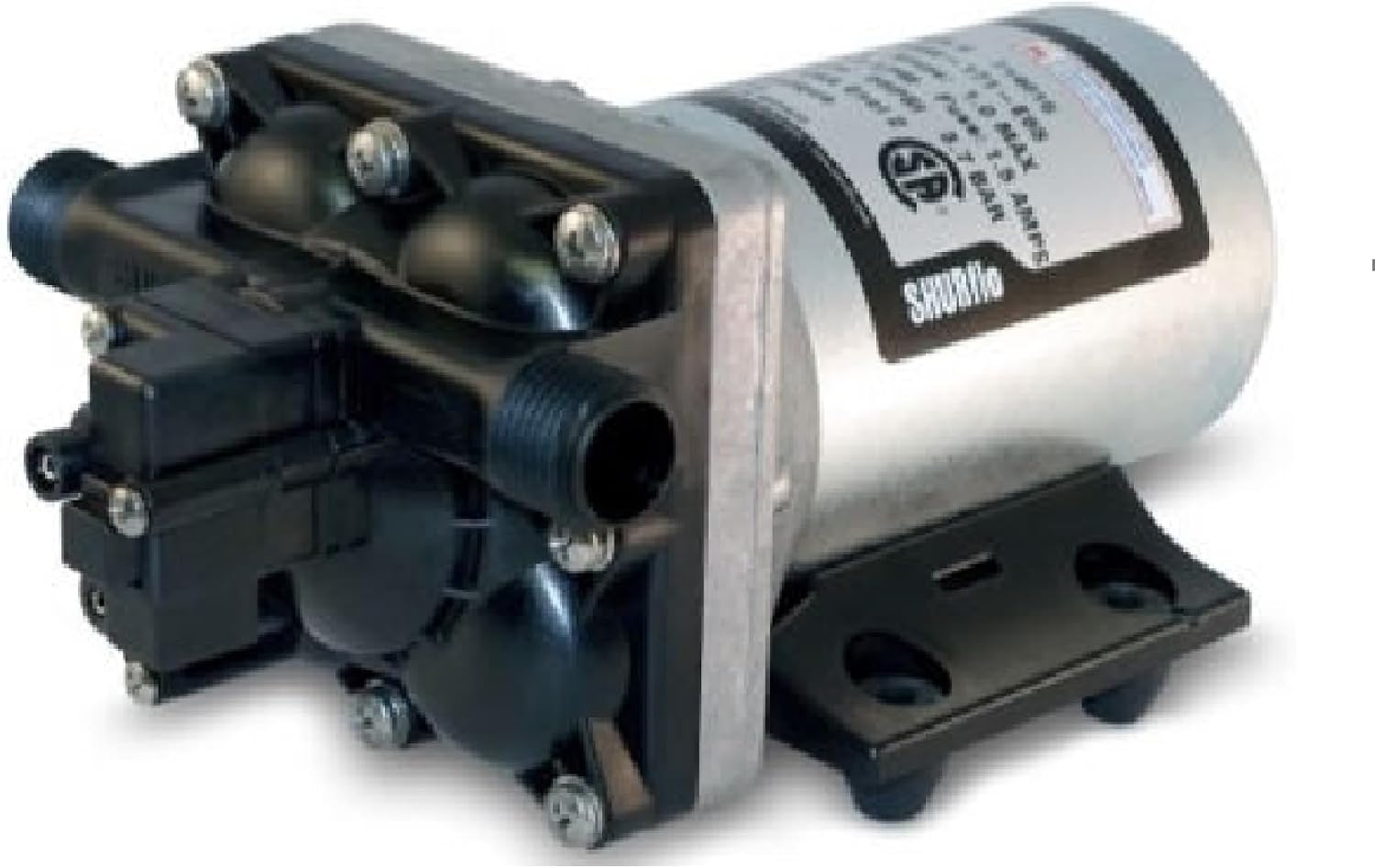
Shurflo 4008 Revolution Freshwater Pump
Best all-around 12V pressure pump for a cruising boat's fresh water system
This is the pump most boats already have, and for good reason: it is inexpensive, self-priming, and its internal bypass keeps it from hammering on and off every time someone opens a tap partway. Pair it with a small accumulator tank and it will run a shower and a galley faucet without drama. Buy the rebuild kit when you buy the pump — diaphragms and valves are consumables, not lifetime parts, and a spare kit costs a fraction of a service call in a marina.
- Type
- Self-priming diaphragm, demand-controlled
- Flow
- 3.0 GPM rated open-flow
- Pressure
- 55 PSI shut-off, internal bypass for low-cycling
- Draw
- Up to 7.5A at 12V; self-primes to about 6 ft of lift
Pros
- Internal bypass genuinely reduces short-cycling compared with older demand pumps
- Widely stocked, so a replacement is rarely more than a phone call away in most cruising grounds
- Runs dry without damage if a tank empties unexpectedly
Cons
- 3.0 GPM rated flow is a best-case bench number — expect noticeably less at the tap after head and hose losses
- Diaphragms are a wear item and will eventually need replacing, typically every few years of regular use
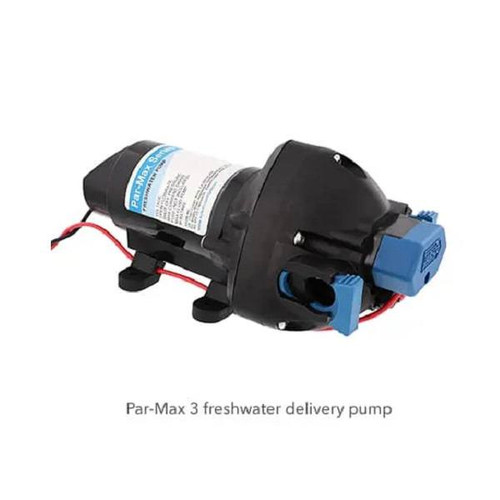
Jabsco Par-Max 3 Freshwater Pump
Best higher-pressure alternative for longer plumbing runs
Par-Max pumps are the other default choice, and the 40 PSI version is worth the extra draw on boats with a long plumbing run to a stern shower or watermaker feed, where a 25-30 PSI pump loses too much pressure by the time water reaches the outlet. Quick-connect ports make it one of the easier pumps to swap without cutting hose. Note this is a different pump family from the 29000-series raw water pumps used elsewhere on some engines, so double-check the model before ordering parts.
- Type
- Self-priming diaphragm, demand-controlled
- Flow
- 3 GPM rated
- Pressure
- 25 or 40 PSI models, 12V or 24V
- Fittings
- Quick-connect ports for straightforward hose changes
Pros
- Higher-pressure variants push water further through long runs to a distant transom shower or aft head
- Quick-connect fittings make swapping a failed pump a same-afternoon job
- Available in 24V, useful on boats without a 12V house circuit for accessories
Cons
- Higher pressure models draw more current and cycle harder if a pressure switch or accumulator isn't sized to match
- Parts commonality with Shurflo is limited, so carry Jabsco-specific spares rather than assuming interchangeability
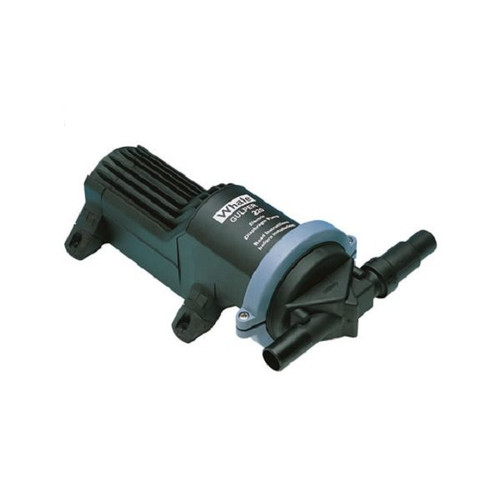
Whale Gulper 220 Waste/Shower-Sump Pump
Best pump for shower sumps and grey water that clogs ordinary bilge pumps
A standard centrifugal bilge pump in a shower sump is a maintenance headache: hair and soap wrap the impeller and it clogs within a season. The Gulper's valve design was built specifically for this job and shrugs off the debris that kills other pumps. It belongs in every shower sump and is equally useful for pumping out a galley sink sump or a small grey-water holding tank. It is not a substitute for a real bilge pump — size it for what it is, a sump and waste-water specialist.
- Type
- Self-priming diaphragm pump with Gulper valve technology
- Flow
- Up to about 14 L/min (3.7 US GPM)
- Mounting
- Installs vertically or horizontally in tight lockers
- Fuse
- Manufacturer-recommended 10A circuit
Pros
- Non-clog valve design handles hair, soap scum and gel that jam impeller bilge pumps within weeks
- Runs dry without damage, which matters in a shower sump that cycles on and off constantly
- Compact enough to fit the tight lockers most shower sumps live in
Cons
- Not a high-volume bilge pump — it is sized for sump and grey-water duty, not emergency dewatering
- Diaphragm and valve service parts are Whale-specific and worth keeping a spare set of
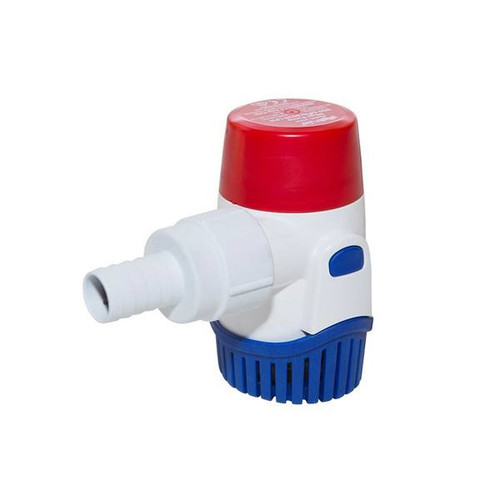
Rule 1100 GPH Submersible Bilge Pump
Best primary electric bilge pump for a mid-size cruising boat
This size class is the workhorse automatic bilge pump on most cruising boats, and it is worth understanding why the number on the box is misleading. Rated GPH is measured with no vertical lift and no hose restriction; once you add a few feet of head and ten feet of corrugated hose with fittings, real delivered flow drops substantially — a rule of thumb worth remembering is that actual installed flow often runs at roughly half the rated figure. Size your pump and count on the lower number when deciding whether it can keep up with a plausible leak.
- Rated flow
- 1,100 GPH at open, no-head bench conditions
- Real installed flow
- Commonly closer to 500-650 GPH once lift and hose runs are accounted for
- Activation
- Automatic float-switch or solid-state sensing versions available
- Cycle check
- Automatic models test for water roughly every 2.5 minutes
Pros
- The 1100 GPH class is a sensible middle ground for boats in the 30-45 ft range as a primary automatic pump
- Submersible design is simple to mount low in a sump with no separate strainer housing to maintain
- Widely available worldwide, so a same-size replacement is rarely hard to find
Cons
- The GPH rating on the box is a marketing number from a lab bench — plan your bilge capacity around the derated, installed figure, not the label
- A submersible centrifugal pump is not a substitute for a manual backup pump required for serious offshore flooding
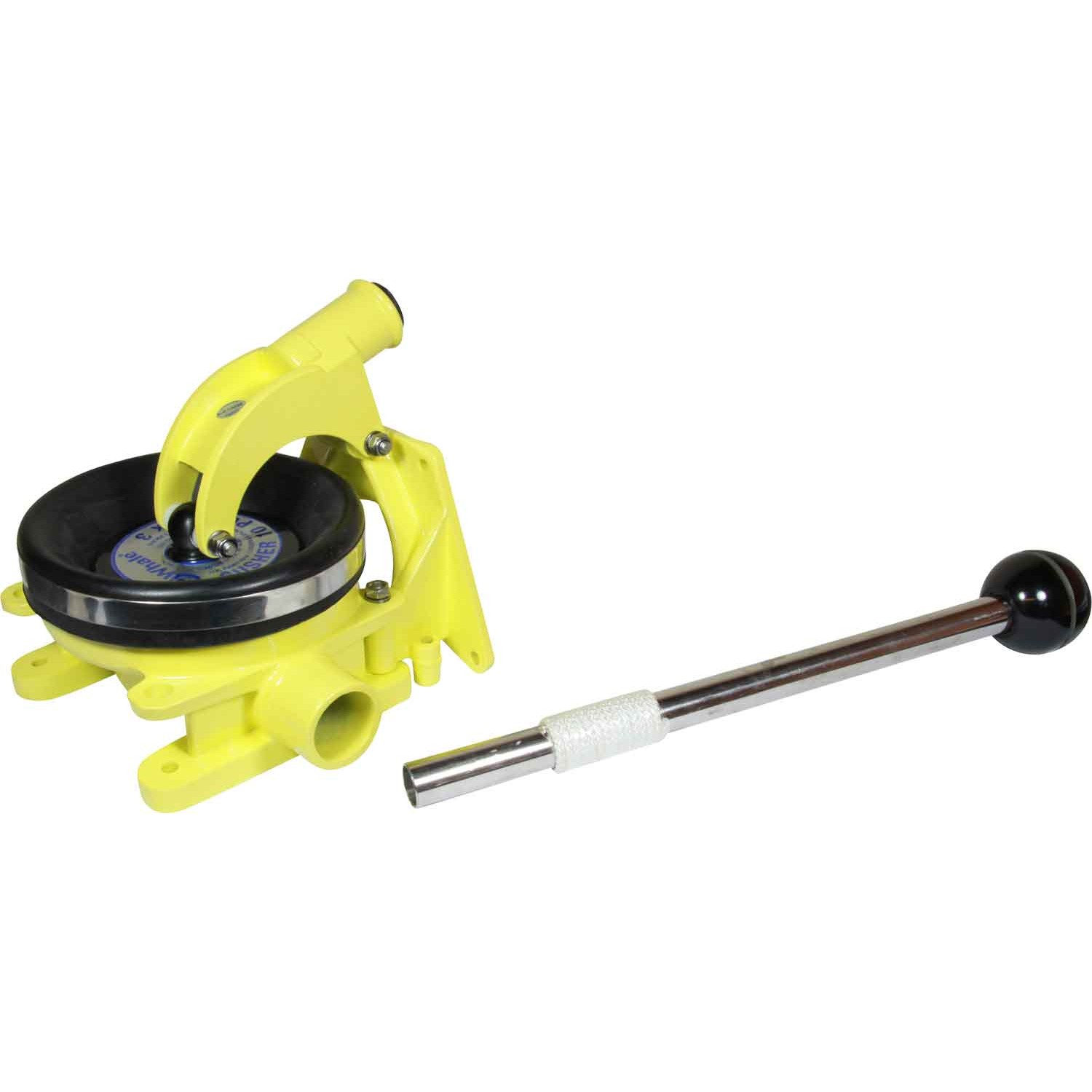
Whale Gusher 10 Manual Bilge Pump
Best manual backup pump for offshore passages
Offshore rules and plain seamanship both point the same direction: every boat leaving sight of land needs a manual bilge pump completely independent of the battery, and it needs to be plumbed and ready before it is needed, not dug out of a locker mid-emergency. The Gusher 10 is the class-standard choice at this size, moving real volume by hand when electric pumps have failed, lost power, or simply cannot keep pace. Mount it somewhere it can be worked from the cockpit or companionway without opening the boat further to the sea.
- Flow
- Up to about 17 US GPM (65 L/min) by hand
- Construction
- Long-life diecast alloy body
- Mounting
- On-deck or thru-deck/bulkhead versions
- Valves
- High-flow, non-choke valves with no filter to clog
Pros
- Diaphragm design moves debris-laden bilge water that would jam a smaller manual pump
- Works with zero electrical power, which is the entire point of carrying one offshore
- Diecast alloy construction has a long service record on serious bluewater boats
Cons
- Physically demanding to operate for any length of time in a real flooding scenario
- Needs a permanently plumbed, dedicated large-diameter hose run to be useful in an emergency, which is a real installation project
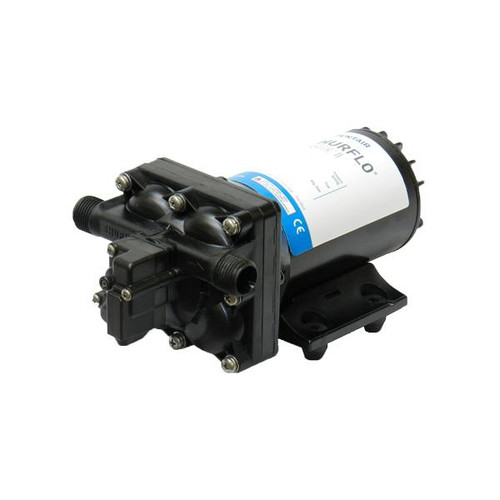
Shurflo Blaster II Washdown Pump Kit
Best deck washdown pump for anchor and chain cleaning
A dedicated washdown pump earns its keep the first time you retrieve fifty feet of chain out of soft harbour mud. Running that job off your fresh water pressure pump is a bad idea twice over — it drains the tank in minutes and it is not sized for the flow and pressure a proper rinse needs. This kit is sized correctly and includes the nozzle and strainer to get raw water on deck without makeshift plumbing. Fit a dedicated strainer on the intake, since chain lockers and anchor mud are exactly the debris this pump needs protecting from.
- Type
- Self-priming diaphragm washdown pump
- Flow
- 3.5 GPM
- Pressure
- 45 PSI
- Kit contents
- Pump, nozzle, strainer and fittings; coiled hose sold separately or in deluxe kits
Pros
- Purpose-built pressure and flow for blasting mud off chain and anchor rather than a repurposed fresh water pump
- Thermally protected and tolerates running dry briefly without damage
- Straightforward 3/4-inch fittings make plumbing to a dedicated raw-water washdown line simple
Cons
- Needs its own raw-water strainer and thru-hull, which is a real installation task, not a drop-in accessory
- Running it off the fresh water tank instead of raw water burns fresh water fast when cleaning a muddy chain
How to choose
Match the pump to the job rather than shopping on flow rate alone. The table below is a quick reference for which technology and pick suits which task.
| Job | Pump type | Our pick |
|---|---|---|
| Fresh water pressure system | Self-priming diaphragm | Shurflo 4008 Revolution / Jabsco Par-Max 3 |
| Shower or galley sump | Non-clog diaphragm | Whale Gulper 220 |
| Primary automatic bilge | Submersible centrifugal | Rule 1100 GPH |
| Offshore backup bilge | Manual diaphragm | Whale Gusher 10 |
| Deck and chain washdown | High-pressure diaphragm | Shurflo Blaster II kit |
Budget tiers. A basic single freshwater pump plus a submersible bilge pump is typically $150-$300 in parts for a small coastal boat. Adding a shower sump pump and an accumulator tank pushes a mid-size cruiser into roughly $400-$700 across the whole fresh and grey water system. Outfitting for serious offshore work — a manual backup pump properly plumbed, redundant bilge sensing, and a dedicated washdown circuit — is realistically $800-$1,500 in pumps and hardware before installation labour, which is often the larger cost given the hose runs and thru-hulls involved.
Frequently asked questions
Why is my bilge pump's rated GPH so much higher than what it actually pumps?
Bilge pump flow ratings are measured on a bench with the pump discharging straight up with no hose, no fittings and minimal lift — essentially the best possible conditions. Once installed with several feet of vertical head, a length of corrugated hose, a seacock and a thru-hull fitting, real delivered flow commonly drops to roughly half the rated number. When sizing a pump for a bilge, plan around that derated figure, not the number printed on the box.
Do I need an accumulator tank for my freshwater pump?
Not strictly, but it makes a real difference to comfort and pump life. Without one, a demand pump cycles on and off every time flow through a partly open tap changes, which is noisy and increases wear. A small accumulator tank stores a little pressurised water and smooths out those cycles, so the pump runs less often and for longer, steadier bursts.
Float switch or solid-state bilge sensor — which is better?
Mechanical float switches are simple, cheap and easy to diagnose, but the moving arm can jam with debris or corrode over years of wet-bilge life. Solid-state sensors have no moving parts and check for water periodically rather than relying on a float lifting, which makes them more reliable long-term, though they generally cost more and depend on clean sensor contacts. Many bluewater boats run one of each pump type as redundancy rather than relying on a single detection method.
Is a manual bilge pump actually required, or just recommended?
Requirements vary by flag state, class society and race organiser, but a manual bilge pump completely independent of the boat's electrical system is close to universal offshore practice and is required outright under many offshore racing and safety category rules. Independent of any rule, it is basic seamanship: electric pumps fail with the battery, the wiring, or the switch, and a flooding boat cannot wait for a fix.
How do I winterise my boat's water pumps?
For the freshwater pressure pump, drain the fresh water tank and lines, then run non-toxic antifreeze through the system until it appears at every tap, including the shower and any deck washdown outlet fed from the tank. Bilge and sump pumps generally don't need antifreeze if the boat stays above freezing, but if the bilge can freeze, drain standing water from the sump and disconnect or elevate the pump so no water sits inside the housing over winter.
What causes most sailboat pump failures?
The recurring list is short: a torn or perished diaphragm in demand pumps after years of cycling, a seized or melted impeller in centrifugal and raw-water pumps that ran dry even briefly, a clogged intake strainer starving the pump of flow, a chafed or kinked discharge hose restricting output, and corroded wiring terminals causing intermittent or weak operation. A basic annual inspection — strainers, hose clamps, terminal crimps and a visual check of the diaphragm or impeller — catches most of these before they become an emergency.
Looking for more gear guides? Browse all our gear recommendations or the full guides index.