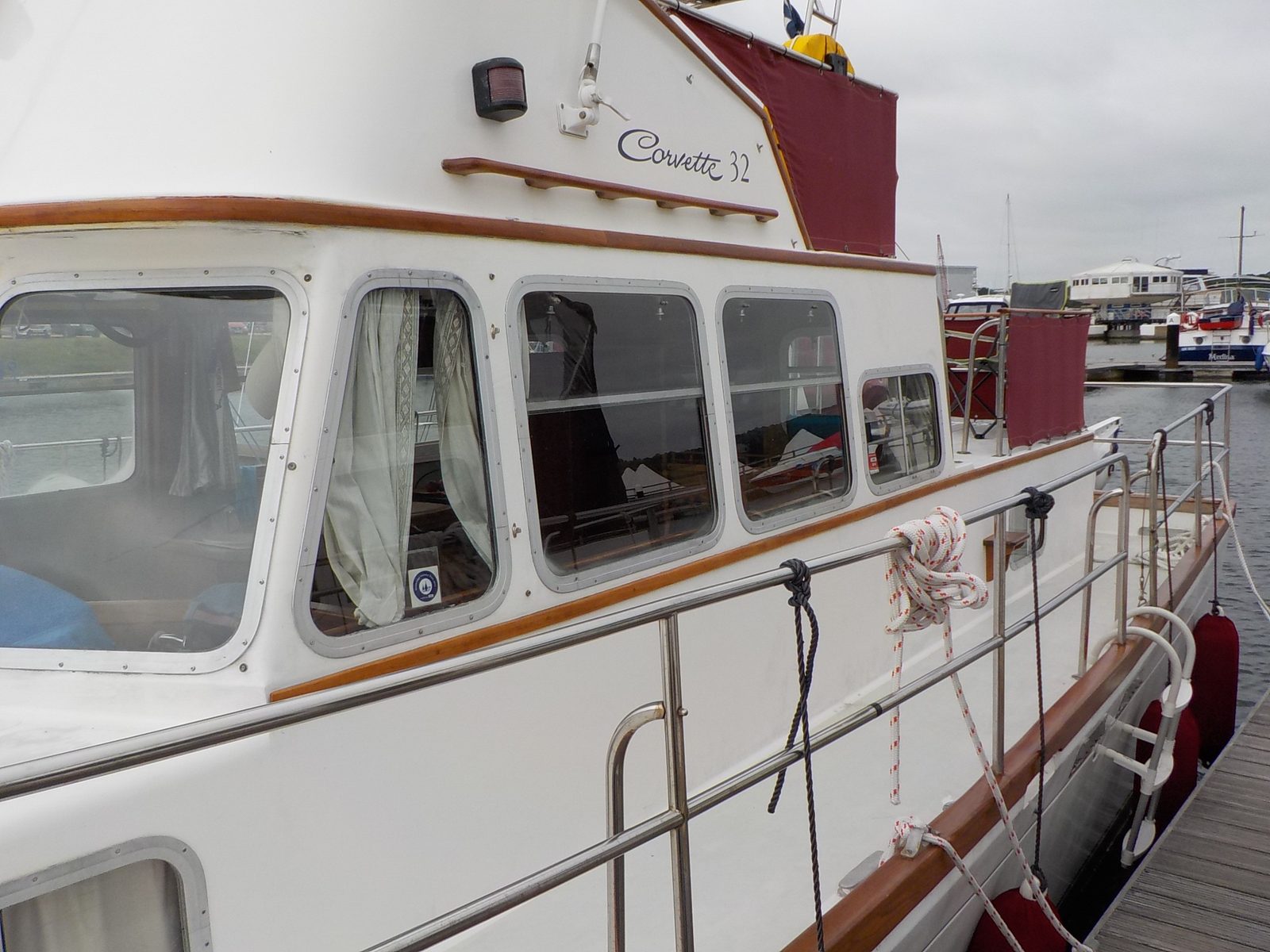
Trawlers vs Motorsailers vs Sailboats: Can You Really Cross an Ocean?
A sailboat is the only one of the three that crosses an ocean without a plan for fuel. A long-range trawler can do it if — and only if — it was built with the tankage, typically 1,000 US gallons or more on a 45-50 ft hull. A motorsailer sits between the two and will cross under sail with the engine as a genuine, frequently used backup. Everything else in this comparison is detail.
That detail matters, though, because the three types diverge sharply in running cost, motion at sea, and what your crew can actually tolerate for three weeks. This guide covers fuel burn and range in real numbers, what each hull form does in a seaway, and three specific boats that illustrate the tradeoffs.
Sailboat Atlas may earn a commission from qualifying purchases made through links on this page, at no extra cost to you.
The range problem: why fuel, not seaworthiness, decides it
Most people frame this as a safety question — is a trawler strong enough for the North Atlantic? The wrong question. Plenty of trawlers are built heavily enough to handle weather that would frighten their owners. The binding constraint is arithmetic. A passage from the Canaries to the Caribbean is roughly 2,700 nautical miles. A 40 ft trawler making 6 knots and burning around 2 gallons an hour needs about 900 gallons of diesel to cover it with no reserve at all, and no competent skipper crosses without a 20-30% reserve for weather routing and headwinds.
Boats designed for that mission exist — the Nordhavn 40 and its peers carry the tankage and the redundancy deliberately. The far more common coastal trawler with 300-500 gallons simply cannot, and the workarounds owners use (deck bladders, jerry cans lashed on deck) add weight high up and introduce a fuel-contamination risk exactly when you least want one. A sailboat has no equivalent problem. It carries fuel for harbour manoeuvring, calms and charging, and the ocean provides the rest.
Fuel burn compared, using real logged numbers
Published fuel-consumption figures are close to useless because they come from flat water, clean bottoms and optimistic sea trials. Cruisers' own logs are better. One owner of a 52,000 lb, 56 ft displacement sailing hull reports 6 knots on 1.1 US gallons per hour — about 6 miles per gallon — and 7.8 knots on 2.4 gallons per hour, roughly 3.25 mpg. The same pattern shows up on smaller boats: a 41 ft sailboat logged over years averaged about 8 mpg under power.
By contrast, a 40 ft trawler at 6 knots is usually reckoned at around 3 mpg. Over 12,000 motored miles that difference works out to roughly $8,300 of diesel on the sailboat against about $22,200 on the trawler — the owner who published those figures calculated the gap at about $1,700 a year, or 3% of a cruising budget. Treat these as illustrative ranges from real logs, not laboratory constants: hull form, prop, bottom condition and sea state move them substantially.
Two things surprise people in that data. First, a heavy sailing hull under power is genuinely fuel-efficient — a fine-ended displacement hull pushes easily at 6 knots. Second, the trawler's fuel penalty, while large in absolute dollars, is a smaller slice of the total cruising budget than most sailors assume. Dockage, insurance, haul-outs and maintenance dominate both columns, a point our ownership cost breakdown goes into.
Motion at sea: the thing your crew actually remembers
A sailboat under sail is the most comfortable of the three on passage, and this is not romanticism. Sail pressure damps roll. A boat heeled 15 degrees on a steady reach has a predictable, sustained motion that people adapt to within a day or two. The same boat motoring in a leftover swell with no sail up rolls sharply and unpredictably, which is exactly why sailors set a reefed main even when they are motoring — the steadying effect is worth more than the extra half-knot.
A trawler has no sail to damp it, which is why serious passagemaking trawlers carry paravane stabilisers ("flopper-stoppers") or active fin stabilisers. Both work. Both add cost, complexity and drag, and fins need a working hydraulic system. Without stabilisation, a beam sea on a round-bilged trawler produces a roll period that exhausts a crew inside 24 hours.
The motorsailer's pitch is exactly this: enough rig to steady the boat, enough engine to keep a schedule. In practice it delivers when the rig is real and the displacement is high. A motorsailer whose "sail plan" is a small main and a roller headsail that cannot drive the hull in under 15 knots of wind gives you a trawler with two extra maintenance items bolted on.
What each type costs to keep, not just to buy
Purchase price is the least interesting number. A sailboat carries the standing and running rigging bill — figure a full standing rigging replacement every 10-15 years, in the $6,000-$15,000 range on a 40-footer, plus sails that wear out on a similar cycle. A trawler avoids those entirely but usually has more engine: twin diesels mean twice the oil changes, twice the impellers, twice the injector service, and a much larger repowering bill when the time comes, which our repowering guide sizes up.
Trawlers also tend to carry more systems as standard — a generator, air conditioning, sometimes a watermaker and washer-dryer — because the electrical budget allows it. Each is a genuine comfort and each is an annual service line. Motorsailers get the worst of both columns on paper: rig maintenance plus a larger engine. What saves them is that the rig is usually simple and heavily built, and the engine, while bigger, is normally a single unit rather than a pair.
Insurance is the quiet differentiator. Underwriters price ocean passages on crew experience and boat condition more than hull type, but they will ask hard questions about fuel range on a motor vessel and about rig age on a sailboat. Our insurance guide covers what they actually look for.
Redundancy: the argument sailors win
On a sailboat, a total engine failure 1,500 miles from land is an inconvenience. You sail on, you arrive later, and you probably enter the destination harbour under tow or under sail. On a single-engine trawler, the same failure is an emergency requiring rescue or salvage. This is why serious passagemaking motor vessels carry either twin engines or a get-home system — a wing engine or a hydraulic drive off the generator. That redundancy costs real money and real space.
It also cuts the other way. A dismasting on a sailboat mid-ocean is a genuine crisis, and boats have been lost to it. The difference is frequency: rigs fail far less often than fuel systems, and a well-maintained rig inspected annually is among the more predictable systems on a boat. Both types reward the same discipline — replace things on a schedule rather than on failure.
Who should choose which
Choose a sailboat if the crossing itself is part of the appeal, if the budget is limited, or if you want the option to keep going indefinitely without a fuel budget dictating the route. This covers the large majority of people who ask the question.
Choose a trawler if you are coastal cruising the Great Loop, the Inside Passage or the Intracoastal Waterway, where a rig is a liability under bridges and motoring is the plan anyway — and accept that an ocean crossing means either a purpose-built long-range hull or shipping the boat.
Choose a motorsailer if you sail shorthanded or with a crew whose tolerance for heel is limited, and you want a boat that will make a schedule in light airs without guilt. Buy one with genuine displacement and a real rig, and read the sail plan sceptically before you believe the brochure.
Our picks
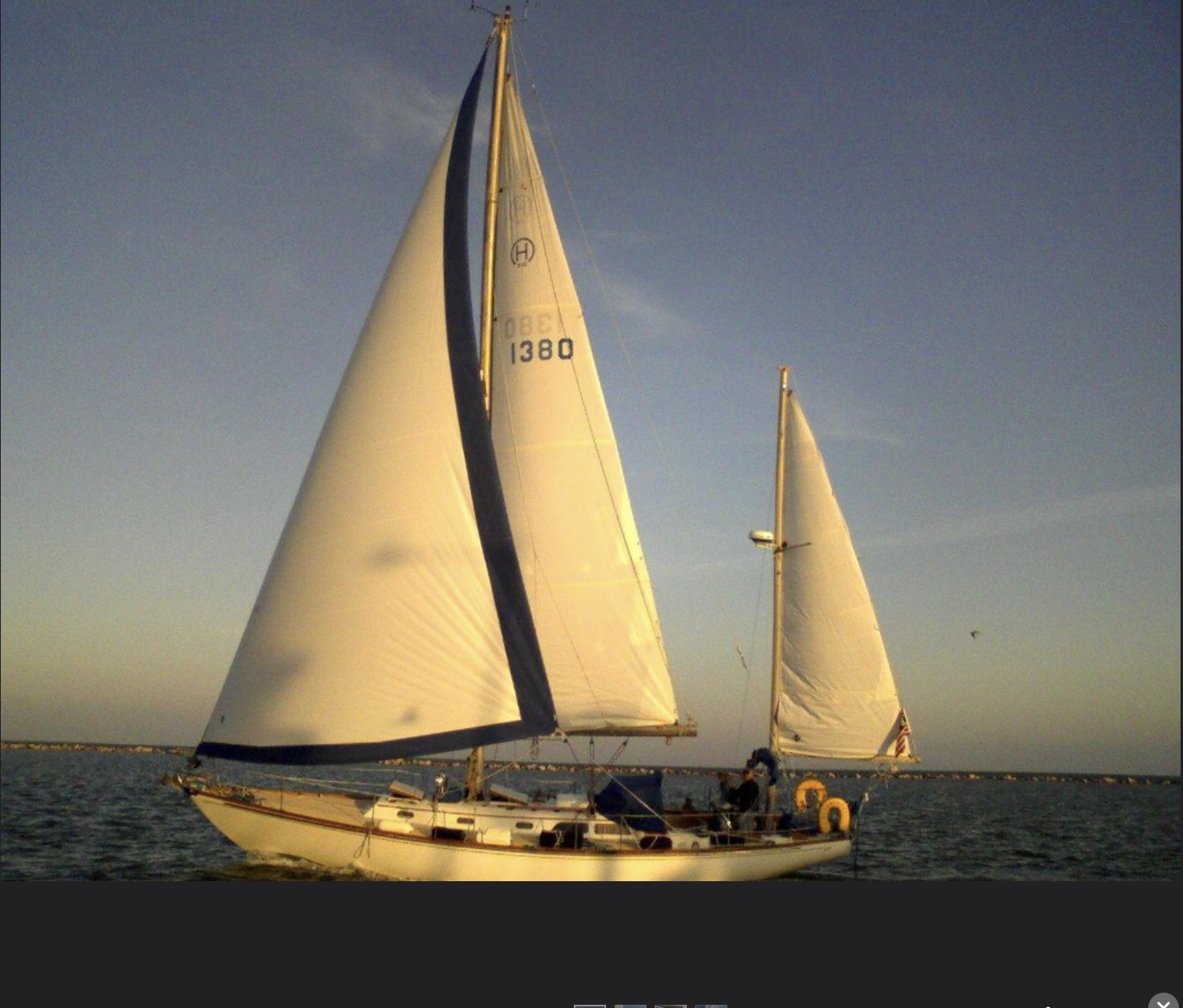
Hinckley Bermuda 40
Best classic motorsailer-style cruiser that genuinely sails well
The Bermuda 40 is the boat people mean when they say a sailboat can be civilised without becoming a motorboat: heavy, beautifully finished, with a diesel auxiliary that will push her at hull speed all day when the wind dies. It is the honest answer to anyone drawn to a motorsailer for comfort — you get the comfort without giving up the sailing. Skip it if your budget is under six figures or if 4' 3" board-up draft is still too deep for your home waters; the hull is heavy enough that thin-water cruising is a compromise, not a superpower.
- LOA / LWL
- 40' 9" / 27' 10"-28' 10" depending on Mark
- Beam / Draft
- 11' 9" / 4' 3" board up, 8' 7" board down
- Displacement
- 19,000-20,000 lb, 6,500-7,000 lb lead ballast
- Built
- 1959-1991, Henry R. Hinckley & Co., 203 hulls, designed by William Tripp Jr.
Pros
- Centreboard yawl rig gives you a shoal-draft cruiser that still points respectably
- Built to a standard almost nobody matches today, and hulls from the 1960s are still crossing oceans
- Strong owner community and a factory that still supports the boats
Cons
- Brokerage prices have held at roughly $135,000-$195,000, so this is not a bargain entry into cruising
- Centreboard trunk and pennant are a recurring maintenance item, and a neglected one is an expensive yard job
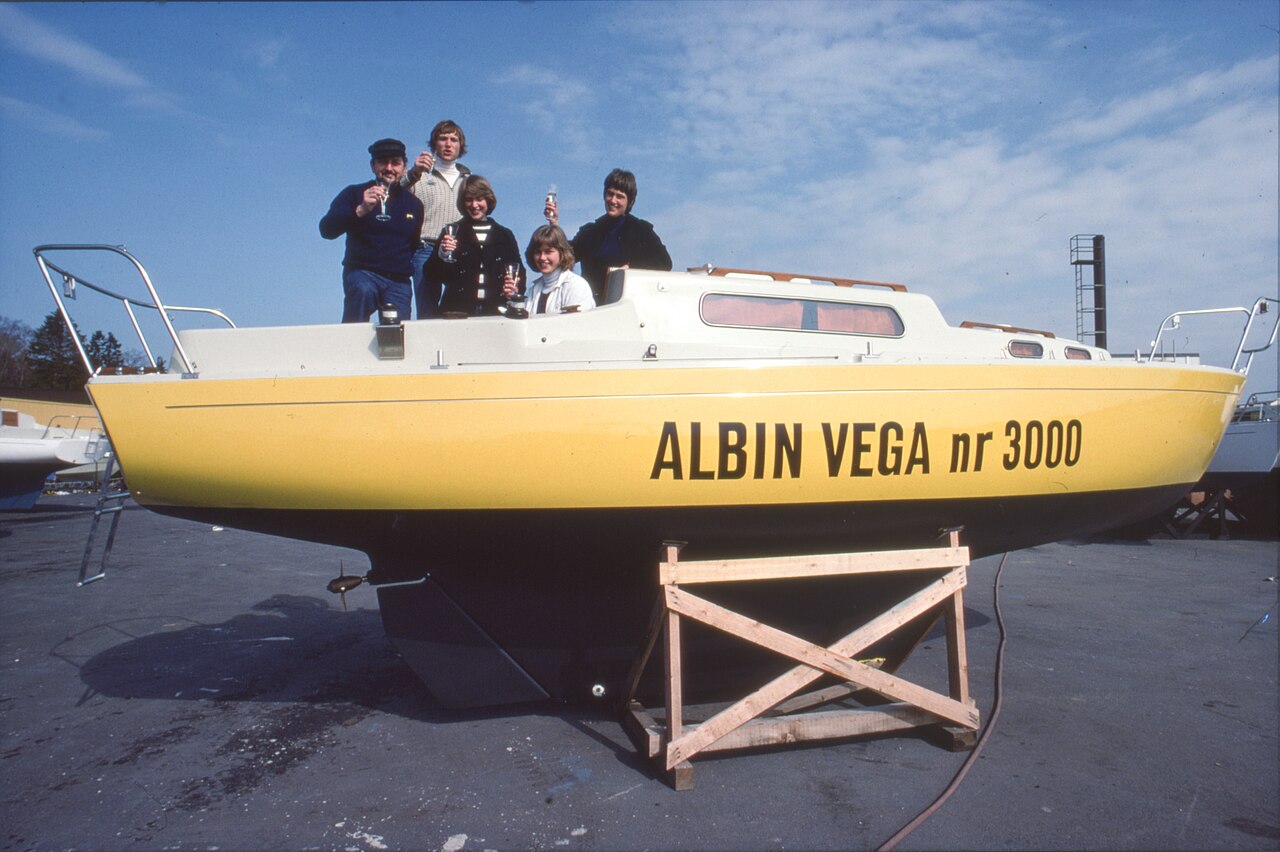
Albin Vega 27
Best small, cheap, genuinely ocean-capable sailboat
The Vega belongs in this comparison because it demolishes the argument that ocean crossings require a big boat and a big engine. She is slow by modern standards and you will motor in light airs, but the fuel bill for a whole season is what a trawler burns in a long weekend. Buy one if you want offshore capability for the price of a used car and you are genuinely happy to live small. Do not buy one expecting a comfortable liveaboard — that is exactly the tradeoff you are making.
- LOA / LWL
- 27' 0" / 22' 11"
- Beam / Draft
- 8' 0" / about 3' 8"
- Displacement
- 5,070 lb, roughly 2,000 lb ballast
- Built
- 1965-1979, Albin Marin, Sweden; about 3,450 hulls, designed by Per Brohäll
Pros
- Long ocean-crossing record for a 27-footer, including multiple circumnavigations
- Typically $7,000-$15,000 used, which puts a seaworthy boat inside almost any budget
- Small diesel auxiliary sips fuel, so the motoring half of a passage costs almost nothing
Cons
- 27 feet of interior means two people and no luxuries — headroom and stowage are both tight
- Boats this old carry the usual list: tired rigging, soft deck core in places, original wiring that should be replaced

Cheoy Lee Clipper 36
Best example of a true motorsailer compromise you can actually afford
This is the boat to look at if the motorsailer idea appeals: a stout hull, a rig that can be shortened in stages, and enough displacement to carry stores. The buying decision hinges almost entirely on the decks and the engine. A Clipper 36 with sound decks and a recently repowered diesel at $50,000 is a good boat; the same model at $30,000 with soft decks and an original engine is a project that will cost more than the difference. Survey before you fall in love. We could not find a freely licensed photograph of this model, so the card above uses our generic placeholder rather than a broker's copyrighted image.
- LOA / LWL
- 35' 8" / 25' 0"
- Beam / Draft
- 10' 9" / about 5' 4"
- Displacement
- 16,250 lb, roughly 5,375 lb ballast
- Built
- 1969-1988, Cheoy Lee Shipyard, Hong Kong; sources differ on hull count (60 to 78)
Pros
- Staysail ketch rig breaks the sail plan into small, manageable pieces for a shorthanded crew
- Heavy displacement and a deep forefoot make her comfortable in a seaway rather than quick
- Typically $30,000-$50,000 used, well under an equivalent-length production cruiser in good condition
Cons
- Teak decks and teak everything: gorgeous when maintained, a five-figure liability when not
- The ketch rig adds a second mast, second set of standing rigging, and second set of sails to replace
How to choose
The quick comparison below is for a nominal 40 ft boat of each type in cruising trim. Treat the fuel figures as illustrative ranges from cruisers' logs rather than guaranteed numbers.
| Type | Typical used price | Fuel at 6 kt | Ocean crossing? |
|---|---|---|---|
| Cruising sailboat | $40,000-$200,000 | About 8 mpg under power | Yes, routinely |
| Motorsailer | $30,000-$150,000 | 4-6 mpg depending on hull | Yes, under sail with engine backup |
| Coastal trawler | $100,000-$300,000 | About 3 mpg | No — insufficient range |
| Long-range trawler | $400,000+ | 2.5-3.5 mpg, 1,000+ gal tankage | Yes, as designed |
How to decide. Work backwards from the longest passage you genuinely intend to make, not the one you daydream about. Multiply its distance by 1.3 for reserve, divide by your candidate boat's real-world mpg, and compare the result with its actual tankage. If the answer does not fit, you are either buying a different boat or buying sails. Then price the annual bill — dockage, insurance, haul-out, engine service, rig or stabiliser maintenance — because that recurring figure, far more than the purchase price, determines whether the boat stays in your life.
Frequently asked questions
Can a trawler really cross an ocean?
Some can, most cannot without help. A true long-range trawler designed with the tankage for it — typically 1,000+ US gallons on a 45-50 ft hull — can make an Atlantic crossing on a favourable routing. The common coastal trawler with 300-500 gallons cannot, and owners who cross usually add bladder tanks on deck or ship the boat. Fuel range, not seaworthiness, is the binding constraint.
How much more fuel does a trawler burn than a sailboat?
Roughly two to three times as much per mile at displacement speed. One long-term cruiser's own logs show a 41 ft sailboat averaging about 8 mpg under power against an estimated 3 mpg for a 40 ft trawler at 6 knots. Those are one owner's records rather than a controlled study, but the ratio matches what most cruisers report.
Is a motorsailer a bad sailboat and a bad motorboat?
Sometimes, which is why the category has a poor reputation. The old jibe is that a motorsailer motors badly and sails worse. The good ones — heavy displacement hulls with a proper rig and a generously sized diesel — sail acceptably and motor efficiently. The bad ones have a token rig that cannot drive the hull and an engine sized for a lighter boat.
What is the cheapest way to cross an ocean?
A small, well-found sailboat you already own, sailed with the seasons. A 27-30 ft sailboat in good order will cross for the cost of food, insurance and a few hundred dollars of diesel. Every step up in size or power multiplies the fuel, dockage, haul-out and insurance bills, which our guide to sailboat ownership costs breaks down in detail.
Does a motorsailer need a bigger engine than a sailboat the same length?
Yes, usually considerably. A 36 ft sailboat is commonly fitted with 25-40 hp, sized to push through a chop and hold station. A motorsailer of the same length expected to make 7-8 knots under power alone typically carries 60-100 hp, which brings a bigger fuel bill, a bigger tank, and a heavier drivetrain.
Which type holds its value best?
Well-built sailboats from respected yards hold value best over decades, which is why 1960s Hinckleys still trade near six figures. Production trawlers and motorsailers generally depreciate faster, with condition — especially engine hours and deck integrity — mattering more to price than the badge on the hull.
Looking for more gear guides? Browse all our gear recommendations or the full guides index.