Best Boat Ladders for Sailboats: Boarding and Recovery
For most small sailboats and runabouts with a low transom, a stainless telescoping transom ladder such as the Garelick 19683 three-step is the simple answer: it stows flat, drops into the water, and is rated to 400 lb. If you swim with fins, dive, or have higher freeboard, step up to an angled sport/diver ladder such as Garelick's three- or four-step stainless model, which is easier to climb but costs far more and needs a solid transom mount.
The question that matters most is not how shiny the ladder looks at the dock. It is whether a tired, cold, wet person in the water can reach the bottom rung and climb out without help. This guide explains how to measure for that, why many factory swim ladders are too short for real recovery, and what to check before you drill holes in your transom.
Sailboat Atlas may earn a commission from qualifying purchases made through links on this page, at no extra cost to you.
Why the boarding ladder is safety gear, not just a swim accessory
On a sailboat, the ladder is often the only practical way back aboard for someone who has fallen in. Freeboard (the height of the deck above the waterline) of even 2–3 feet is surprisingly hard to overcome from the water without something to stand on, especially in a life jacket and wet clothing. Many crew overboard drills end with a successful pickup alongside and then a long, exhausting struggle to get the person onto the deck.
That means the ladder should be reachable and deployable from the water, not only from the cockpit. A ladder that is folded up and locked behind a pushpit (the stern rail) is useless to the person who needs it most. Look at how the ladder is secured, and whether a swimmer can pull a lanyard or release a strap to drop it. Some owners add a short line with a loop that hangs near the waterline for exactly that reason.
How deep should the bottom step be below the waterline?
A common rule of thumb used by sailors is that the bottom step should sit at least 2 feet (about 60 cm) below the surface, and deeper is better. When you are floating, your feet hang well below you; if the lowest rung is barely submerged, you have to haul your whole body weight up with your arms to get a knee onto it.
Measure from the mounting point down to the waterline, then add the depth you want below the surface. Compare that with the ladder's deployed length, not the number of steps. Garelick's 19683 telescoping transom ladder, for example, is listed at about 23.5 inches deployed, which suits low transoms, while the three-step sport/diver ladder is about 34 inches and the four-step about 42 inches. On a boat with higher freeboard, a short ladder may leave the bottom rung too close to the surface.
Transom, telescoping, over-the-side and dive ladders explained
Telescoping transom ladders mount flat on the transom or swim platform and slide out into the water. They are compact and inexpensive, but their steps are usually narrow round tubes, and the ladder hangs close to vertical, which is harder to climb.
Sport and diver ladders hang at an angle, more like a staircase, with wider steps and twin posts. They are much easier to climb wearing fins or a tank, and Garelick's version uses a quick-release transom bracket so the ladder can be removed. The trade-offs are cost, weight and the need for a strong mounting surface.
Over-the-gunwale and hook-on ladders hang from the side deck or rail. They work on boats without a usable transom, but they can scratch the topsides and they need to be tied off so they do not lift when someone steps on them. Rope or webbing emergency ladders roll up small and are useful as a backup, but they swing under the hull as soon as weight goes on them and are hard work for anyone who is exhausted.
Mounting a boarding ladder safely on a sailboat transom
A 400 lb rating only means something if the mount can carry it. Through-bolt mounting brackets with backing plates (a larger plate behind the hull skin that spreads the load), rather than relying on screws into fiberglass. Seal every fastener with a marine sealant suited to the hull material so water does not get into the core of a cored transom.
Check rudder and self-steering clearance on sailboats with transom-hung rudders, windvanes or swim-platform steps. Also check that the deployed ladder does not sit near the propeller; the engine must be off and the propeller stopped before anyone is in the water near the stern.
Corrosion, maintenance and when to replace a ladder
Stainless steel resists corrosion well but is not immune, particularly where it stays wet inside brackets or under plastic step covers. Rinse with fresh water, look for brown staining or cracks at welds and bends, and check that telescoping sections still slide freely. A ladder that jams halfway is a real problem in an emergency.
Replace worn non-skid step covers and any bungee or securing strap that has gone brittle in UV. If a step has bent or a weld shows a crack, replace the ladder rather than repairing it with a hose clamp.
Our picks
Garelick 19683 Telescoping 3-Step Transom Ladder
Low transoms and small boats on a budget
This is the ladder to buy if you have a dinghy-height transom, a swim platform, or a small daysailer where the deck is close to the water. It is compact enough to leave mounted all season. Skip it if your transom is more than a couple of feet above the waterline: at about 23.5 inches deployed, the bottom step will not sit deep enough for comfortable recovery. Through-bolt it with backing plates, and add a pull line that someone in the water can reach to drop the ladder.
- Material
- 304 stainless steel
- Deployed length
- 23.5 in
- Stowed length
- 14.75 in
- Rating
- 400 lb (retailer listing)
Pros
- Stows almost flat on the transom
- Self-locking brackets hold it closed
- Simple, inexpensive, widely sold
Cons
- Short deployed length suits only low freeboard
- Near-vertical round steps are tiring to climb
Garelick EEz-In 3-Step Stainless Sport/Diver Ladder
Swimmers, snorkelers and divers with fins
Buy this if people regularly swim or dive from your boat, or if anyone aboard would struggle to climb a vertical ladder. The angled twin-post design lets you walk up rather than pull up, which is exactly what a tired person needs. The quick-release bracket means the ladder can come off while sailing so it does not drag or catch lines. Skip it on a boat with a reverse transom or no flat mounting area, and measure carefully: the bracket must be through-bolted, and you need somewhere to stow a 34-inch ladder below.
- Material
- Electropolished stainless steel
- Length
- 34 in (3-step)
- Width
- 13.5 in
- Rating
- 400 lb boarding weight
Pros
- Angled stair-like climb is much easier
- Wide non-skid steps work with fins
- Quick-release transom bracket included
Cons
- Expensive compared with simple transom ladders
- Needs a strong, flat mounting area and storage space when removed
Garelick EEz-In 4-Step Stainless Sport/Diver Ladder
Higher freeboard and deeper bottom step
Choose the four-step version when you measure and find the three-step leaves the bottom rung too shallow, which is common on cruising sailboats with higher sterns. The extra 8 inches of length is often the difference between stepping on and hauling up. Skip it if the three-step already gives you two feet of depth; the extra weight and stowage are not free. As with the smaller model, through-bolt the bracket with backing plates and confirm that the ladder clears any rudder, windvane or swim-platform fittings.
- Material
- Electropolished stainless steel
- Length
- 42 in (4-step)
- Folded
- 19.5 in
- Rating
- 400 lb boarding weight
Pros
- Extra step puts the lowest rung deeper
- Same easy angled climb as the 3-step
- Folds for storage
Cons
- Heavier and bulkier to stow
- Highest cost in this shortlist
How to choose
| Product | Price check | Best for | Key detail |
|---|---|---|---|
| Garelick 19683 Telescoping 3-Step Transom Ladder | Typically under $300; check seller | Low transoms and small boats on a budget | 23.5 in deployed; 400 lb rating |
| Garelick EEz-In 3-Step Stainless Sport/Diver Ladder | Often $500–$650; check seller | Swimmers, snorkelers and divers with fins | 34 in long; angled stair-like design |
| Garelick EEz-In 4-Step Stainless Sport/Diver Ladder | Higher than 3-step; check seller | Higher freeboard and deeper bottom step | 42 in long; folds to 19.5 in |
Amazon links open model searches, not verified individual listings. Availability and seller identity have not been independently confirmed; compare the exact model with its maker's documentation before buying. No unverified live price is quoted.
Budget tiers and the decision that matters
Budget tier: a stainless telescoping transom ladder is the cheapest permanent solution and works well on small, low boats. Check its deployed length against your own freeboard before buying.
Mid and upper tier: an angled sport/diver ladder costs more but is dramatically easier to climb. If anyone aboard is older, less fit, or regularly in the water, it is the better investment.
Whichever ladder you choose, practise. Have each crew member climb aboard from the water in calm conditions with the engine off, and decide in advance who deploys the ladder and how the person in the water can deploy it themselves.
Related planning decisions
Sources and photograph credits
- Garelick 19683 Telescoping 3-Step Transom Ladder: manufacturer documentation
- Garelick EEz-In 3-Step Stainless Sport/Diver Ladder: manufacturer documentation
- Garelick EEz-In 4-Step Stainless Sport/Diver Ladder: manufacturer documentation
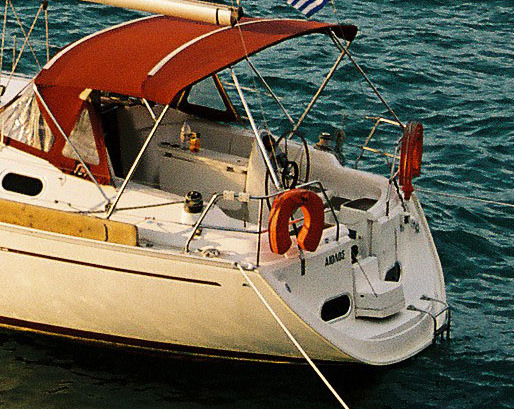
- Dufour Gib'Sea 37 with bathing ladder in the water by Vonvon, CC BY 3.0. Display crops and JPEG recompression may apply; image adaptations retain the indicated license. Photo licensing does not imply endorsement.
Reviewed 20 October 2026. Specification-led editorial guidance, not a claim of hands-on testing. Recheck models, manuals, availability and prices before purchase.
Frequently asked questions
How long should a boat ladder be?
Long enough that the bottom step sits at least about two feet below the waterline. Measure from the mount to the water and add that depth, then compare with the ladder's deployed length rather than its step count.
Can I use a rope ladder as my main boarding ladder?
It is better as a compact backup. Rope ladders swing under the hull when loaded, which makes them hard to climb for anyone who is tired or cold.
Is a weight rating of 400 lb enough?
For one adult climbing at a time it is usually adequate, but the rating assumes a correctly through-bolted mount. A ladder screwed into thin fiberglass will fail well below its rating.
Should the ladder be deployable from the water?
Yes. The person most likely to need it is in the water alone. A pull line or release strap that hangs within reach is a simple, worthwhile addition.
Do I need stainless steel?
Stainless steel is the usual choice in salt water because it resists corrosion and keeps its strength, but it still needs rinsing and inspection at welds and inside brackets.
Related guides
 Safety
Marine Fire Extinguishers: Ratings and Best Picks
USCG requirements by boat length, 5-B vs 20-B, the 12-year rule, and the best marine extinguishers.
 Safety
Best Inflatable Life Jackets for Sailing
Automatic vs hydrostatic inflation, harness life jackets, ratings and rearming — plus the best picks for sailors.
 Safety
Best Life Rafts for Offshore Sailing
Offshore-certified life raft picks and buying guidance for cruising sailors — Viking, Winslow, Ocean Safety, Revere.
 Safety
Storm Sails and Drogues for Offshore Sailboats
Storm jibs, trysails, and drogues — how to size, choose, and actually deploy heavy-weather tactics offshore.
Looking for more gear guides? Browse all our gear recommendations or the full guides index.