
Marine Sealants: 4200 vs 5200 vs Sikaflex vs Life-Calk
For serviceable deck hardware, choose a marine bedding product that seals the joint without making future removal unnecessarily destructive. Reserve high-strength adhesive sealants for applications that genuinely require that bond and are approved by the product and fitting manufacturers. The most common expensive mistake is treating 3M 5200 as an all-purpose answer to every leak.
This guide compares four common sealant families by task, substrate, and serviceability rather than claiming one tube is universally best. A sealant cannot restore a rotten deck core, compensate for a loose fitting, or turn an unsuitable installation into a safe underwater connection. Diagnose the joint before choosing the chemistry.
Sailboat Atlas may earn a commission from qualifying purchases made through links on this page, at no extra cost to you.
What is the difference between marine bedding, sealant and adhesive?
Bedding is the material placed between a fitting and the surface beneath it to keep water from traveling through the interface. A sealant fills and seals a joint while allowing the movement its product specification permits. An adhesive is intended to bond parts. Some marine products combine those roles, but the balance differs substantially; a strong bond is not inherently a better seal for a removable fitting.
A deck cleat or stanchion base should normally obtain its load capacity from the designed mechanical attachment and backing, not a bead of sealant. A decorative trim joint presents a different problem from a fitting carrying rig loads. Start with the fitting manufacturer's installation method and the boat's construction. Do not assume a product marked marine can carry a structural load without a tested joint design.
Future removal is part of the job specification. Winches, deck organizers, hatches, and inspection fittings may need servicing. A permanent adhesive can make that work expensive and damage finishes or laminates during removal. Conversely, an application genuinely requiring an adhesive bond must not be downgraded to an easy-release bedding material simply because it is convenient. Write down whether the task is sealing, bonding, or both.
Should you use 3M 4200 or 5200 for a leaking deck fitting?
The useful distinction is not that one number is automatically a superior version of the other. 4200 Fast Cure is positioned as a medium-strength adhesive sealant; 5200 is known for a much more tenacious bond. Exact cure behavior also depends on whether you are buying standard or fast-cure versions. Check the tube and current data sheet, not a casual reference to the brand name.
For a removable deck fitting, serviceability generally favors a less permanent approved bedding choice. That does not mean 4200 is appropriate for every plastic, painted surface, or hatch. Compatibility and preparation remain decisive. If the fitting manufacturer specifies another material, follow that instruction. Do not force a familiar polyurethane into an application designed for a different chemistry.
A recurring leak is rarely solved well by smearing another bead around the outside. Water can enter through fastener holes, travel along old bedding, and emerge somewhere else. Remove and inspect the fitting when practical, identify the water path, and repair the substrate before rebedding. If the deck is soft, fasteners no longer tighten correctly, or laminate cracks are visible, get the structure assessed rather than hiding it with adhesive.
Which sealants work on fiberglass, wood, metal and plastic?
Substrate compatibility is a checklist, not a broad material slogan. Gelcoat, painted aluminum, bare stainless steel, oily teak, acrylic glazing, and polycarbonate are different bonding surfaces. A product's acceptance of fiberglass does not automatically include a window plastic set into it. Some combinations require a specific cleaner, primer, or activation step, and some are explicitly excluded.
Identify both surfaces and any finish between them. A strong sealant bond to loose paint can fail when the paint releases. Wood moisture, surface oils, and old polish may also affect adhesion. Consult the current technical data sheet and the fitting or glazing manufacturer. Do not replace an approved glazing system with general-purpose deck sealant because both tubes claim water resistance.
If a test is called for, use an inconspicuous area or a sample with the same surface preparation and observe as directed. A quick finger test does not establish long-term compatibility, plastic stress cracking resistance, or underwater performance. Keep the exact product name, batch information, and preparation record with your maintenance notes so a future repairer knows what was used.
How do you prepare and rebed deck hardware without trapping a leak?
First remove the old material without gouging the laminate or enlarging fastener holes. Use a removal method suitable for the surface and the cured sealant. Do not flood a painted or plastic part with an arbitrary solvent. Once the fitting is off, inspect the underside, backing arrangement, fasteners, and exposed core. Repair any structural or moisture damage using an appropriate process before sealing the joint again.
Clean and dry the surfaces using the selected product's preparation instructions. Mask where useful, keep the outlet and fasteners organized, and confirm the fitting seats correctly before applying material. The joint needs enough sealant to remain continuous without obstructing intended drains or moving parts. Do not use generic tightening folklore in place of the fitting and sealant manufacturer's instructions; joint design, gasket use, and hardware differ.
Cored decks need special attention at penetrations. An unprotected core can absorb water even when the visible bead looks satisfactory. Isolating the core around a fastener hole is often a separate laminate repair task, not something achieved by coating the bolt in sealant. If you cannot establish what lies beneath the gelcoat, or the fitting carries substantial loads, use an experienced marine repairer.
How long must marine sealant cure before rain or launching?
Skin formation, tack-free time, and full cure are different milestones. A bead that no longer sticks to a glove may still be uncured beneath the surface. Moisture-curing products also depend on temperature, humidity, and bead thickness. A published result obtained under specified laboratory conditions is not a guarantee for a thick joint in a cold shed.
Read the product's current data sheet for the exact formulation and the intended exposure. Allow the required cure before stressing the bond or immersing the assembly. Do not transfer a fast-cure time to the standard version, or assume that rain resistance means immediate underwater service. If a launch deadline leaves insufficient cure time, change the schedule or use an independently approved alternative rather than hoping the skin is enough.
Plan work so you can protect the joint while preserving the conditions the sealant needs. Check cartridge shelf life and storage requirements, especially for part-used tubes. A blocked nozzle or cured plug does not tell you that all remaining material is still usable. Record the application date and weather conditions; that makes a later cure or adhesion problem easier to diagnose.
Can marine sealant repair a through-hull or stop an active leak?
A below-waterline fitting is a safety-critical assembly. Its material, bedding compatibility, mechanical seating, backing, seacock connection, and hose arrangement all matter. Use a product expressly approved for the substrates and immersion conditions, following the fitting maker's installation instructions. A label mentioning below-waterline use does not certify the entire connection or replace a proper installation.
Do not treat an ordinary cartridge sealant as an emergency underwater repair tool. Many need clean, prepared surfaces and a controlled cure. An active leak requires the boat's emergency flooding response, appropriate plugs or damage-control equipment, and professional help when necessary. A smear over a wet moving joint can give false confidence while water continues entering underneath.
Schedule permanent through-hull work with the boat safely out of the water where appropriate and allow the full specified cure before launching. Inspect and function-test the complete arrangement afterward. The same discipline applies above the waterline: sealing a failed hose, damaged pump body, or loose mechanical connection externally is not a sound replacement for repairing the component.
Our picks
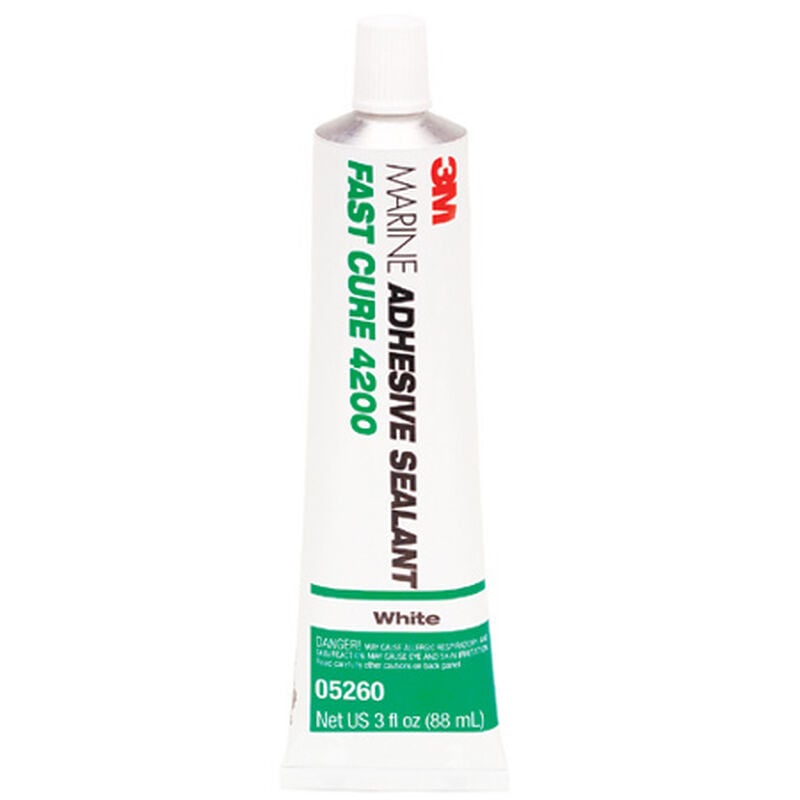
3M Marine Adhesive Sealant Fast Cure 4200
Approved serviceable bedding where disassembly matters
Choose 4200 Fast Cure when the fitting and substrate manufacturers approve it and later servicing is important. Its medium-strength position is the useful distinction from a deliberately permanent bond, but removable does not mean effortless or damage-free. Skip it for an application requiring a different glazing chemistry or an engineered high-strength bond. Use the exact Fast Cure technical sheet and allow for actual thickness and weather. The current 3M US page labels this product for industrial or occupational use, not consumer sale or use; confirm the applicable regional label and obtain professional advice rather than treating retail availability as DIY approval.
- Chemistry
- One-part moisture-curing polyurethane
- Tack-free
- 1–2 hours at 23°C in September 2024 TDS
- Cure rate
- 4 mm per 24 hours at stated TDS conditions
- Cured hardness
- Shore A 40, typical value
Pros
- Manufacturer explicitly allows disassembly
- Listed for above- and below-waterline applications
- Non-sagging elastic formulation accommodates movement
Cons
- Not the default for an intentionally permanent adhesive joint
- Surface skin does not establish full cure through a deep joint
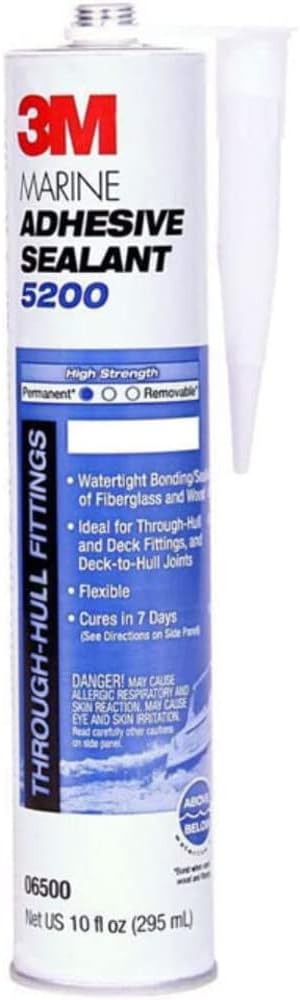
3M Marine Adhesive Sealant 5200, regular cure
Approved joints where a permanent bond is intentional
Use regular-cure 5200 only when a strong permanent bond is part of an approved repair plan, not because a leak looks stubborn. Its tenacity becomes a drawback on fittings you will later remove. Skip it for routine serviceable hardware and whenever the fitting or substrate guidance specifies another system. The quoted cure rate is from the dated technical sheet; simplified marketing times and Fast Cure formulations must not replace it. As with 4200, the current US manufacturer page carries an industrial or occupational-use restriction. Have the application assessed professionally and verify the regional product instructions before buying.
- Chemistry
- One-part moisture-curing polyurethane
- Tack-free
- 12 hours at 23°C in September 2024 TDS
- Cure rate
- 3 mm in five days under stated TDS conditions
- Cured hardness
- Shore A 68, typical value
Pros
- High-strength permanent-bond positioning
- Listed above- and below-waterline applications
- Flexible bond accommodates vibration and movement
Cons
- Removal can turn routine service into destructive work
- Slow through-cure complicates launch schedules
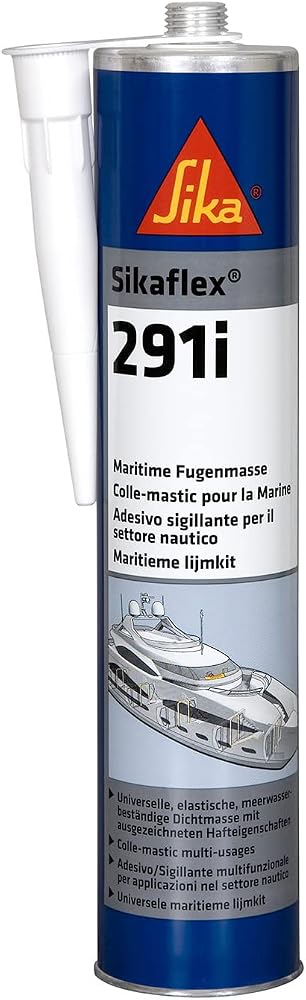
Sikaflex-291i
Compatible elastic marine joints, not plastic glazing
Consider 291i for compatible elastic joints when Sika’s preparation system and the fitting guidance fit the job. GRP means glass-reinforced plastic, the usual fiberglass laminate; that approval is not approval for every transparent plastic. Skip this product on acrylic or polycarbonate glazing: Sika explicitly excludes stress-cracking-sensitive plastics. Its current regional documentation identifies experienced professional users and requires substrate-specific preparation and testing. Do not substitute historical Sikaflex 291 test results or US 291 specifications for 291i. Verify the locally supplied formulation and technical sheet before scheduling a joint around the stated open time.
- Chemistry
- One-component polyurethane
- Application temperature
- 10–40°C
- Skin time
- 60 minutes at 23°C and 50% relative humidity
- Open time
- 45 minutes at 23°C and 50% relative humidity
Pros
- Elastic vibration-resistant sealing
- Listed for wood, metals, GRP and two-component paint coatings
- Can be overpainted subject to compatibility testing
Cons
- Not for stress-cracking-sensitive acrylic or polycarbonate
- Open time and temperature range constrain some working conditions
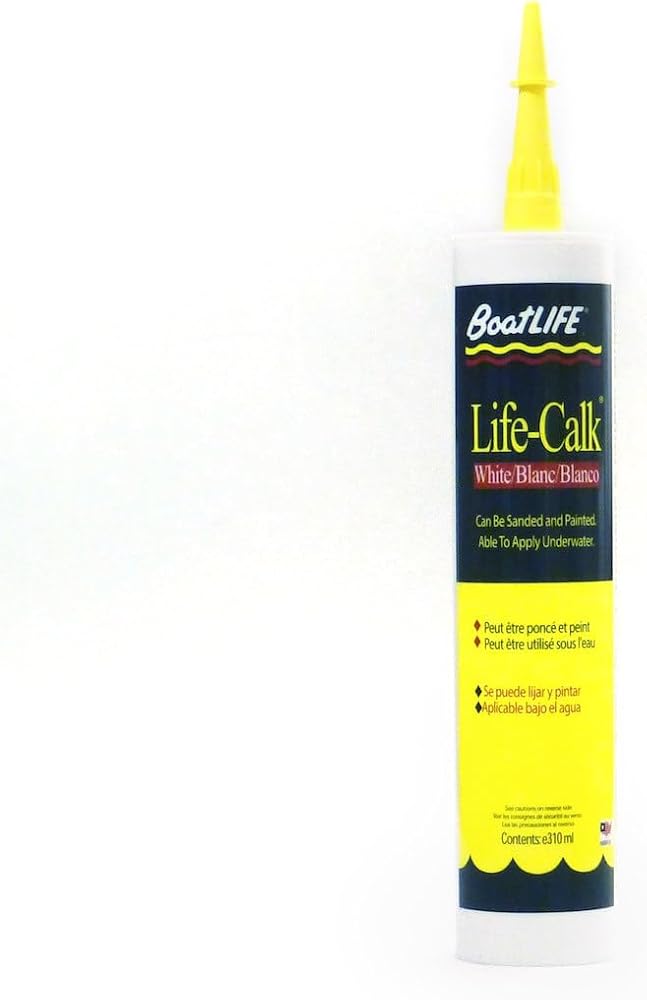
BoatLIFE Life-Calk cartridge
Compatible wood or teak joints and fuel-exposed bedding
Life-Calk is worth considering when compatible wood, teak oils, or fuel exposure determines the chemistry choice. Verify the substrate and finish first; a polysulfide useful around one wood fitting is not automatically appropriate for a plastic hatch or every teak coating. Skip it for plastics and the finishes the manufacturer excludes. Its tack-free interval is relatively long and is not a full-cure promise. BoatLIFE describes damp and emergency underwater applications, but that does not make a cartridge a substitute for emergency damage-control equipment or a properly repaired through-hull. Do not confuse Life-Calk with the different Life-Seal formulation.
- Chemistry
- Marine polysulfide
- Selected package
- 10.6 fl oz cartridge
- Tack-free time
- 1–3 days, manufacturer listing
- Waterline use
- Listed above and below
Pros
- Manufacturer states resistance to teak oils, gasoline and diesel
- Sandable and conditionally paintable
- Maker permits damp-surface application under its instructions
Cons
- BoatLIFE excludes plastics for polysulfide products
- Maker flags incompatibility with Sikkens, Cetol and Deks Olje finishes
How to choose
| Product | Price / purchase check | Best for | Key detail |
|---|---|---|---|
| 3M Marine Adhesive Sealant Fast Cure 4200 | Check exact cartridge size and regional label | Approved serviceable bedding where disassembly matters | Medium-strength polyurethane |
| 3M Marine Adhesive Sealant 5200, regular cure | Check regular-cure variant, size and local label | Approved joints where a permanent bond is intentional | High-strength polyurethane |
| Sikaflex-291i | Confirm local formulation and supply | Compatible elastic marine joints, not plastic glazing | 10–40°C application range |
| BoatLIFE Life-Calk cartridge | Check the 10.6 fl oz cartridge listing | Compatible wood or teak joints and fuel-exposed bedding | Marine polysulfide |
Prices and stock vary by region, size, configuration, and seller. Amazon links open searches rather than a verified individual listing: confirm the exact model, seller, approval label, and included accessories before buying. Where a price was not reliably confirmed, the table deliberately leaves a purchase check instead of inventing a range.
Budget tiers: what is worth paying for?
Small repair: buy the right chemistry in a usable cartridge size with fresh shelf life. A cheap large tube is poor value if most cures in storage or is unsuitable for the substrate.
Routine rebedding: budget for removal tools, approved cleaners or primers, replacement fasteners, and any backing or core repair. Labor and substrate condition commonly matter more than the difference between two cartridge prices.
Structural or underwater work: pay for an appropriate repair plan and installation assessment. No premium sealant eliminates the need for sound structure, compatible fittings, and enough cure time.
Related planning decisions
- Assess teak deck and caulking repairs
- Plan bilge pumping and hose maintenance
- Schedule underwater repairs during a haul-out
Manufacturer references and review notes
- 3M Marine Adhesive Sealant Fast Cure 4200: manufacturer specifications
- 3M Marine Adhesive Sealant 5200, regular cure: manufacturer specifications
- Sikaflex-291i: manufacturer specifications
- BoatLIFE Life-Calk cartridge: manufacturer specifications
Specification-led editorial shortlist, not a claim of hands-on testing. Reviewed 2026-10-20; recheck regional documentation, product generations, stock, and prices before purchase.
Frequently asked questions
Is 3M 5200 better than 4200?
They serve different bonding needs. 5200's tenacious bond can be undesirable on hardware that must be removed later. Choose by the approved application, substrate, and serviceability rather than treating the larger number as an upgrade.
Can I paint marine sealant?
It depends on the exact sealant, paint, and cure state. Read both manufacturers' compatibility instructions and any required test procedure. Do not infer paintability from another product in the same brand family.
Can I apply sealant over the old bead?
That rarely fixes a failed bedding interface properly. Remove and inspect the fitting where practical, then clean and prepare the surfaces as required. Applying fresh material over contaminated or loose old bedding can leave the original water path intact.
Is tack-free sealant ready for immersion?
Not necessarily. Tack-free time refers to the exposed surface, while full cure and permitted immersion are separate requirements. Follow the exact formulation's data sheet and allow for the actual joint and weather conditions.
Which sealant should I use for acrylic boat windows?
Use the glazing manufacturer's specified system for that plastic and installation. General marine sealants may not be compatible with acrylic or polycarbonate, including risks not visible immediately. Do not substitute a deck-bedding product without explicit approval.
Will sealant fix a soft deck around a stanchion?
No. Softness may indicate wet or damaged core, which affects the attachment's strength. Remove the source of leakage and have the substrate repaired before rebedding; an external bead cannot restore structural capacity.
Related guides
 Maintenance
Sailing Knives: Maintenance Tools and Rescue Tradeoffs
Plain and serrated blades, locks, multitools and saltwater care—with a clear distinction between maintenance and rescue.
 Maintenance
Sailboat Teak Decks: Repair, Replace or Rip It Out?
How to judge teak deck wear, what re-caulking and replacement really cost, and when removing the teak is the better decision.
 Maintenance
Boat Cleaners and Waxes: Gelcoat and Nonskid Care
Choose boat cleaner and marine wax by surface and stain. Compare deck cleaners, hull stain removers and gelcoat protection without making decks slippery.
 Maintenance
Sailboat Water Pumps: Fresh, Bilge and Washdown
How to choose and install every pump on a cruising boat — fresh water, bilge, sump, washdown and manual backup — with real flow rates and failure modes.
Looking for more gear guides? Browse all our gear recommendations or the full guides index.