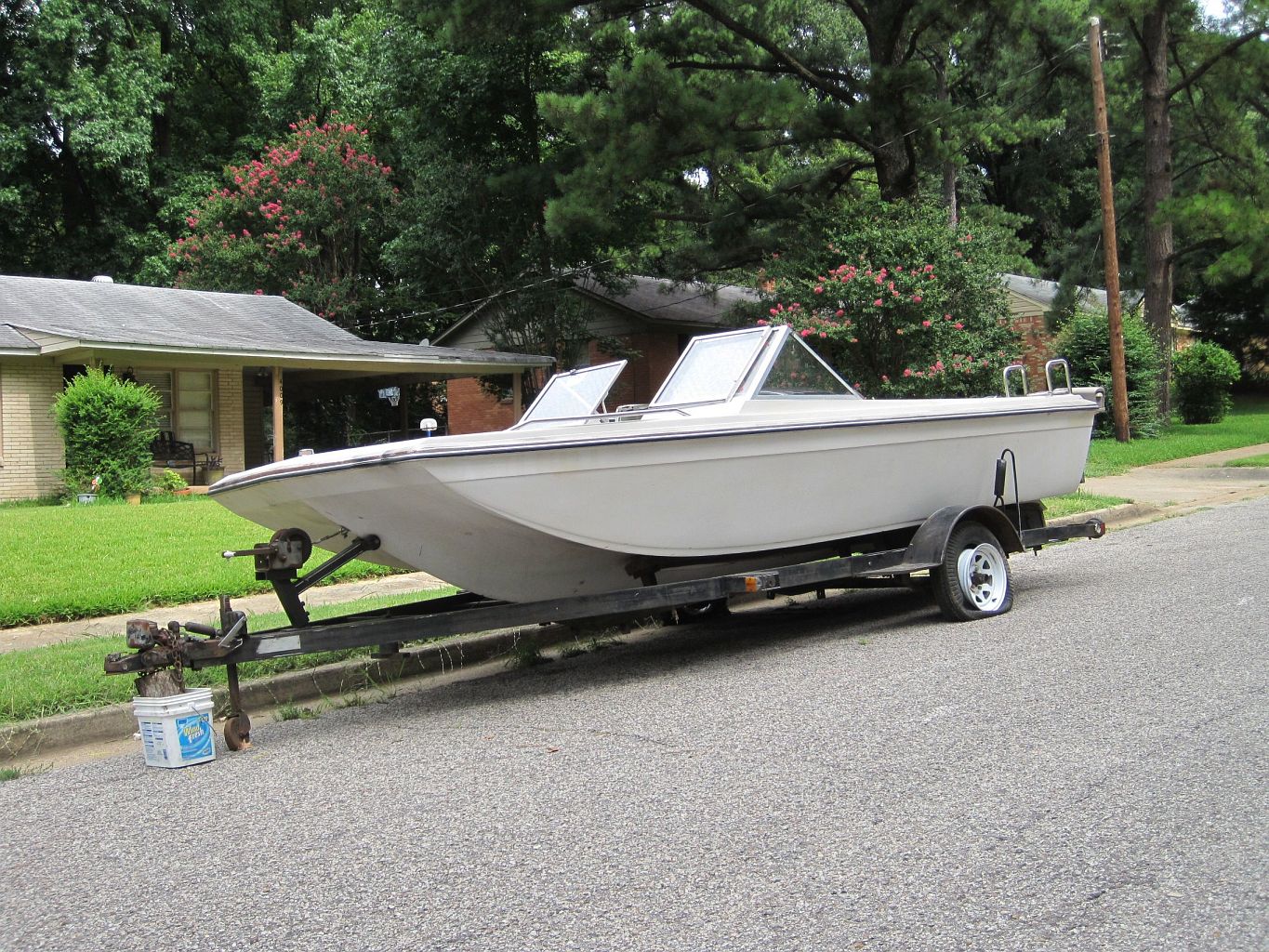
Best Boat Covers: Trailerable and Mooring Covers Compared
For most trailerable runabouts, fishing boats and small daysailers, a semi-universal cover such as the Classic Accessories StormPro or the Vortex Heavy Duty cover is the sensible buy: sized by length and beam, strapped to the trailer, and replaced every few seasons. If your boat has a tower, a swim platform or an unusual deck shape, step up to a styled cover like Carver's Sun-DURA line, which is cut for a boat type rather than a length range.
Whatever you buy, the cover itself is only half the job. Poles that create a pitched roof, straps that stop wind getting underneath, and ventilation that lets moisture out matter more than marketing claims about fabric thickness. This guide explains how covers fail, how to measure, and which picks suit which boats.
Sailboat Atlas may earn a commission from qualifying purchases made through links on this page, at no extra cost to you.
Why boat covers fail: water pooling, wind flap and trapped moisture
Almost every cover failure comes back to one of three causes. The first is pooling: a flat cover collects rainwater, the weight stretches the fabric, the puddle grows, and eventually seams leak or the cover tears at a tie-down point. A single large puddle can weigh more than the person who has to tip it off, so keeping the roof pitched is not optional.
The second is wind flap. A loose cover acts like a sail. Every gust lifts the fabric and drops it again, and that constant movement abrades the cover against windscreen frames, cleats and rub rails until the fabric wears through and the gelcoat underneath is polished dull. Tight straps under the hull and a snug elastic hem stop most of it.
The third is trapped moisture. A cover that is completely airtight holds condensation against upholstery and wood, and mildew follows within weeks in warm weather. Good covers include vents near the bow and stern, which let damp air escape while keeping rain out. If your cover has no vents, prop it slightly open at one end in dry weather or add aftermarket vents.
How to measure your boat for a cover
Universal covers are sold by two numbers: centerline length and beam. Measure centerline length in a straight line from the tip of the bow to the stern, excluding the outboard motor, bow pulpit and swim platform unless the maker says otherwise. Measure beam at the widest point of the hull. Then pick the size range where your length falls in the middle, not at the edge; a boat at the very top of a range usually ends up with a tight cover that strains its seams.
Check the fit style next. Covers labelled for V-hull runabouts assume a windscreen near the middle of the boat. Covers for fish-and-ski or pro-style bass boats assume a lower profile. A center-console, a T-top, a bow rail or a sailboat mast changes the shape enough that a generic runabout cover will not sit properly. When in doubt, look for a model that names your hull type, or buy a styled or custom cover.
Sailboats are a special case. A trailer-sailer with the mast unstepped can often use a large universal cover if the mast is stored on deck in crutches, but the mast changes the ridge line. Keelboats on moorings usually need a custom winter cover or a cockpit-only cover rather than a trailer-style full cover.
Boat cover fabrics explained: polyester, denier and solution-dyed acrylic
Most affordable covers use coated polyester. You will see a denier rating such as 600D or 1200D; denier describes the weight of the yarn, so higher numbers usually mean a thicker, heavier fabric that resists abrasion better. It does not tell you how well the coating will hold up in sun, and a heavy 1200D cover is harder to fold and lift onto a large boat by yourself.
Premium covers use solution-dyed fabrics such as Sunbrella or Carver's Sun-DURA, where the color is in the fiber rather than printed on the surface. These generally keep their color and strength longer in strong sun and breathe better, which helps with mildew. They cost more, and some breathable fabrics need a water-repellent treatment renewed every few seasons.
Sun is the real enemy. Ultraviolet light breaks down coatings and stitching thread long before the main fabric wears out. In sunny climates, check seams every season and expect a budget polyester cover to have a shorter life than one used mostly in winter storage.
Trailering with a boat cover: what the straps need to do
Most universal covers are marketed as trailerable, but highway speed is far harder on a cover than a windy driveway. The straps must pass under the hull and be tensioned so the fabric cannot balloon. Tuck loose strap tails away and recheck tension after the first few miles, because fabric settles once air pressure pushes on it.
Pad sharp points such as windscreen corners, cleats and bow-eye hardware before trailering. Even a well-strapped cover moves slightly at speed, and a sharp corner will wear a hole in a single long trip. Many owners remove the cover for long highway runs and use it only at the destination, which gives the cover a much longer life.
Support poles and ridge lines: the step most owners skip
A cover supported only by the windscreen and gunwales will sag in the middle of the cockpit and bow. Adjustable support poles, which sit on the cockpit floor and push the fabric up into a tent, create the slope that sheds rain and snow. One pole suits a small open boat; larger boats often need two or three, or a strap-and-pole ridge system from bow to stern.
Check whether poles are included before comparing prices; many covers are sold without them. Use poles with a rounded top or a cap so they do not punch through the fabric, and place them on a hard surface rather than on cushions. A ridge line can be as simple as a strap tensioned from the bow eye to the outboard, but test it after the first heavy rain to make sure water runs off rather than collecting in a new low spot.
How to make a boat cover last longer
Put the cover on a dry, clean boat. Dirt trapped under the fabric acts like sandpaper, and wet upholstery under a cover is how mildew starts. Rinse salt and bird droppings off the cover with fresh water and let it dry before folding it.
Store the cover dry in its bag, out of sunlight. Repair small tears immediately with a fabric patch kit before wind turns them into large ones. Replace worn elastic and broken buckles; most are standard parts. Finally, inspect stitching along the top seams each spring, because thread usually fails before fabric does.
Our picks
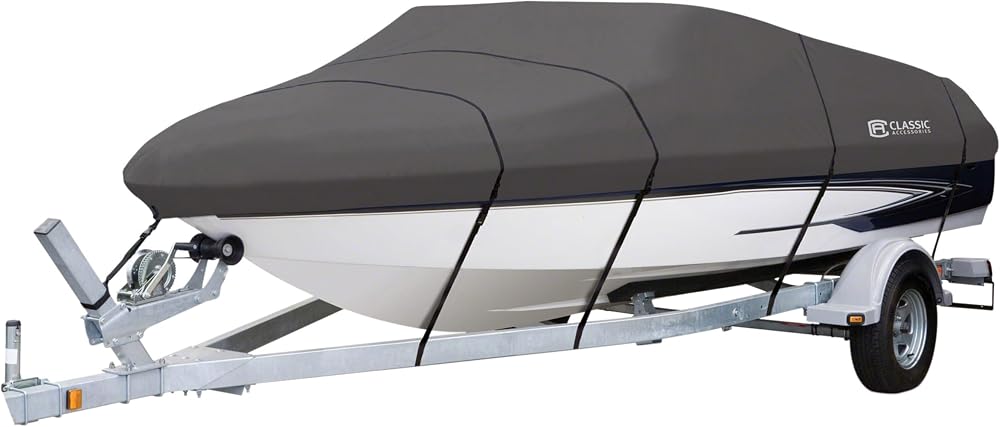
Classic Accessories StormPro Heavy-Duty Boat Cover
Owners who want a heavy, strap-down universal cover for trailer storage
Pick the StormPro if your boat lives outdoors on a trailer for months at a time and you want a cover built to take repeated wind and rain rather than occasional use. It is a semi-universal design, so it fits typical V-hull runabouts and fishing boats well but will not hug a T-top or tower. Measure carefully, choose a size where your boat falls mid-range, and budget for a support pole so the heavy fabric does not hold a puddle in the cockpit.
- Example size
- Fits 16 ft – 18.5 ft long × 98 in beam
- Other sizes
- Range from 12–14 ft × 68 in up to larger runabouts
- Fit style
- Semi-universal, sized by length and beam
- Attachment
- Elastic hem with tie-down straps; check listing for count
Pros
- Heavy-duty construction aimed at long-term outdoor storage
- Wide size range including small open boats
- Classic Accessories sells matching poles and replacement straps
Cons
- Heavier and bulkier to fold than budget covers
- Support poles are generally sold separately
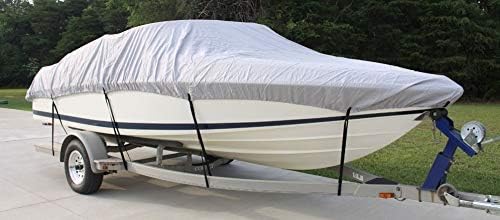
Vortex Heavy Duty V-Hull / Fish / Ski / Runabout Cover
Budget-conscious owners who still want 1200D fabric
The Vortex cover suits owners of ordinary runabouts and fish-and-ski boats who want a heavy fabric without paying premium-brand prices. Its universal cut is forgiving, but that same looseness means you must cinch the straps tightly and add a pole or two to stop flapping and pooling. Skip it if you have a center-console or tower boat; buy a cover that names your layout instead.
- Fabric
- 1200D polyester (per listing)
- Example sizes
- 17–19 ft; 22–24 ft up to 102 in beam
- Fit style
- Universal for V-hull, fish-and-ski and runabouts
- Color
- Gray
Pros
- Thick 1200D fabric at a lower price than most premium brands
- Covers a wide range of common runabout shapes
- Gray color shows less dirt than white
Cons
- Universal cut leaves more loose fabric on unusual hulls
- Less established parts and warranty support than larger brands
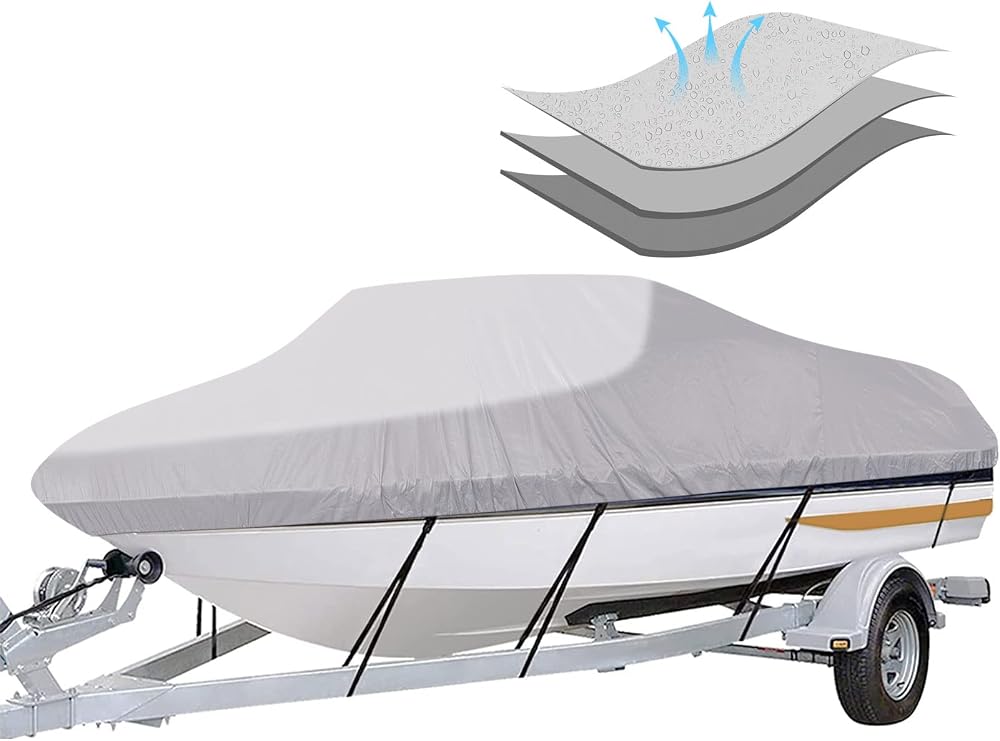
iCOVER Trailerable Boat Cover
Occasional covering, short trailer runs and boats stored in a garage or under a roof
iCOVER is a practical choice when the cover's main job is keeping dust, leaves and the odd shower off a boat that mostly lives in a garage, barn or carport, or when you need something easy to throw on at the ramp. One person can handle it more easily than a 1200D cover. For full-time outdoor storage in strong sun or snow, a heavier cover with poles will usually last longer.
- Sizes
- 14–16 ft, 16–18.5 ft, 17–19 ft, 20–23 ft
- Fit style
- V-hull, fish-and-ski, pro-style, runabout
- Included
- Storage bag (per listing)
- Fabric
- Marine-grade polyester; check listing for denier
Pros
- Lighter and easier to handle alone
- Includes a storage bag
- Good size coverage for common trailerable boats
Cons
- Lighter fabric is less suited to years of outdoor sun
- Fabric weight varies between listings, so read the exact version
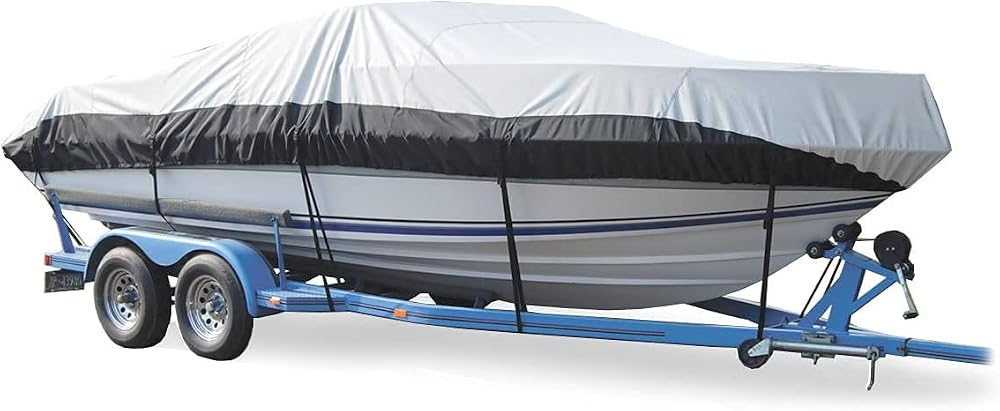
Taylor Made BoatGuard Eclipse Trailerable Cover (70906)
19–21 ft V-hull runabouts where a known marine brand matters
Taylor Made has made boat covers and fenders for decades, and the BoatGuard Eclipse 70906 is cut for one specific job: 19 to 21 foot V-hull runabouts with a beam up to 102 inches. That narrow fit is a strength if your boat matches it and a problem if it does not. Check the model number against your measurements; the 70205 version covers smaller 17 to 19 foot hulls.
- Model
- 70906
- Fit
- 19–21 ft × 102 in beam V-hull runabout
- Style
- Trailerable, semi-universal
- Related model
- 70205 BoatGuard for 17–19 ft V-hulls
Pros
- Long-established marine accessory brand
- Clear model numbers make re-ordering easy
- Sized specifically for wide-beam runabouts
Cons
- Narrow size window per model number
- Not designed for towers, T-tops or open bow rails
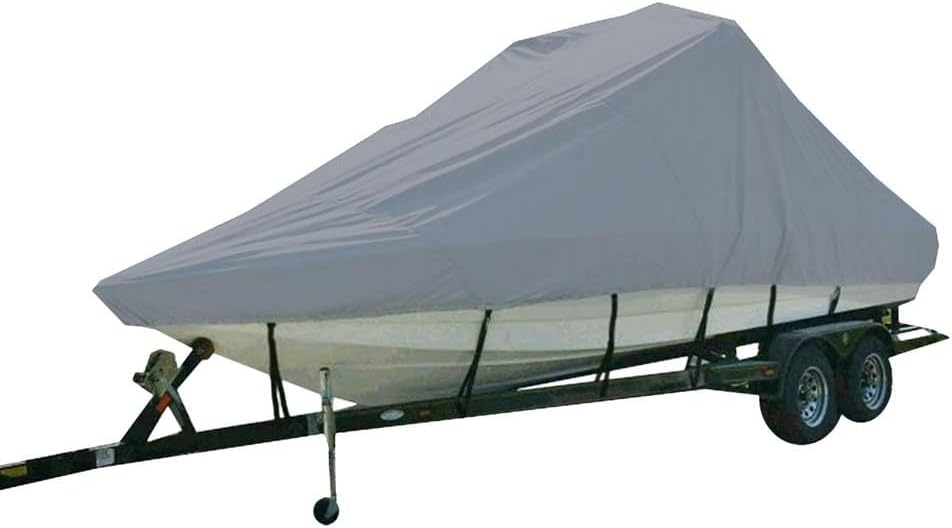
Carver Sun-DURA Styled-to-Fit Boat Cover
Tower boats, swim platforms and owners who want a near-custom fit
Choose Carver when a universal cover simply will not fit: wakeboard towers, swim platforms, walk-through windscreens or unusual bows. Carver's styled-to-fit covers are cut for a specific boat type, which means much less loose fabric to flap and wear. The trade-off is price and the work of finding the right pattern; confirm the listing names your boat style and length before ordering.
- Fabric
- Sun-DURA solution-dyed polyester
- Fit style
- Styled to fit a boat type, e.g. 21.5 ft inboard ski boats with tower
- Cut
- Accommodates towers, platforms and bow features by model
- Color
- Grey and other colors by model
Pros
- Shaped for boat types that universal covers cannot fit
- Solution-dyed fabric resists fading
- Less loose fabric, so less flapping
Cons
- Costs considerably more than universal covers
- You must match the exact boat style and dimensions, which takes time
How to choose
| Product | Typical price | Best for | Key detail |
|---|---|---|---|
| Classic Accessories StormPro Heavy-Duty Boat Cover | Typically $150–$300 depending on size | Owners who want a heavy, strap-down universal cover for trailer storage | Heavy-duty storage cover sized by length and beam |
| Vortex Heavy Duty V-Hull / Fish / Ski / Runabout Cover | Typically $100–$200 depending on size | Budget-conscious owners who still want 1200D fabric | 1200D fabric at a budget price |
| iCOVER Trailerable Boat Cover | Typically $80–$160 depending on size | Occasional covering, short trailer runs and boats stored in a garage or under a roof | Light, easy-handling universal cover |
| Taylor Made BoatGuard Eclipse Trailerable Cover (70906) | Typically $150–$280 | 19–21 ft V-hull runabouts where a known marine brand matters | Model-specific fit for 19–21 ft runabouts |
| Carver Sun-DURA Styled-to-Fit Boat Cover | Typically $300–$700 depending on pattern | Tower boats, swim platforms and owners who want a near-custom fit | Styled fit for tower and platform boats |
Prices vary by size, color and seller. Some Amazon links open a model search; others lead to an identified listing. Confirm the exact size, part number, seller and checkout total before buying.
Budget tiers: what is worth paying for?
Under about $150: a lighter universal cover such as iCOVER is fine for garage storage and occasional outdoor use. Spend part of what you saved on a support pole and a patch kit.
About $150–$300: heavy-duty universal covers such as the StormPro, Vortex and Taylor Made BoatGuard are the sweet spot for most trailerable boats stored outdoors.
Over $300: styled-to-fit or custom covers make sense for tower boats, center-consoles and anyone keeping a boat outside year-round in strong sun, where fit and fabric life pay for themselves.
Related Sailboat Atlas guides
- Bimini, dodger and cockpit enclosure guide
- Marine canvas DIY: fabrics, thread and sewing machines
- Boat cleaners and waxes for gelcoat care
- Best small sailboats for beginners
Specification-led editorial shortlist based on manufacturer and listing information, not hands-on testing. Reviewed October 2026.
Frequently asked questions
What size boat cover do I need?
Measure centerline length from bow tip to stern, excluding the outboard and swim platform, and measure beam at the widest point. Choose the size range where your boat falls in the middle rather than at the top or bottom of the range.
Is 1200D better than 600D for a boat cover?
A 1200D fabric uses heavier yarn, so it is usually thicker and more abrasion-resistant. It is also heavier to handle, and denier says nothing about UV resistance of the coating, so fit, straps and poles matter as much as the number.
Can I trailer my boat with a universal cover on?
Most are sold as trailerable, but only if every strap is tight under the hull and sharp corners are padded. Recheck straps after a few miles, and consider removing the cover for long highway trips to extend its life.
How do I stop water pooling on my boat cover?
Use one or more support poles to push the fabric into a peak, or run a ridge strap from bow to stern. The goal is a continuous slope so rain runs off instead of collecting in the cockpit or bow.
Should a boat cover be completely waterproof?
It should shed rain, but a totally airtight cover traps condensation and encourages mildew. Vents near bow and stern, or a slight opening in dry weather, let moisture escape.
How long does a boat cover last?
It depends mostly on sun exposure. Covers used outdoors in strong sun wear out much faster than those used in winter or under a roof. Inspect seams and straps every season and repair small tears immediately.
Related guides
 Maintenance
Sailing Knives: Maintenance Tools and Rescue Tradeoffs
Plain and serrated blades, locks, multitools and saltwater care—with a clear distinction between maintenance and rescue.
 Maintenance
Sailboat Teak Decks: Repair, Replace or Rip It Out?
How to judge teak deck wear, what re-caulking and replacement really cost, and when removing the teak is the better decision.
 Maintenance
Marine Sealants: 4200 vs 5200 vs Sikaflex vs Life-Calk
Choose marine sealants for deck fittings, through-hulls and repairs. Compare bond strength, cure time, substrates and future removal before buying.
 Maintenance
Boat Cleaners and Waxes: Gelcoat and Nonskid Care
Choose boat cleaner and marine wax by surface and stain. Compare deck cleaners, hull stain removers and gelcoat protection without making decks slippery.
Looking for more gear guides? Browse all our gear recommendations or the full guides index.