Best Liveaboard Sailboats: Monohulls and Catamarans Compared
For a couple living aboard full time on a realistic budget, the Island Packet 439 is the most liveable monohull you can buy; for a family, a Lagoon 450 or Leopard 45 catamaran will change daily life more than any other single decision. The honest summary is that catamarans win on space and comfort at anchor while monohulls win on purchase price, running costs, and heavy-weather behaviour — and the right answer depends almost entirely on how many people are aboard and where the boat will sit. This guide covers how much boat you actually need, what living aboard costs each month, the systems that determine whether you can leave the dock, and seven boats that do the job well.
Sailboat Atlas may earn a commission from qualifying purchases made through links on this page, at no extra cost to you.
Monohull vs catamaran: what actually changes day to day
The sailing arguments are the least important part of this decision. What changes your life is what the boat does at anchor, because that is where a liveaboard spends most of their hours.
A catamaran sits level. That means a galley you can cook in during a rolly anchorage, a bed that doesn't need a lee cloth, a table you can work at, and a cockpit that stays useable when a swell wraps around a headland. Two hulls also create physically separate cabins with a saloon between them, which is why families and couples cruising with guests gravitate to them. Shallow draft (typically 3.5–4.5 feet) lets you tuck in behind reefs and sandbars that deep-keeled monohulls can't reach.
A monohull heels, rolls at anchor, and packs its accommodation into a narrower hull. In exchange it costs less to buy at any given length, costs far less to keep — marinas typically charge catamarans 1.5–2× the monohull rate for the same LOA, and many yards can't lift a 24–26-foot beam at all — and behaves more predictably when conditions get genuinely bad. A monohull knocked down rights itself; a cruising catamaran, once inverted, stays inverted.
Sailing-wise, cats are faster on a reach and much faster under motor for the same fuel, while monohulls point higher and are more forgiving of being over-canvassed. A loaded cruising catamaran must be reefed earlier and more decisively than a monohull, because it doesn't relieve pressure by heeling.
How much boat you actually need
People consistently overestimate the length they need and underestimate the volume. The useful questions are: how many people sleep aboard every night, how much can you carry, and how many days can you stay away from a dock?
One or two people: 35–40 feet is genuinely liveable, and thousands do it. You will need to be disciplined about possessions and you will notice the lack of a second head on a rainy week, but the running costs are half those of a 45-footer.
Couple with occasional guests: 40–45 feet, ideally with two cabins and a second head. This is the largest boat most couples can handle without powered winches.
Family with children: 45 feet monohull or 42+ feet catamaran. Children need somewhere to be that isn't the saloon, and homeschooling needs a table that isn't also dinner. This is where catamarans stop being a luxury and start being the practical answer.
Also weigh what a boat can carry. Every liveaboard eventually loads their boat well past the designed waterline with tools, spares, water, and food. Heavy-displacement designs like the Island Packet and Morgan absorb this without much change in trim; light performance cruisers and charter-spec catamarans notice it immediately in both waterline and behaviour.
What living aboard costs — the numbers people leave out
Beyond the purchase, plan for a recurring annual figure of roughly 5–10% of the boat's value in maintenance, replacement, and haul-out. That percentage is not optional; it is what a boat consumes whether or not you spend it, and deferring it simply compounds the bill.
Berthing. A liveaboard slip is the single biggest controllable cost, and catamarans pay a premium for beam. Many marinas also add a liveaboard surcharge or cap the number of residential boats, so availability matters as much as price.
Haul-out and bottom paint. Annually in warm water, every 18–24 months in cooler climates. Catamarans mean two hulls to paint and a travel-lift or crane that can take the beam — in some regions that alone dictates where you can cruise.
Insurance. Liveaboard and offshore coverage costs meaningfully more than coastal-use policies, and underwriters increasingly want a recent survey, named-storm plans, and crew experience documentation.
Consumables and systems. Batteries every 5–12 years depending on chemistry, sails every 8–12, standing rigging every 10–15, engine servicing continuously. Living aboard accelerates all of it because nothing gets a winter off.
The systems that decide whether you can leave the dock
A liveaboard boat is judged by how long it can stay away from shore power and a hose. Four systems set that limit.
Power. Fridge, freezer, autopilot, laptops, and lighting are a daily amp-hour budget you must be able to replace. A large lithium house bank paired with enough solar is what makes anchoring out indefinitely normal rather than an endurance test, and an inverter-charger ties it together.
Water. Two people use 10–20 gallons a day living normally. A watermaker removes the constraint that most often drives cruisers back to a marina.
Refrigeration. A properly insulated marine fridge is the highest-value comfort upgrade on any liveaboard, and also the largest continuous electrical load — the two facts are related and need designing together.
Climate. In the tropics that means airflow: hatches, opening ports, awnings, and fans. In temperate or high latitudes it means a diesel heater, without which condensation and damp will make the boat miserable and eventually rot the joinery.
Add a good marine head and holding-tank setup and a serious anchor and windlass, and the boat becomes genuinely independent.
Marina life, anchoring out, and the legal reality
Where you keep the boat changes the boat you should buy. Marina liveaboards can accept a shallower battery bank, no watermaker, and a boat with modest tankage; anchor-out liveaboards cannot.
The legal side surprises people. Many municipalities restrict or ban long-term anchoring, require holding-tank pumpout records, or limit how many nights you can stay in one place. Marinas frequently cap liveaboard slips because of local zoning and sewage rules, and some insurers exclude liveaboard use unless it's declared. None of this is a reason not to do it, but check your intended region before committing to a berth-dependent plan.
A practical middle path many cruisers settle on: a mooring or anchorage for most of the year with a marina month booked for the worst weather and any big maintenance. That pattern rewards a boat with genuine self-sufficiency and a good dinghy — see our dinghy and outboard guide, because when you live at anchor the dinghy is your car.
Common mistakes when choosing a liveaboard boat
Buying the boat for the passage you might make. Most liveaboards do far less offshore sailing than they planned. Buying a spartan, deep-draft bluewater boat for a life that turns out to be coastal is a common and expensive mismatch.
Ignoring ventilation. Mould and condensation ruin more liveaboard experiences than storms do. Count the opening hatches and ports, and look for insulated hull liners.
Forgetting the beam premium on catamarans. Buyers price the boat and forget that berths, haul-outs, and some canals and locks all cost more or are simply unavailable.
No refit fund. Spending the entire budget on the purchase leaves you living aboard a boat you cannot afford to fix. Hold back at least 20% of the purchase price.
Our picks
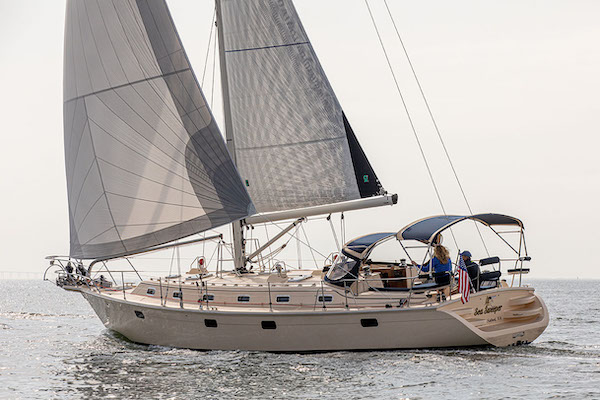
Island Packet 439
Best overall liveaboard monohull
If you want one monohull that is unambiguously built for people to live on, the Island Packet 439 is it. Everything the brand is criticised for offshore — heavy displacement, shoal draft, beam carried well aft — is exactly what makes the interior work for full-time living, with locker space, tank capacity, and headroom that boats of the same length simply don't offer. Buy it if your cruising is Caribbean, Bahamas, and the US East Coast, where shoal draft is worth more than speed. Skip it if your plan involves upwind passages in light air or high-latitude sailing.
- LOA
- 47' 0" (incl. bowsprit)
- Displacement
- ~32,000 lb
- Draft
- Shoal — full keel with cutaway forefoot
- Rig
- Cutter
Pros
- Enormous stowage and tankage for the length — the boat is designed around living aboard, not around a charter week
- Shoal draft opens up the Bahamas, ICW, and Florida Gulf coast where deep-keel boats can't follow
- Cutter rig and a huge house battery/tankage capacity suit long stays away from a dock
Cons
- Heavy and beamy: it is not a fast boat, and it needs real breeze to sail well upwind
- High freeboard means significant windage in a crosswind while docking or anchored in a squall
Amel Super Maramu
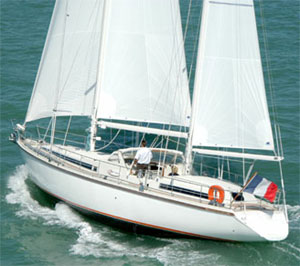
Best liveaboard for long-distance, short-handed couples
The Super Maramu has probably completed more couple-crewed circumnavigations than any other single model, and the reason is philosophical rather than technical: Henri Amel built boats for two people who intend to keep sailing into their sixties and seventies. The ketch rig means no single sail is large, the electric furling means nobody goes forward in a squall, and the centre-cockpit layout gives a genuine aft stateroom. The other side of that is complexity — this is not a boat to buy if you want simple systems you can fix with hand tools, and pre-purchase surveys should focus hard on the electrics and hydraulics.
- LOA
- 52' 6"
- Displacement
- ~35,300 lb
- Rig
- Ketch, all electric furling
- Layout
- Centre cockpit, aft owner's cabin
Pros
- Designed from the start for a couple: every sail furls electrically from the cockpit and the watertight bulkheads are genuine
- Aft owner's cabin with a real bed and en-suite head makes long-term living feel like a home rather than camping
- Cutter-ketch rig breaks the sail plan into small, manageable pieces — nothing needs a strong crew
Cons
- Deeply systems-dependent: electric furlers, bow thruster and hydraulics all need maintenance and a competent owner
- Amel's proprietary parts and layouts mean some repairs need brand-specific knowledge or shipped components
Hallberg-Rassy 44
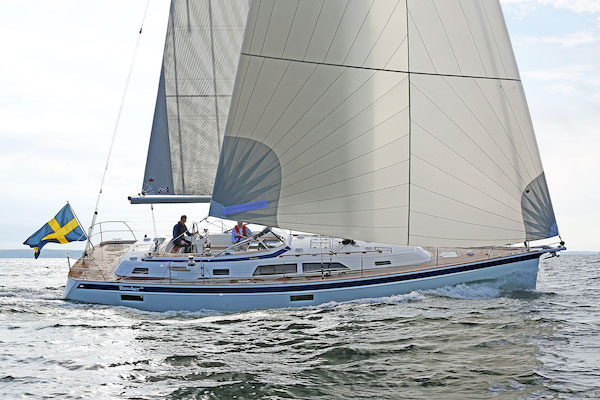
Best liveaboard for cold and high-latitude cruising
The HR44 is the answer for people who want to live aboard somewhere with weather: the Baltic, Scotland, the Pacific Northwest, Patagonia. A fixed windscreen sounds like a detail until you have stood a wet night watch behind one, and the boat pairs it with proper insulation, a diesel heater installation done at build rather than retrofitted, and enough tankage to stay out. It is comfortable rather than fast, and it is expensive, but it depreciates slowly enough that a few years aboard can cost less in total than a cheaper boat that loses value hard.
- LOA
- 47' 5"
- Displacement
- ~29,300 lb
- Layout
- Centre cockpit with fixed windscreen
- Designer / year
- Germán Frers, 2016
Pros
- Fixed windscreen and a sheltered cockpit transform life aboard in cold, wet climates
- Insulation, heating provision, and joinery quality are best-in-class for a production yard
- Holds value better than almost any other cruising boat, which lowers the true cost of several years aboard
Cons
- Very expensive to buy — you pay a large premium over an equivalent-length production cruiser
- Moderate beam and a conservative rig mean it is comfortable rather than quick
Catalina 425
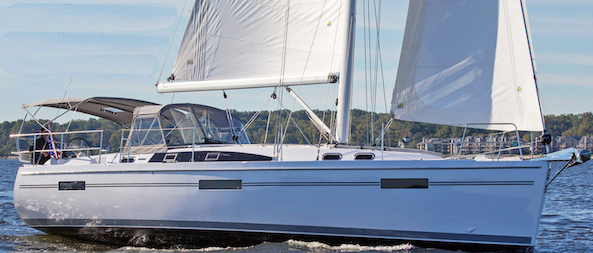
Best value liveaboard for coastal and marina living
Most people who say they want to live aboard are going to do it in a marina or at anchor within a day's sail of one, and for that life the Catalina 425 beats every 'proper' bluewater boat on this list. You get standing headroom throughout, a saloon that seats real guests, a galley that works, and ventilation that makes summer aboard tolerable — all for a fraction of the price of an equivalent-length Hallberg-Rassy. Be honest about your plans: if there is a real ocean crossing in your future, buy differently. If there isn't, this is the most liveable dollar you can spend.
- LOA
- 43' 6"
- Displacement
- ~18,100 lb
- Layout
- Aft cockpit, two or three cabin
- Builder / year
- Catalina Yachts, 2016
Pros
- Far more interior volume, light, and ventilation per dollar than any offshore-oriented boat of the same length
- Excellent dealer and parts support in North America, and a huge owner community for troubleshooting
- Light displacement makes it genuinely pleasant to sail in the 8–15 knot conditions coastal liveaboards actually see
Cons
- Built to a coastal standard: fine for the ICW, Chesapeake, and Great Lakes, but not the boat for a Southern Ocean plan
- Large opening ports and hatches that make it airy at anchor are also more to seal and maintain over years afloat
Morgan Out Island 41
Best budget liveaboard with maximum space
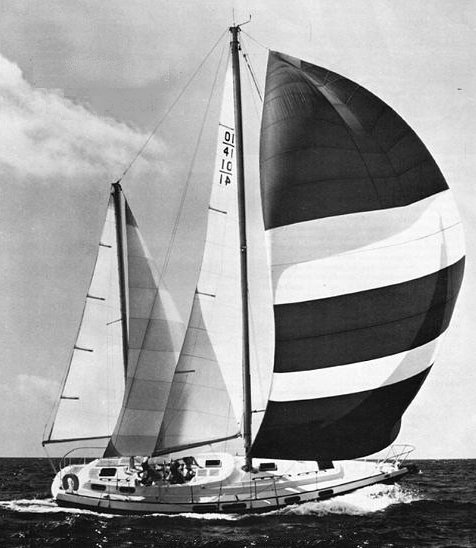
The Out Island 41 was built as a Caribbean charter boat, and that heritage is exactly why it works as a cheap liveaboard: two private cabins, two heads, and a saloon that fits a crowd, in a hull you can still buy for the price of a used car in some markets. What you give up is sailing performance — this is a boat that motorsails to windward and does it happily. Budget aggressively for age-related work; the boats that sink liveaboard dreams are the ones bought cheap with no refit fund behind them.
- LOA
- 41' 3"
- Displacement
- ~27,000 lb
- Draft
- ~4' 2" shoal keel
- Designer / year
- Charley Morgan, 1971
Pros
- Astonishing interior volume for the money — often the cheapest route to a genuine two-cabin liveaboard
- Shoal draft suits Florida, the Bahamas, and thin-water anchorages
- Built in large numbers for the charter trade, so parts, layouts, and known problems are well documented
Cons
- Sails poorly to windward — the shoal keel and heavy hull make upwind work slow and leeway significant
- Nearly all boats are 45+ years old, so rewiring, retanking, and deck core repairs should be assumed, not hoped against
Lagoon 450
Best catamaran for full-time family living
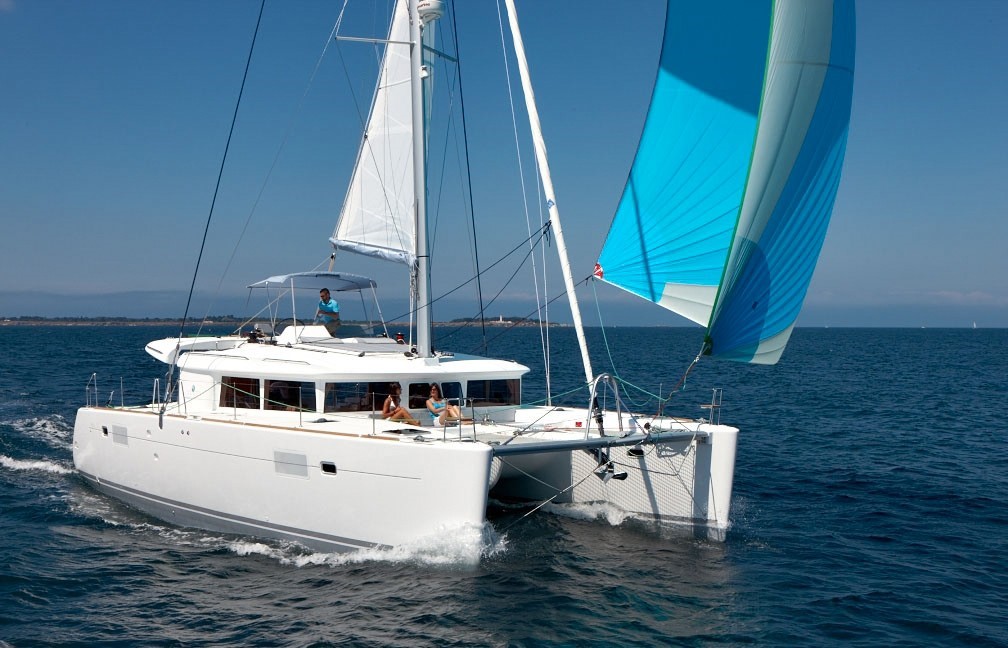
For a family living aboard full time, the Lagoon 450 is close to the default answer, and the reason is simple physics: it doesn't heel. Cooking, sleeping, homeschooling, and working all happen on a level platform, and the two hulls create genuinely separate living zones instead of one open saloon with curtains. The costs are equally concrete — nearly double the marina fees, a limited set of yards that can haul you, and a boat that must be reefed early because a loaded cruising cat gives less warning than a monohull before it becomes overpowered.
- LOA
- 45' 11"
- Displacement
- ~33,300 lb
- Layout
- Flybridge, 3–4 cabins
- Builder / year
- Lagoon, 2010
Pros
- Level living at anchor and under sail — no heel, which is the single biggest quality-of-life difference for families
- Separate hulls give real privacy: kids or guests on one side, owners on the other
- Huge deck and cockpit area, and shallow draft that lets you anchor closer in than any monohull
Cons
- Marina berths cost roughly 1.5–2× a monohull of the same length, and many yards can't lift a 26-foot beam
- Heavy, high-windage boat that needs to be sailed conservatively — reefing early is not optional on a loaded cat
Leopard 45
Best catamaran for owners who want to charter it out
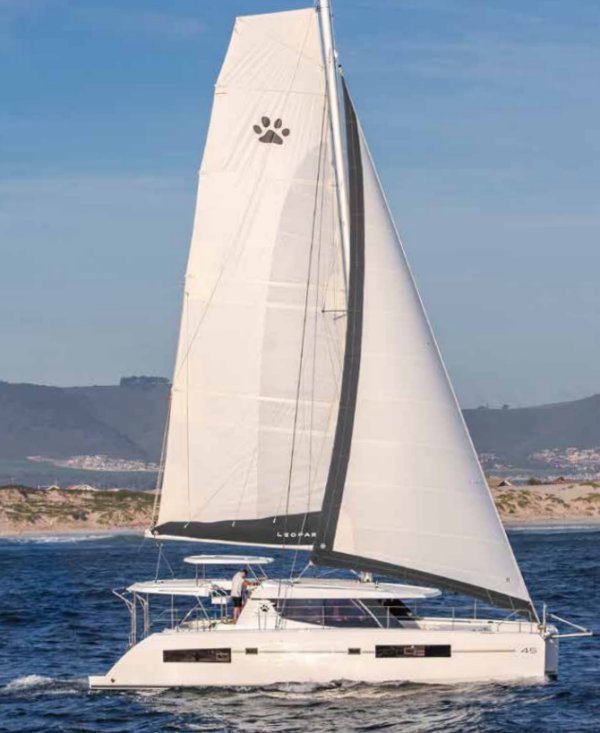
The Leopard 45 is the practical liveaboard catamaran for people who want their boat to earn money part of the year. Robertson & Caine build to a charter standard, which in practice means gear you can get serviced anywhere in the Caribbean and layouts that survive hard use. The detail that decides it for most owners is the forward cockpit: it turns the bow into a shaded, protected space that gets used every day. If you plan to live aboard full time, insist on the owner's-version three-cabin layout — the four-cabin charter boat gives away exactly the stowage you will need.
- LOA
- 45' 0"
- Displacement
- ~32,400 lb
- Layout
- Forward cockpit, 3–4 cabins
- Builder / year
- Robertson & Caine, 2017
Pros
- Forward cockpit accessed through the saloon is a genuinely useful second outdoor living space at anchor
- Built for the charter trade, so systems are robust, simple, and serviceable in the Caribbean
- Strong resale and an established charter-management route if you want the boat to offset its own costs
Cons
- Charter-derived interior finish is durable rather than luxurious compared to a European owner's-version cat
- Four-cabin versions sacrifice the owner's suite and stowage that full-time liveaboards actually need
How to choose
| Boat | Typical price | Best for | Type |
|---|---|---|---|
| Island Packet 439 | $300k–$450k | All-round liveaboard couple | Monohull, shoal draft |
| Amel Super Maramu | $180k–$320k | Long-distance couple | Monohull ketch |
| Hallberg-Rassy 44 | $450k–$650k | Cold-climate living | Monohull, centre cockpit |
| Catalina 425 | $300k–$400k | Coastal/marina living | Monohull, aft cockpit |
| Morgan Out Island 41 | $40k–$90k | Maximum space per dollar | Monohull, shoal keel |
| Lagoon 450 | $450k–$700k | Families full time | Catamaran |
| Leopard 45 | $550k–$750k | Owner-operators who charter | Catamaran |
Prices are broad market ranges for boats in sound condition and vary with year, equipment, and region — treat them as a planning starting point, not a quote.
Under $100,000: A Morgan Out Island 41 or a similar 1970s–80s centre-cockpit cruiser, with a genuine refit fund. You are buying volume and accepting age.
$200,000–$400,000: The broadest choice. An Amel Super Maramu for couples with ocean plans, a Catalina 425 for coastal comfort, or a well-kept Island Packet 439 if you want both liveability and shoal-draft cruising grounds.
$450,000+: A catamaran or a Hallberg-Rassy. At this level the decision is purely about climate and crew: cats for warm-water family living, HR for cold and wet.
Before committing, charter or borrow the type you think you want for a full week in weather you don't like. A week of rain aboard tells you more about a liveaboard boat than a year of boat-show visits.
Frequently asked questions
What size sailboat do you need to live aboard comfortably?
For one or two people, 35–40 feet is workable and 40–45 feet is comfortable. For a family with children, most full-time cruisers end up between 42 and 50 feet, or on a catamaran in the low 40s, where separate hulls create privacy that a monohull of the same length can't.
Is a catamaran or monohull better for living aboard?
Catamarans win on interior space, level living, shallow draft, and privacy. Monohulls win on purchase price, marina and haul-out costs, upwind sailing, and behaviour in genuinely heavy weather. If your budget is fixed, a monohull buys you significantly more boat; if your priority is daily comfort at anchor, a cat is hard to beat.
How much does living aboard actually cost per month?
Aside from the boat itself, budget for marina or mooring fees, insurance, haul-out and bottom paint (annually or biennially), and 5–10% of the boat's value per year in maintenance and replacement. Anchoring out drops the biggest line item but raises your dependence on solar, watermaking, and battery capacity.
Can you live aboard in a marina year-round?
In many places yes, but liveaboard slips are limited and often waitlisted, and some marinas prohibit residency outright or charge a liveaboard surcharge. Check local rules before buying — in some cities the berth is harder to find than the boat.
What systems matter most for full-time living aboard?
Power and water, in that order. A large house bank with solar, refrigeration that doesn't drain it, a watermaker if you anchor out, good ventilation, and heating if you're anywhere cold. These four determine whether you can stay away from a dock, which is the difference between cruising and commuting.
Is an older boat a false economy for liveaboard use?
Not necessarily, but the maintenance load is continuous rather than occasional when you're aboard every day. A 1970s boat with original wiring, tanks, and deck core will demand work while you are living in it. Either buy one already refitted, or budget both money and a year of your life for the work.
Related guides
 Boats
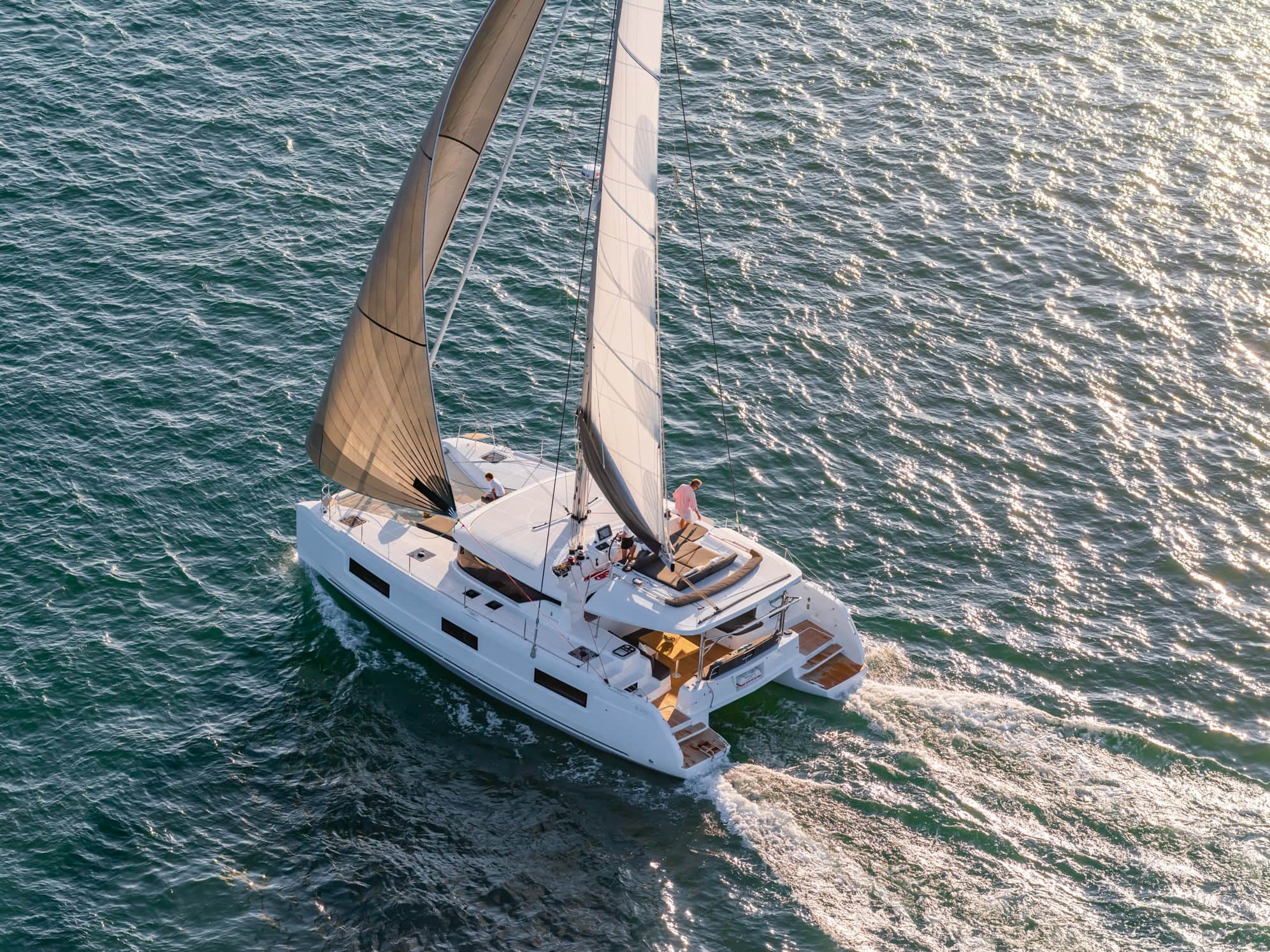
BoatsBest Liveaboard Catamarans: 7 Top Picks (2026)
The Lagoon 46 suits most families; couples should start with the Astréa 42. All 7 compared, with real running costs.
 Reference
Types of Sailboats
Sloops, cutters, ketches, catamarans and more — how the major sailboat rigs and hull types compare.
 Boats
BoatsBest Bluewater Sailboats Under 40 Feet
Eight proven offshore cruisers under 40 feet compared — hull form, build quality, real weaknesses and refit costs.
 Boats
BoatsBest Trailerable Sailboats
Tow weights, ramp setup time, keel types and five trailer sailers worth owning, from Catalina 22 to Corsair 760.
Looking for more gear guides? Browse all our gear recommendations or the full guides index.