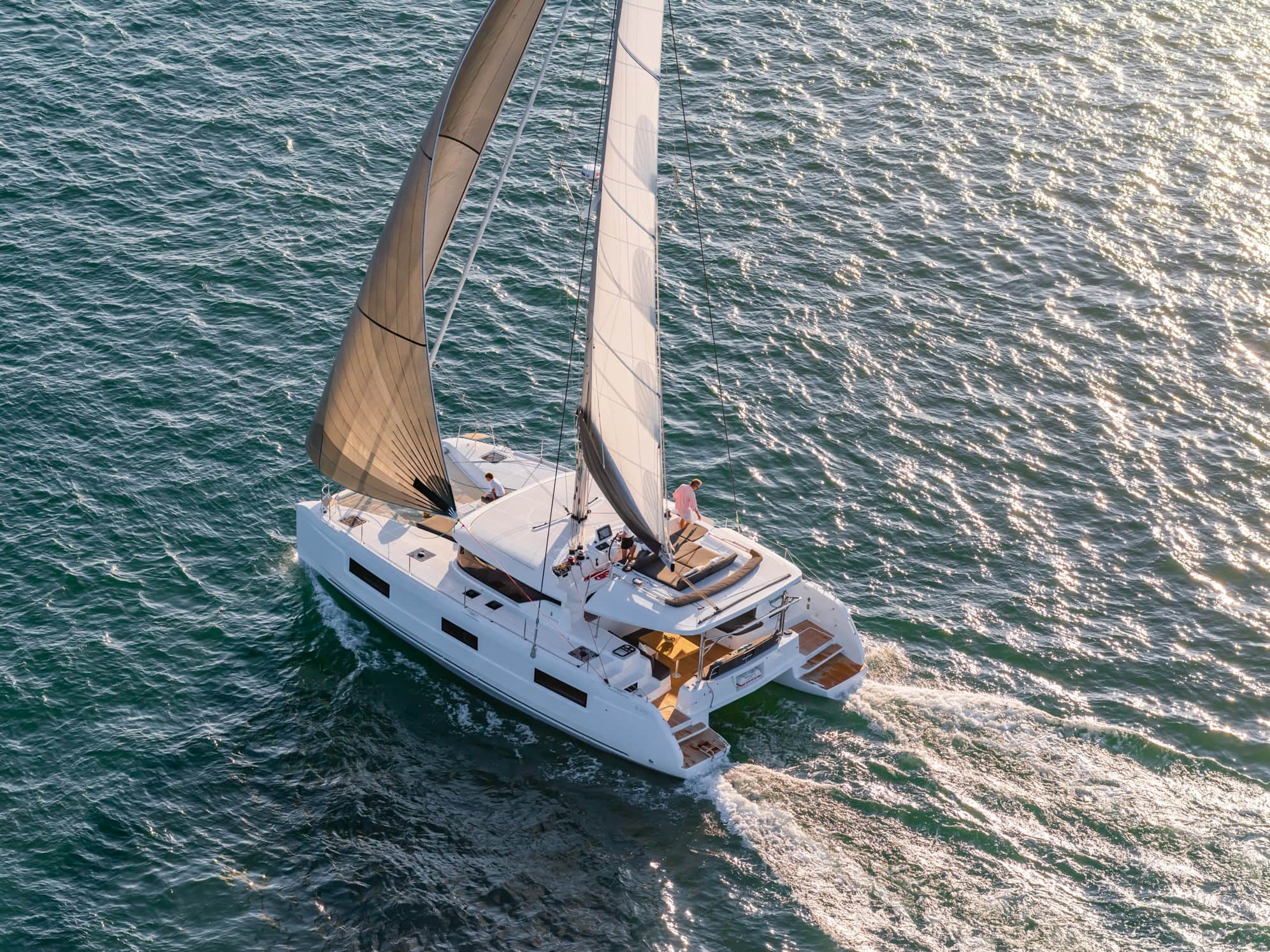
Best Liveaboard Catamarans
For most families living aboard full time, the Lagoon 46 is the best cruising catamaran you can buy — enormous living space, conventional systems, and support everywhere. Couples who want lower running costs and better sailing should look hard at the Fountaine Pajot Astréa 42 or the Nautitech 44 Open, and buyers on a used-market budget should start with a Lagoon 450 or an ex-charter Leopard 45. Catamarans win at living aboard because they don't heel, don't roll at anchor, and give each part of the crew its own hull — and they cost roughly twice as much to keep as a monohull of the same length. This guide covers layout, stowage, running costs, sailing behaviour, and seven boats worth the money.
Sailboat Atlas may earn a commission from qualifying purchases made through links on this page, at no extra cost to you.
Why catamarans work so well as homes
The defining fact is stability: a cruising catamaran resists heeling because its righting moment comes from beam, not ballast. At anchor that means no roll in a wrapping swell; under sail it means the galley, the saloon table, and the bunks all stay level. For anyone who works, cooks, or homeschools aboard, this changes daily life more than any other single feature.
Two hulls also create real separation. A monohull with an aft cabin still puts everyone in one acoustic space; a catamaran puts sleeping cabins in different structures with a saloon between them. Families with teenagers and couples who host guests for weeks at a time consistently report this as the thing they would not give up.
Shallow draft — typically 3.5 to 4.5 feet — opens anchorages that deep-keel monohulls cannot enter, and lets you anchor closer in where the water is calmer. Add huge roof area for solar, cockpit and deck space that a monohull cannot match, and shallow bilges that make systems accessible, and the case for living aboard one is strong.
The real cost of catamaran ownership
Nothing about a cat is more misunderstood than the running cost. Buyers price the boat and are then surprised by everything that follows from beam and duplication.
Berthing. Most marinas charge by length, then add a beam multiplier or simply charge for two slips. Budget 1.5–2× the monohull rate, and expect availability to be limited in busy or older harbours.
Haul-out. Two hulls to pressure-wash and antifoul, and a travel lift wide enough to take 24–27 feet of beam. In some regions that narrows your options to a handful of yards, which affects both price and where you can spend hurricane season.
Machinery. Two engines, two saildrives, two shafts of servicing, two sets of anodes. Saildrive diaphragms have a replacement interval measured in years and are a recurring planned expense, not a repair.
Sails and rigging. The sail area is large and the loads are high because nothing spills wind by heeling. Sails and standing rigging cost more and are worked harder than on an equivalent monohull.
Insurance is higher too, and underwriters increasingly ask for named-storm plans and crew experience. None of this makes a cat a bad choice — it makes the 40–45 foot range a far better value proposition than most buyers expect.
Layout: owner's version, charter version, and where the stowage goes
The single most consequential choice on a used catamaran is the cabin configuration. A three-cabin "owner's version" gives one entire hull to the owners — cabin, desk, hanging lockers, and en-suite head. A four- to six-cabin charter version splits both hulls into guest cabins with small heads.
For living aboard, the owner's version is almost always right. The stowage you lose in a charter layout is exactly the stowage a full-time cruiser needs: tools, spares, provisions, dive gear, and the accumulated equipment of a life afloat. Charter versions make sense only if you genuinely intend to charter the boat.
Also look at where the helm is. A flybridge gives shade, visibility, and an extra social space but isolates the driver from the cockpit. Aft helms (Nautitech, some Leopards) keep the crew together and give better sail feel, at the price of weather exposure. Neither is wrong — but short-handed couples usually prefer aft helms, and families at anchor usually prefer the flybridge.
Finally, weigh capacity. Catamarans are sensitive to load, and every pound goes into hulls designed with limited reserve buoyancy. Overloaded cats sail badly, pitch more, and lose bridgedeck clearance — which is what causes the slamming that owners complain about.
How a loaded cruising cat actually sails
Cruising catamarans are fast on a reach, comfortable downwind, and mediocre upwind. Expect to tack through 100–110 degrees rather than the 80–90 a decent monohull manages, and expect leeway to increase quickly as the boat loads up.
The safety-critical difference is that a cat does not tell you it is overpowered by heeling. A monohull rounds up and spills wind; a catamaran simply loads up its rig and eventually lifts a hull. The rule every experienced cat sailor follows is to reef on schedule rather than on feel — first reef well before you think you need it, and again before squall lines rather than during them. A good furling system and properly sized winches make that discipline easy to maintain.
Bridgedeck clearance determines comfort at sea. Boats with generous clearance slam far less in a short chop; heavily loaded boats with modest clearance will keep you awake. This is one of the strongest arguments for not overloading, and for inspecting how a used boat sits on her lines before buying.
Under power, twin engines set well apart make catamarans exceptionally manoeuvrable — you can turn one in its own length using engines alone, which makes docking a 45-foot boat easier than docking a 35-foot monohull.
Systems for full-time catamaran living
Catamarans are the best possible platform for energy independence, and most serious liveaboard cats are set up to never need shore power.
Start with the roof: a hard bimini or coachroof on a 44-foot cat will carry 1–2 kW of solar without looking cluttered. Pair it with a large lithium bank and a properly sized inverter-charger and you can run refrigeration, a watermaker, and induction cooking on sunlight alone in the tropics.
A watermaker is close to mandatory for full-time living: it removes the constraint that most often forces cruisers back to a marina. Add serious ground tackle — cats have high windage and sail around at anchor, so oversize the anchor rather than the rode — and a capable dinghy on davits, since living at anchor makes the tender your car.
For safety gear at this scale, a life raft sized for the full crew and an EPIRB are the non-negotiables, along with an AIS transponder — a wide, low boat is harder for ships to see on radar than owners assume.
Common mistakes buying a liveaboard catamaran
Buying a charter layout to live on. The cabin count looks generous and the stowage deficit only becomes obvious after you've provisioned.
Ignoring beam when planning cruising grounds. Some canals, locks, and yards simply cannot take you. Check the route, not just the destination.
Overloading. The most common cause of a cat that pitches, slams, and disappoints is 3,000 lb of gear that was not in the designer's calculations.
Skipping the saildrive inspection. On ex-charter boats it is the most predictable large bill, and it is easy to check before you buy rather than after.
The used-catamaran survey checklist
Most liveaboard cats are bought used, and the survey is where the purchase is won or lost. Beyond the standard hull-and-machinery survey, these are the catamaran-specific items that decide whether the boat is a home or a project:
- Saildrive diaphragms and seals. Ask for the replacement date in writing. They age out on a schedule regardless of hours, and replacement means a haul-out.
- Bridgedeck and bulkhead condition. Look for stress cracking around the bridgedeck, saloon windows, and main bulkheads — the areas that take the wracking loads two hulls generate in a seaway.
- Evidence of grounding. Keel stubs, rudder bearings, and saildrive mounts tell the story. Cats get driven into shallows precisely because their draft invites it.
- Standing rigging age. Budget for replacement if it is past ten years, and negotiate accordingly — it is a five-figure job on a 45-foot cat.
- How the boat floats. Look at her on her lines before you ever step aboard. A boat sitting visibly low is a boat already overloaded, and everything about how she sails and slams follows from that.
- Engine and generator hours against the asking price. Ex-charter boats often carry 3,000–5,000 hours; a well-kept private boat far fewer. Price the difference honestly.
Pay for a surveyor who knows catamarans specifically — the failure modes are different enough from monohulls that a generalist will miss the expensive ones.
Try before you buy: a sensible path to your first cat
A liveaboard catamaran is a house purchase as much as a boat purchase, and the buyers who regret it almost always skipped the trial steps. The path that works:
- Charter the exact model for a week. Not a similar boat — the same model and layout. Live on it, cook on it, and run the systems rather than day-sailing from a marina.
- Charter the size below as well. Many buyers discover a 42 does everything they need at two-thirds the running cost of a 46 — but only by living on both.
- Do a passage, not just anchoring. A night at sea in a short chop tells you more about bridgedeck slam and motion than any brochure.
- Price the year, not the boat. Add berth, insurance, haul-out, rigging reserve, and systems upkeep to the purchase price before deciding what you can afford.
- Then shop the used market with the checklist above. The same model with 2,000 fewer engine hours and newer rigging is worth a meaningful premium.
Our picks
Lagoon 46
Best overall liveaboard catamaran
The Lagoon 46 is the boat most full-time cruising families end up on, and the reasoning is boring but sound: the interior volume is exceptional, the systems are conventional and serviceable, the dealer network is everywhere, and the boat holds its value. The flybridge helm divides opinion — it gives shade and visibility but puts the driver away from the cockpit. Sail it conservatively: loaded to cruising weight it wants a reef earlier than owners expect, and it will not point with a monohull. For living on, none of that matters much; for passage making, it does.
- LOA
- 45' 11"
- Beam
- ~26' 11"
- Layout
- Flybridge, 3–6 cabins
- Builder / year
- Lagoon, 2018
Pros
- Forward-set mast and self-tacking jib option make the rig genuinely manageable for a couple
- Enormous saloon and cockpit that flow together — the single best space for family living at this size
- Very strong resale and worldwide dealer support, which matters when something breaks in a remote place
Cons
- Heavy, and slow in light air once loaded with cruising gear, water, and fuel
- Nearly 27 feet of beam limits which marinas and boatyards can take you, and doubles many fees
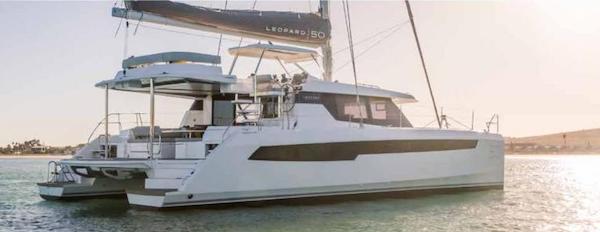
Leopard 50
Best catamaran for owners who want serious space
The Leopard 50 is what you buy when the boat is your house rather than your holiday, and you want the extra 15% of space that makes it feel permanent. The layout is the strongest argument: the forward cockpit is not a gimmick — it becomes the shaded morning space every day — and the raised helm keeps the person driving part of the conversation. Robertson & Caine's charter heritage shows in gear choices that are easy to service anywhere in the Caribbean. The counterweight is cost: everything about a 50-footer is proportionally more expensive to keep than a 45.
- LOA
- 50' 0"
- Layout
- Forward cockpit, 3–5 cabins
- Helm
- Raised, connected to cockpit
- Builder / year
- Robertson & Caine, 2017
Pros
- Forward cockpit plus a huge aft cockpit gives two distinct outdoor spaces at anchor
- Helm position keeps the driver connected to the cockpit rather than isolated on a flybridge
- Built to charter-fleet durability standards, so systems are robust and repairable in the Caribbean
Cons
- At 50 feet the running costs step up sharply — berths, haul-outs, sails, and insurance all scale
- Finish is practical rather than luxurious compared with European owner-focused yards
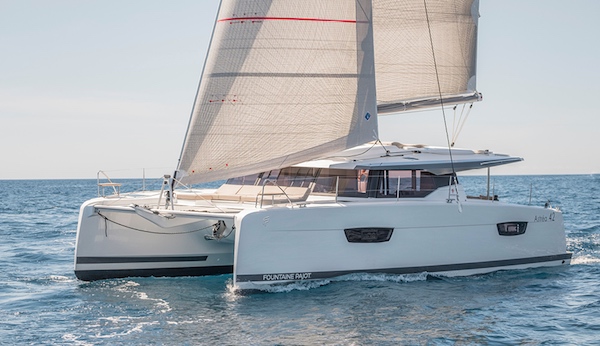
Fountaine Pajot Astréa 42
Best liveaboard catamaran for couples
For a couple, going bigger is not automatically better — a 42-foot cat is dramatically cheaper to berth, haul, and re-rig than a 50, and the Astréa is the one that gives up the least in return. Choose the owner's version and you get a private hull with a genuine cabin and workspace, which is the single feature that makes long-term living feel civilised. It also sails better than the volume-first cats it competes with. The compromise is stowage: provision for a long passage and you will feel the difference against a Lagoon 46.
- LOA
- 41' 8"
- Beam
- ~24' 3"
- Layout
- 3–4 cabins, owner's version available
- Builder / year
- Fountaine Pajot, 2018
Pros
- Owner's version dedicates an entire hull to the couple — a real cabin, desk, and en-suite head
- Sails noticeably better than most cats its size thanks to finer hulls and a well-balanced rig
- Smaller beam than a 45–50 footer, so marina access and haul-out options stay realistic
Cons
- Less stowage than a bigger cat, which shows quickly when you provision for months rather than weeks
- Interior finish, while attractive, uses lighter joinery that shows wear faster under full-time use
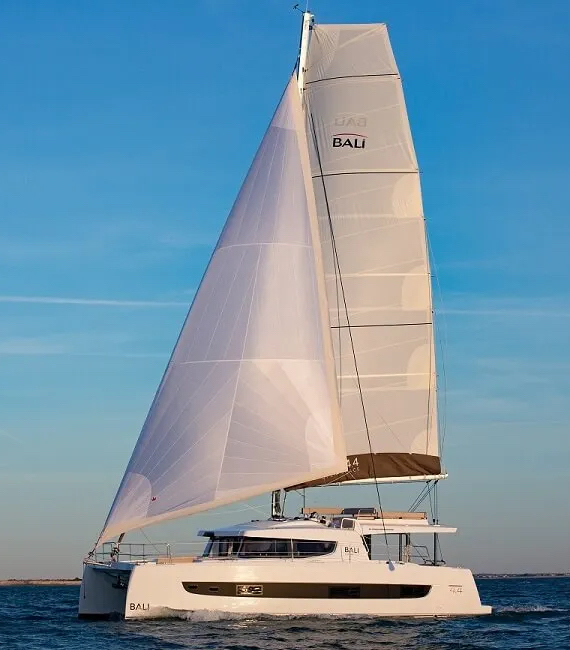
Bali 4.4
Best for indoor-outdoor living and entertaining
Bali took the standard catamaran layout apart and rebuilt it around living rather than sailing, and the 4.4 is the size where that idea works best. Fold the aft door up and the saloon and cockpit merge into one shaded, breezy room with a galley in the middle of it — for people who spend nine months a year at anchor in warm water, nothing else feels this comfortable. The cost is on the water: the solid foredeck and extra weight forward make it a duller sailer than a Fountaine Pajot of similar size. If you sail primarily to reposition and live the rest of the time, that is a fair trade.
- LOA
- 44' 0"
- Feature
- Solid foredeck and tilting garage door aft
- Layout
- 3–4 cabins, flybridge
- Builder / year
- Catana Group, 2021
Pros
- The tilting aft door turns saloon and cockpit into one enormous room — a genuinely different way to live aboard
- Solid foredeck instead of trampolines gives a huge usable, safe deck area, especially with children or pets
- Excellent natural light and ventilation throughout, which matters more than any spec sheet in the tropics
Cons
- The solid foredeck adds weight and windage forward, which hurts light-air performance and pitching
- The big glass door and its mechanism are a system to maintain, and a large single point of failure in the living space
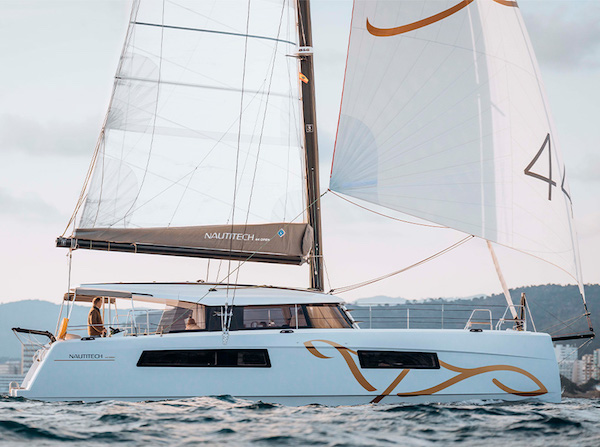
Nautitech 44 Open
Best sailing catamaran that still works to live on
Most cruising catamarans are apartments that sail badly. The Nautitech 44 Open is the compromise for people who refuse that trade: finer hulls, aft helms with real steering feel, and a rig you can trim properly. It still has the level living, shallow draft, and two-hull privacy that make cats good homes — you simply give up some volume for it. Buy it if you intend to sail a lot and live aboard between passages. Skip it if your priority is maximum cubic feet per dollar, because on that measure the volume-first cats win outright.
- LOA
- 44' 0"
- Helm
- Twin aft helms
- Hulls
- Fine entry, higher length-to-beam ratio
- Builder / year
- Nautitech, 2016
Pros
- Genuinely enjoyable to sail — twin aft helms give feel and visibility that flybridge cats simply don't
- Finer hulls mean better light-air performance and less pitching in a seaway
- Single-level open cockpit and saloon layout suits living aboard while keeping the boat sailable short-handed
Cons
- Less interior and stowage volume than a Lagoon or Bali of the same length — the performance comes from finer hulls
- Aft helms are exposed; you will want a good bimini and dodger for wet or cold cruising
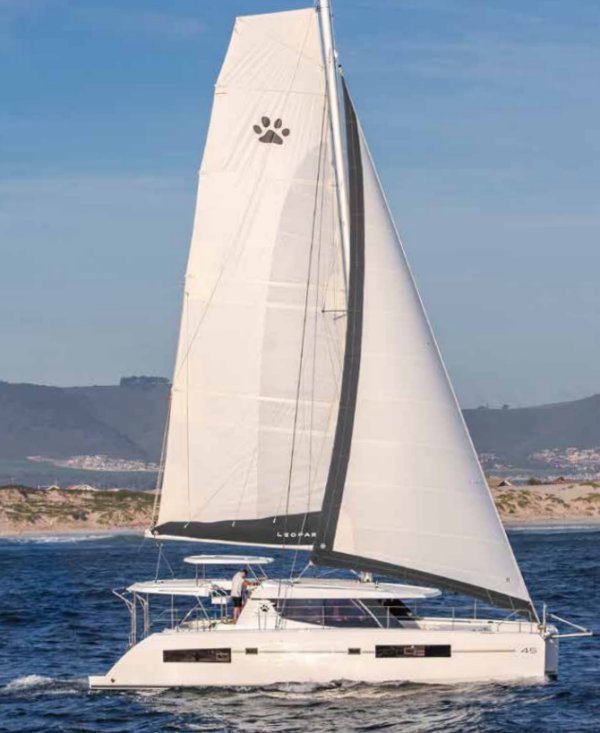
Leopard 45
Best value liveaboard cat with charter potential
The Leopard 45 is the sensible-money entry to full-time catamaran living, especially on the used market where ex-charter boats come up regularly. The design is proven, the systems are simple, and anywhere in the Caribbean you can find someone who knows the boat. The two things that decide a purchase: get the three-cabin owner's version if you're living aboard, and pay for a thorough survey on any ex-charter hull, focusing on saildrive seals, rudder bearings, and evidence of grounding. Do both and it is one of the best value liveaboard cats available.
- LOA
- 45' 0"
- Displacement
- ~32,400 lb
- Layout
- Forward cockpit, 3–4 cabins
- Builder / year
- Robertson & Caine, 2017
Pros
- Well-proven charter-fleet design with excellent Caribbean service support and parts availability
- Forward cockpit is a real daily living space, not a marketing feature
- Established charter-management programmes can offset a meaningful share of ownership costs
Cons
- Ex-charter boats have hard lives — hours, groundings, and cosmetic wear need a careful survey
- Four-cabin charter layouts trade away the owner's suite and stowage that liveaboards need
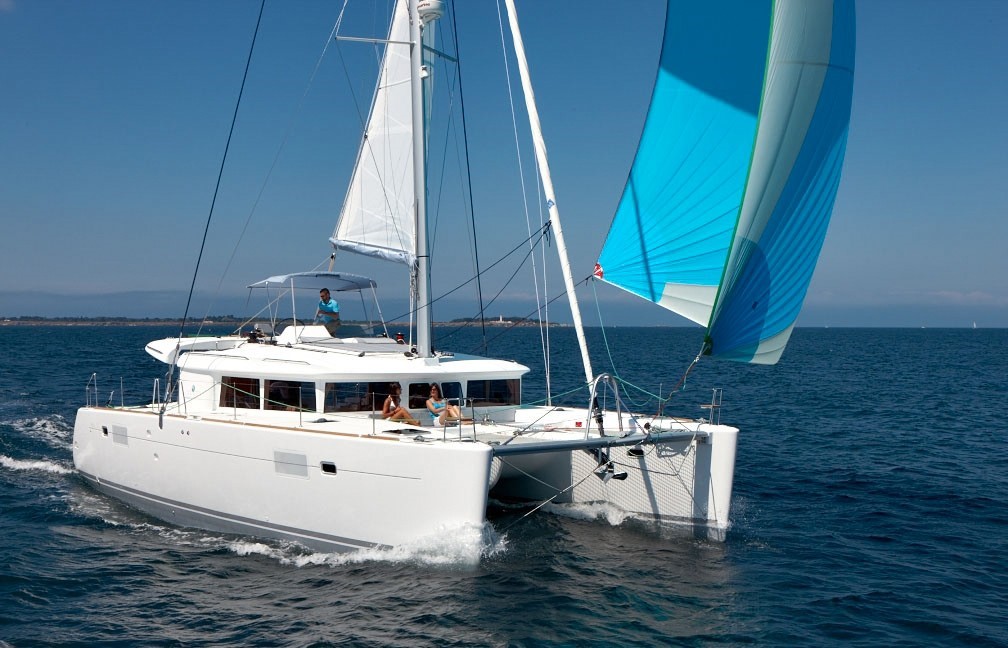
Lagoon 450
Best used catamaran for family liveaboard on a budget
If the Lagoon 46 is the new-boat default, the 450 is the used-market equivalent, and for a family with a fixed budget it is often the smarter buy. You get essentially the same volume and layout philosophy for substantially less money, at the cost of taking on a boat that is a decade or more into its service life. Focus the survey on saildrive diaphragms, standing rigging age, and the state of the electronics, then budget for those three items rather than hoping. Sorted, it will do everything the newer boat does.
- LOA
- 45' 11"
- Displacement
- ~33,300 lb
- Layout
- Flybridge, 3–4 cabins
- Builder / year
- Lagoon, 2010
Pros
- Built in large numbers, so the used market is deep and prices are more competitive than newer models
- Flybridge gives shade, visibility, and a second social area at anchor
- Interior volume and stowage are excellent even by modern standards
Cons
- Early flybridge versions place the helm far from the cockpit, which some short-handed crews dislike
- Ageing boats mean saildrives, rigging, and electronics are all approaching replacement — price accordingly
How to choose
| Catamaran | Typical price | Best for | Helm |
|---|---|---|---|
| Lagoon 46 | $750k–$1.0m | Families full time | Flybridge |
| Leopard 50 | $800k–$1.1m | Maximum space | Raised, cockpit-linked |
| Fountaine Pajot Astréa 42 | $550k–$750k | Couples | Raised starboard helm |
| Bali 4.4 | $700k–$900k | Indoor-outdoor living | Flybridge |
| Nautitech 44 Open | $500k–$700k | Sailing performance | Twin aft helms |
| Leopard 45 | $550k–$750k | Value / charter income | Raised, cockpit-linked |
| Lagoon 450 | $450k–$700k | Used-market families | Flybridge |
Prices are broad market ranges for boats in sound condition; year, equipment, and region move them substantially. Treat them as planning figures rather than quotes.
Under $600,000: A used Lagoon 450 or an ex-charter Leopard 45. Both are proven liveaboard platforms; spend the savings on a thorough survey and on power and water systems.
$600,000–$800,000: The sweet spot. A Fountaine Pajot Astréa 42 for a couple who want to sail, a Bali 4.4 for people who live at anchor in warm water, or a Nautitech 44 Open if performance matters.
$800,000+: A new Lagoon 46 or Leopard 50, configured as an owner's version. At this level buy the layout, not the brochure — cabin count and stowage decide how the boat feels after six months.
Whatever the budget, charter the exact model for a week before committing. A catamaran feels enormous at a boat show and quite different when it is your only address.
Frequently asked questions
What size catamaran is best for living aboard?
A couple is well served at 40–44 feet, where berthing and haul-out costs stay manageable. Families generally land between 45 and 50 feet, where separate hulls plus a dedicated owner's suite create genuine privacy. Going beyond 50 feet adds cost far faster than it adds usable living space.
How much more does a catamaran cost to keep than a monohull?
Expect roughly 1.5–2× the monohull rate for marina berths of the same length because of beam, two hulls to antifoul at haul-out, two engines and two saildrives to service, and a smaller pool of yards with lifts wide enough to take you. Insurance is also typically higher.
Are catamarans safe offshore?
Modern cruising catamarans cross oceans routinely, but they must be sailed differently: reef early, keep them light, and avoid being caught overpowered because a cat does not shed load by heeling. The trade-off is that a monohull will right itself after a knockdown while an inverted cat stays inverted, so conservative sail handling matters more.
Should I buy an ex-charter catamaran?
It's the cheapest route into a cat, and many are fine, but they've had hard use from inexperienced crews. Survey saildrive seals, rudder bearings, engine hours, and any evidence of grounding, and prefer three-cabin owner's versions over four-cabin charter layouts if you plan to live aboard.
Flybridge or aft helm?
A flybridge gives shade, visibility over the coachroof, and an extra social area, but separates the helmsman from the cockpit. Aft helms keep the driver connected to the crew and give better sail feel, at the cost of exposure to weather. Short-handed cruisers often prefer aft helms; families at anchor a lot often prefer a flybridge.
How much power and water do you need on a liveaboard cat?
Cats have huge roof area for solar and space for large battery banks, which is why so many go lithium. A typical full-time setup runs 1–2 kW of solar, 600+ Ah of lithium at 12V or equivalent at 24V, a watermaker, and inverter-driven appliances — enough to stay off shore power indefinitely in the tropics.
Related guides
 Boats
BoatsBest Liveaboard Sailboats
Monohulls and catamarans compared for full-time living — space, running costs, comfort at anchor and systems.
 Boats
BoatsBest Bluewater Sailboats Under 40 Feet
Eight proven offshore cruisers under 40 feet compared — hull form, build quality, real weaknesses and refit costs.
 Boats
BoatsBest Trailerable Sailboats
Tow weights, ramp setup time, keel types and five trailer sailers worth owning, from Catalina 22 to Corsair 760.
 Boats
BoatsBest Small Sailboats for Beginners
Dinghies, daysailers and a pocket cruiser compared — what each teaches, real downsides and first-season costs.
Looking for more gear guides? Browse all our gear recommendations or the full guides index.